TINA S. MEHNPAINE
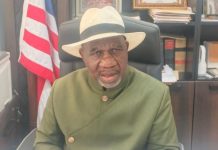
Africa-Press – Liberia. Senator Varney Sherman, the Chairman of the all-powerful Senate Judiciary Committee, has announced his retirement from politics, albeit with an air of disappointment with his constituents’ decision not to reelect him.
Sherman, who was elected as Senator of Grand Cape Mount County in 2014, was bested by Mrs. Dabah Varpillah, who ran on the opposition Unity Party ticket in the just-ended October 10 polls.
In his retirement speech in the Senate Chamber on Tuesday, October 17, Sherman lamented that this defeat was not solely due to tribalism but also because the people of Grand Cape Mount failed to understand the actual role of a Senator.
“I am retiring from politics completely,” the Senator said. “My disappointment is that, unfortunately, over my many years in politics, we have not matured. I don’t know a single place in Cape Mount — 240 towns — anybody asked me what I am doing here. Not one person asked me. Nobody wanted to know what I had done. So you wonder why you come here.
“So I said to myself, if we are going to be that kind of country, then what will we be doing here if the constituents don’t care about what we do here?
“The other thing I have experienced is that, in our country, we have ‘politics of identity’. If the voter can identify himself with you, he doesn’t want to know anything else.”
He illustrated his point by explaining the tribal dynamics in Grand Cape Mount County. According to him, out of eleven candidates for the Senatorial position, seven were of the Vai tribe and four were from the Gola tribe.
“So the Vai divided themselves among the seven. How could you possibly win? And it was very, very unfortunate. Like I said, I am disappointed that as I retire from politics, this phenomenon will continue to be there.”
The outgoing Senator, who made his name as an expert lawyer, once ran for President of Liberia and later served as the Chairman of the Unity Party, during which time he won his Senatorial seat. He fell out of favor with the party in 2019 after breaking ranks with its mandate not to vote for the impeachment of Associate Justice Kabineh Ja’neh.
The Unity Party and many analysts believed the impeachment of Ja’neh was a politically motivated decision initiated by Rep.Moses Acarous Gray, the main sponsor of the impeachment bill. Ja’neh later won a payout from the ECOWAS Court after he complained that the government impeachment process was carried out without due process, validating the Unity Party and other people’s claims.
The ECOWAS Court also ordered the government to pay US$200k to Ja’neh for “reparation for moral prejudice suffered for the violation of his rights” and called for his reinstatement or, in the alternative, to grant him the right to retire from service with full pension benefits as if he had retired at the normal retirement age.
Sherman, after his expulsion from the Unity Party, aligned senatorial decisions with the Weah administration and even spearheaded the Senate’s decision, along with Pro-Tempore Albert Chie, to overhaul the retirement package for elected officials and members of the judiciary, drawing a serious rebuke from the public.
But his striking downfall came in 2020 when he became the first Liberian Senator to be sanctioned for corruption. The U.S. Treasury Department accused him of offering “bribes to multiple judges associated with his trial for a 2010 bribery scheme, and he had an undisclosed conflict of interest with the judge who ultimately returned a not guilty verdict in July 2019.”
“Sherman has routinely paid judges to decide cases in his favor, and he has allegedly facilitated payments to Liberian politicians to support the impeachment of a judge who has ruled against him,” the Department said.
In the 2010 alleged bribery allegation that led to this trial, Sherman was hired by a British mining company in an effort to obtain one of Liberia’s last remaining mining assets, the Wologizi iron ore concession.
According to a Global Witness report, the Senator advised the company that, in order to obtain the contract, they first had to get Liberia’s procurement and concessions law changed by bribing senior officials.
In 2016, he was indicted by the Liberian government, along with several other government officials, for their involvement in the US$950,000 bribery scheme.
But in 2019, he and all individuals accused were acquitted of the allegation. The U.S., however, believes that “Sherman’s acts of bribery demonstrate a larger pattern of behavior to exercise influence over the Liberian judiciary and the Ministry of Justice.”
The Senator, however, denied the allegations and rebuked the U.S. for the sanction, which, among other things, led to the collapse of his law firm, which was one of the highly sought-after.
Sherman, whose constituency, Grand Cape Mount, is one of the poorest in the country, has also been accused of not doing much to push for the socioeconomic development of his people, a claim he has also denied.
He also faces allegations of voting in favor of concession companies in the county and not speaking out when the companies have been accused of neglect and bad practices against the citizens of the county.
“When is it that people are going to listen to policy, capacity, ability? Never,” Sheman said. “Maybe, on my gravestone, you all will publish that once upon a time there was a senator who did his best, but the people didn’t care.”
For More News And Analysis About Liberia Follow Africa-Press