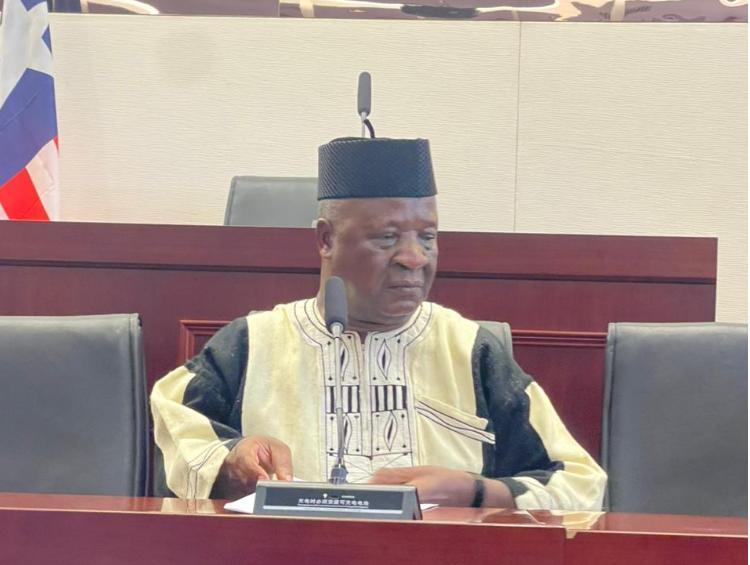
Africa-Press – Liberia. The Minister-designate of the Ministry of Local Government Francis Nyumalin has vowed to ensure that budgetary allocations to counties are managed in a transparent manner to benefit the citizenry.
According to him, counties will also have access to own-source revenues, including real property taxes, business licenses, fees, fines, and other locally generated income.
He pointed out that revenues from national resources—including minerals, oil, forestry, maritime operations, seaports, airports, and tolls—will be shared with local governments in a fair, transparent, and accountable manner, as outlined in the law’s allocation formula.
Nyumalin made these assertions when he appeared before the Senate Committee on Internal Affairs, Peace and Reconciliation for confirmation over the weekend.
He observed that for the decentralization of public services and programs to succeed, it (decentralization) must be anchored in strong institutions, capable leadership, and an engaged citizenry.
“Fiscal decentralization will be advanced by strengthening local revenue systems and ensuring that resources allocated to counties are managed locally and transparently.
Capacity development through the Local Government Institute will provide continuous professional training for local officials so they can effectively manage devolved and delegated responsibilities.”
He said civic education is also important for the effective implementation of decentralization in service delivery and the governance process of the country.
He noted that communities must understand their rights and responsibilities within the decentralization framework so they can actively participate in governance and hold local authorities accountable.
Nyumalin pointed out that true decentralization also requires strong collaboration among Ministries, Agencies, and Commissions (MACs) delivering services at County Service Centers (CSCs).
“We will robustly engage our colleagues within other MACs, if confirmed, to progressively devolve services, personnel, and operational authority, responsibilities and resources to the counties so that these centers and local structures cantruly bring government closer to the people.”
Nyumalin added that decentralization alone will not guarantee stability and development in Liberia in the view of taking government closer to the people.
He said decentralization must go hand in hand with peacebuilding and national unification.
He stated that local governance structures must serve as platforms for dialogue, reconciliation, and conflict prevention.
Nyumalin stressed that through partnerships with traditional leaders, youth groups, women’s organizations, and community stakeholders, the Ministry will continue to promote initiatives that strengthen social cohesion and reinforce the values of unity and peaceful coexistence.
He noted that young people, in particular, must become active partners in peacebuilding. Community-based initiatives that empower young people to participate in dialogue, leadership, and development will help ensure that the next generation sees peace and national unity as shared responsibilities.
He used the occasion to draw lawmakers’ attention to several emerging issues which require careful attention.
Nyumalin named these issues as the migration dynamics involving Burkinabès, persistent intra- and inter-county boundary disputes, and institutional reluctance to devolve authority to local governments.
He applauded members of the Legislature for their engagement with the Ministry of Local Government to resolve these emerging concerns, particularly boundary disputes.
He stated that the dissolution of statutory districts is another sensitive issue.
Nyumalin observed that under Section 2.15(a) of the Local Government Act of 2018, the Ministry is mandated to oversee the retirement of statutory district employees during the seven-year transition period following the dissolution of those districts.
According to him, the Ministry will work closely with the Legislature to ensure this process is handled fairly and responsibly.
He noted that the reaffirmation of cities, townships, and boroughs, in line with Sections 2.16(c) and (d) of the LGA-2018, continues to be a priority to ensure that all local administrative units meet the legal, functional, and infrastructural standards.
“Looking forward, if confirmed, the Ministry, under my leadership, is committed to full implementation of the Local Government Act (LGA) of 2018, which provides the legal framework for devolving administrative and fiscal authority to counties, cities, and townships. To set the compass, the Ministry conducted a comprehensive assessment of Phase I (2020-2024) Implementation of the LGA of 2018 and also developed the Phase II (2026-2030) Implementation Plan with twelve (12) strategic priority areas.”
He assured that County Service Centers (CSCs) will be strengthened through digitalization, ensuring citizens can access services efficiently.
Nyumalin pledged that local councils at county and sub-county levels will be operationalized to manage development planning, budgeting, and service delivery.
He disclosed that central to this plan is the establishment of the Local Government Institute—a professional training center designed to equip county administrations, council members, and technical staff with the knowledge and skills required to manage devolved functions and responsibilities effectively.
According to him, the Ministry of Local Government has sought the guidance of the National Elections Commission (NEC) for the implementation of Section 2.15(x) of the LGA of 2018, which calls for the election of paramount, clan, and general town chiefs.
He disclosed that the ministry is currently having conversations about feasibility in the wake of resource constraints and other challenges.
Nyumalin emphasized that if confirmed, he would look forward to continuing consultations with the Civil Service Agency (CSA) for guidance in implementing Section 2.15(a) of the Local Government Act (LGA) of 2018 regarding the dissolution and subsequent retirement of statutory district employees.
He pledged to strengthen land governance through partnerships with the Liberia Land Authority (LLA) and other stakeholders to resolve boundary disputes and support communities in securing land deeds.
Additionally, Nyumalin noted that the Ministry will continue its collaboration with the Ministry of Finance and Development Planning (MFDP) to begin the gradual implementation of the Revenue Sharing Law of 2022, ensuring counties receive their fair share of local and national revenues.
Nyumalin recognized the role played by lawmakers to allocate funding in the current national budget for County Councils for the first time since their establishment in 2023.
“We will seek your guidance to ensure the proper functioning of these councils in line with Chapter 2.2 of the Local Government Act of 2018.
The Ministry will work closely with county bar associations in all fifteen (15) counties to strengthen collaboration between legal professionals and local leaders. This partnership will help expand access to justice and improve how disputes are resolved at the community level. Importantly, it will bring greater clarity to roles and responsibilities, helping to prevent misunderstandings and avoid unnecessary tensions.”
He observed that the transition from the Ministry of Internal Affairs to the Ministry of Local Government represents a historic milestone in Liberia’s governance reform.
According to him, this structural transformation positions the Ministry as the central institution responsible for providing executive oversight, enabling coordination, and supporting a decentralized system of governance across counties, cities, townships, and communities.
Nyumalin pointed out that consistent with Section 25.7 of the Ministry of Local Government Act of 2025, the Ministry exercises executive oversight of local governments.
Nyumalin emphasized that his administration would also rely on the Local Government Fiscal Board, as provided for in Section 4.26 of the LGA 2018, to make recommendations to the Legislature and the Ministry of Finance and Development Planning (MFDP) on grant allocations to counties, cities, and townships.
He maintained that the Board will hopefully ensure that local government financing is equitable, transparent, and aligned with national development priorities.
He observed that the Fiscal Board plays a crucial role in implementing the Revenue Sharing Law of 2022, overseeing the fair, accountable, and transparent distribution of revenues among counties, cities, townships, and affected communities.
“We will work with the Minister of Finance and Development Planning and other colleagues for His Excellency, the President, to appoint members to the Local Government Fiscal Board, which will enable this key mechanism to strengthen local government finances and support the decentralization agenda.”
He pointed out that the success of decentralization will ultimately depend on strong institutions, capable leadership, and an engaged citizenry.
Nyumalin maintained that it also requires sustained collaboration between the Ministry of Local Government and other ministries, agencies, and commissions whose services must gradually be decentralized to the counties
“We cannot build County Service Centers while essential government services remain centralized in Monrovia. True decentralization requires that government functions progressively move closer to the people we serve.”
He stated that through interventions such as the Local Government Institute, strengthened County Service Centers, and implementation of the Revenue Sharing Law of 2022, his administration intend to build capable, accountable, and responsive local governance for all Liberians.
For More News And Analysis About Liberia Follow Africa-Press