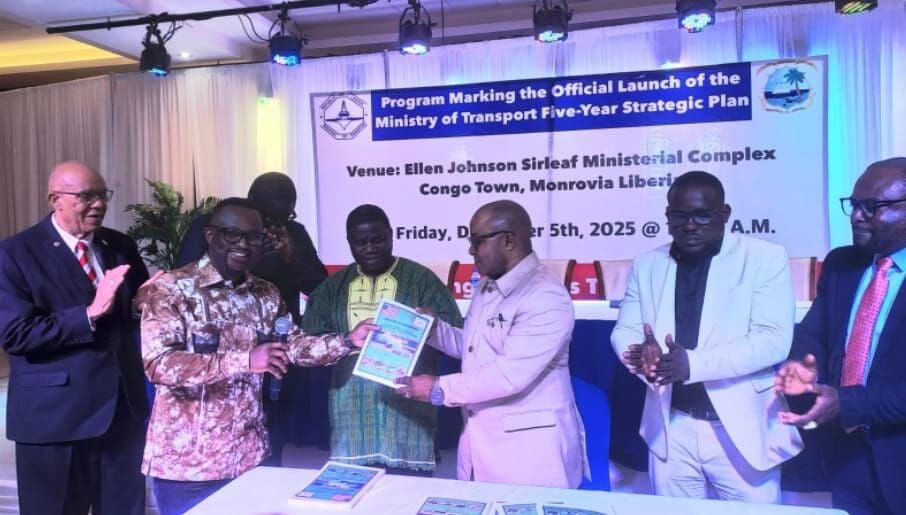
Africa-Press – Liberia. The Ministry of Transport has officially launched its Five-Year Sector Transformation Strategic Plan (2025–2029), setting a comprehensive roadmap to modernize Liberia’s transport sector and position it as a key driver of economic growth, national integration, and social inclusion.
The launch ceremony, held with wide participation from government officials, development partners, and transport-sector institutions, was marked by strong commitments to collaboration, accountability, and effective implementation.
Speaking on behalf of Vice President Jeremiah Kpan Koung, Sr., the Deputy Chief of Staff for Administration, Dr. MacDonald M. Metzer, reaffirmed the Vice President’s unwavering support to the Ministry of Transport as it rolls out what he described as a “people-centered and transformative” strategy.
Dr. Metzer emphasized that transportation goes beyond mobility, noting that it forms the backbone of economic competitiveness, service delivery, and national development. He said the Strategic Plan aligns squarely with the government’s ARREST Agenda for Inclusive Development, particularly its pillars on infrastructure, economic revitalization, transparency, and accountability.
According to him, the plan outlines key national priorities, including strengthening regulatory and institutional frameworks for land, air, and maritime transport; improving safety, licensing, and compliance systems; digitizing transport services to reduce inefficiency and fraud; expanding partnerships with the private sector and development partners; and building institutional and human capacity within the Ministry and affiliated agencies.
“These are not just administrative aspirations,” Dr. Metzer stressed. “They are transformational actions that will affect every Liberian from the motorcyclist seeking safer roads, to business owners moving goods across counties, to investors demanding predictability and accountability.”
However, he cautioned that the success of the strategy will depend largely on disciplined implementation, effective coordination among line ministries and agencies, strong enforcement of transport regulations, robust monitoring and evaluation, and timely digital transformation to curb revenue leakages.
“The Ministry of Transport cannot do this alone,” he said. “A modern transport sector requires a whole-of-government and whole-of-society commitment.”
Officially launching the plan on behalf of the Vice President, Dr. Metzer called on citizens to comply with safety regulations and urged development partners and the private sector to align their investments with national transport priorities.
For his part, Transport Minister Hon. Sirleaf R. Tyler said the new Strategic Plan represents Liberia’s third post-conflict five-year transport strategy and marks a decisive shift toward a modern, digitized, and efficient transport sector.
Minister Tyler said following his appointment, his first 100 days focused on addressing long-standing constraints affecting safety and service delivery, while laying the groundwork for institutional reform and improved performance.
“This plan represents our collective resolve to transform the transport sector from a manual service institution into an innovative, modernized, and effective system that supports inclusive economic growth,” he said.
He explained that the 2025–2029 Strategic Plan builds on lessons from previous frameworks, including the Ministry’s 2018–2024 Strategic Plan, the National Transport Master Plan, and the National Transport Policy and Strategy, while aligning with the ARREST Agenda, Vision 2030, the Sustainable Development Goals, Agenda 2063, and the Doha Programme of Action.
The Plan defines eight priority areas, including strengthening legal and regulatory frameworks; expanding and modernizing transport infrastructure; improving road safety; building institutional and human capacity; implementing the Axle Load Law; promoting green technologies and disaster preparedness; and enhancing resource mobilization, data systems, and research.
Minister Tyler noted that with nearly 45 percent of Liberians living in multidimensional poverty and a youthful population between the ages of 15 and 40, the transport sector has a critical role to play in job creation, revenue generation, and national development.
Representing the Ministry of Finance and Development Planning, Deputy Minister for Economic Management Hon. Dehpue Y. Zuo commended the Ministry of Transport for delivering a clear and aligned roadmap in keeping with the ARREST Agenda.
“This Strategic Plan provides a compass for Liberia’s transport development,” he said, emphasizing that sustainable transport is key to inclusive growth, affordability, climate resilience, and improved quality of life.
UNDP Deputy Resident Representative/Programme Louis Kuukpen, described the plan as a human-centered framework that prioritizes people over vehicles, safety over speed, and access over convenience. He reaffirmed UNDP’s commitment to supporting implementation, particularly in digital transformation, decentralization of transport services, green transport policies, and data-driven decision-making.
The African Development Bank (AfDB), through its representative, also welcomed the plan, highlighting its alignment with ongoing and planned transport investments, including major regional road corridors and future rail and aviation development. The Bank pledged to align its portfolio with government priorities and continue supporting climate-resilient infrastructure, road safety reforms, and job-creating projects.
The launch concluded with broad consensus among stakeholders that the Five-Year Strategic Plan must move beyond paper commitments to tangible action.
“Let today be remembered not only as the day the plan was launched,” Dr. Metzer said in closing, “but as the day Liberia renewed its collective resolve to build a safer, more efficient, and modern transport system for all.”
The Ministry of Transport has called on all government institutions, development partners, private sector actors, civil society, and citizens to take ownership of the plan and work collectively toward its full implementation.
For More News And Analysis About Liberia Follow Africa-Press