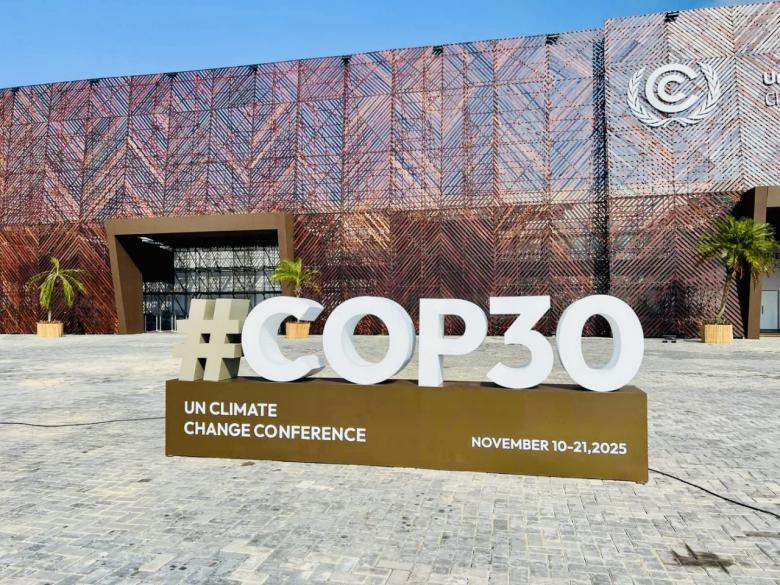
Africa-Press – Liberia. The Hangar Convention Center in Belém, Brazil, venue of COP30. Photo by Darius Toweh, Liberia National Students Union
Summary:
Pledges from the 30th Conference of the Parties to triple adaptation finance by 2035 could support Liberia’s climate-vulnerable communities, but local experts warn delivery will depend on overcoming past corruption and mismanagement.
African nations, including Liberia, continue to face the biggest burden of climate change—severe floods, coastal erosion and unpredictable weather threatening livelihoods, education and food security.
Liberian youth advocates, government officials and civil society stress accountability to ensure global climate promises translate into real-world benefits.
The 30th annual summit of world nations committed to slowing climate change, known as the Conference of the Parties, concluded last week with countries pledging a range of actions to slow global warming and help vulnerable countries adapt.
Leaders at the summit, held in Belém, Brazil, pledged to triple global adaptation finance by 2035, introduce a “Just Transition Mechanism” to support communities moving away from polluting energy sources, and adopt a gender action plan to integrate women’s perspectives into climate planning. A new $5.5 billion Tropical Forest Fund, known as TFFF, is designed to channel more predictable climate finance to forest-rich countries like Liberia, helping them protect biodiversity, support local communities and reduce emissions from deforestation.
For Liberia—already grappling with rising sea levels, flooding and underfunded disaster-response systems—experts said these outcomes offer both hope and uncertainty.
“Imagine a young girl in coastal Montserrado waking to the sound of the ocean pulling the shoreline closer, eroding one to one-and-a-half meters of land each year,” said Ezekiel Nyanfor during his keynote address at Youth Day in Liberia’s pavilion at COP30, a speech also shared on his Facebook page. “Imagine a boy in River Gee struggling to focus in classrooms that feel like ovens, as temperatures have risen 1.5 degrees Celsius since the 1950s. These are Liberian children. These are our children.”
COP30 — Key Achievements at a Glance
1. Adaptation Finance Tripled — World governments agreed to triple global adaptation finance by 2035, aiming to strengthen flood protection, climate-smart agriculture and early-warning systems in vulnerable countries.
2. Just Transition Mechanism Launched — A new mechanism will support developing nations as they move away from polluting fuels, with funding and training intended to protect workers and low-income communities.
3. Global Gender Action Plan Adopted — Countries approved a new plan requiring women’s participation in climate policy and directing more resources toward women most affected by climate impacts.
4. Early-Warning and Resilience Boost — Delegates committed to expanding early-warning systems and scaling up resilience planning for climate-vulnerable regions, including Africa and small island states.
5. New Support for Forest-Rich Nations — Emerging forest-finance tools aim to channel more predictable funding to countries with major rainforest assets, supporting conservation and sustainable livelihoods.
African nations contribute less than four percent of global greenhouse-gas emissions yet face some of the world’s most severe climate impacts. African negotiators expressed concern that slow progress on fossil-fuel commitments will leave their countries exposed to worsening climate shocks. Some energy-exporting nations—including Nigeria, Angola, and Mozambique—also warned that a rapid global phase-out of fossil fuels without substantial international support could create economic challenges.
Many countries confront a “transition dilemma,” being simultaneously vulnerable to climate impacts and reliant on fossil-fuel revenues or fossil-fuel-based energy access. Liberia, though less dependent on fossil fuels than some neighbors, still relies heavily on charcoal and diesel for household and business energy, highlighting the urgent need for clean-energy solutions that protect livelihoods.
During last year’s rainy season, Rivercess County experienced severe flooding that destroyed homes and businesses, including Princess Nanna’s provision shop. Photo by Eric Opa Doue
A FrontPage Africa/New Narratives investigation showed how these concerns play out on the ground: with farming failing under climate stress, thousands of rural Liberians are turning to charcoal production to survive—fueling deforestation, threatening mangroves, and putting the country’s climate goals at risk. While programs to introduce cleaner cookstoves and alternative fuels exist, high costs, broken equipment, and lack of market access often force communities back to cutting trees, leaving both livelihoods and forests vulnerable.
A central outcome of the conference was the creation of the Just Transition Mechanism, designed to help countries move toward cleaner energy sources while protecting livelihoods. In Liberia, where many households rely on charcoal and diesel for cooking and electricity, transitioning to renewable energy will require both investment in clean technologies and support for affected communities.
“Any transition without safeguarding livelihoods risks worsening poverty and social inequality,” said Nyanfor during his address.
Urey K. Yarkwapolo, executive director of the Environmental Protections Agency, did not respond to a request for comment on the outcome of the conference before deadline but earlier this year in interview, he stressed that Liberia’s contribution to global emissions is “negligible” compared to countries like the United States, China, and India, noting in an interview that charcoal producers should not be treated as if they are driving the climate crisis.
“If you put the whole climate graph globally, Liberia barely appears, before we even talk about our people who are doing charcoal,” he said, adding that while charcoal does contribute to deforestation, “we don’t want to hammer our people on the head… that’s their livelihood. If you say we shouldn’t cook with charcoal today, what else do we have?” He said the Environmental Protection Agency is instead working with partners to scale up efficient cookstoves and more sustainable production techniques.
The pledge to triple adaptation finance could help communities build resilience—upgrading drainage systems in Monrovia, strengthening coastal barriers in West Point, and supporting climate-smart agriculture in vulnerable counties. Yet experts caution that previous global finance pledges have often fallen short. Commitments have never been carried through in full.
Binding commitments to reduce fossil-fuel production, enforce forest protections, and fully fund a loss-and-damage fund were not realized. Analysts warn that Liberia—though far less responsible for global emissions than major polluters—remains highly vulnerable because of its reliance on charcoal and diesel energy, fragile infrastructure, and exposed coastal communities.
“Countries like Liberia need fair access to financing to adapt and grow sustainably,” said Dehpue Y. Zuo during remarks delivered at the conference and posted in on the Environmental Protection Agency’s official Facebook page. “Without predictable funding, communities will struggle to implement critical projects and protect their most vulnerable populations.”
Another highlight was the Tropical Forest Forever Facility – $US5.5 billion in reliable finance for countries that maintain or expand forest cover, including Liberia. Because trees absorb the gases that cause climate change, world leaders are working hard to protect forest cover. With one of the world’s largest tracts of remaining forest, Liberia could be at the forefront of such funding.
But experts said that given Liberia’s poor track record in meeting donor requirements and protecting forests, accessing those funds will require a major overhaul in government response. Under the Weah administration project totaling $US37 million in approved funding from the Green Climate Fund, another global fund designed to assist vulnerable countries to adapt, was stalled because of “inflated” salary requests and the appointment of politically connected and unqualified people to leadership positions.
Projects that would have built a sea wall to protect people in West Point from sea erosion and another that would have provided an early weather hazard warning system, were delayed leaving hundreds of thousands of people to become victims of flooding and failed crops.
Figure 2Emmanuel K. Urey Yarkpawolo, head of Liberia’s Environmental Protection Agency, delivering his speech at the 30th Conference of the Parties. Screenshot from the EPA’s official Facebook page
Liberia faces a climate crisis layered over existing socio-economic challenges. The United Nations Children’s Fund For Every Child report notes that more than half of Liberians live below the national poverty line; one in three children are undernourished, and one in four girls marry before the age of 18. This makes them even more vulnerable to climate impacts. During the 2024 rainy season, widespread flooding displaced more than 100,000 people, while hundreds of thousands remain at risk due to gaps in early-warning systems and limited funding for disaster management.
The focus on women, youth and other underrepresented groups was welcomed by advocates. Climate change disproportionately affects women and other vulnerable groups. Speaking at a workshop for Liberia’s Climate Change Gender Action Plan in October, Benjamin Karmorh, chief technical adviser at the EPA, said that “women, children, and persons with disabilities remain among the most vulnerable, and this plan seeks to address their specific challenges.”
“Liberia must adopt a two-track approach: respond to the crisis now and build long-term resilience. A climate-resilient Liberia is impossible without its young people,” said Nyanfor.
As Liberia confronts intensifying climate threats, experts and advocates stress that local engagement, government accountability, and youth-led initiatives will determine whether global climate pledges translate into tangible benefits on the ground.
Source: FrontPageAfrica
For More News And Analysis About Liberia Follow Africa-Press