Africa-Press – Liberia. “Right now, I am the only teacher here. I teach nursery, grade one and grade two all by myself,” Harriton Kwarbo explained, describing the situation as challenging but necessary to keep education alive in the community
SUASU TOWN, Maryland County — In the remote community of Suasu Town, District 3, Maryland County, one teacher is struggling to keep education alive at Suasu Public School amid serious challenges affecting learning.
Suasu Public School, a government institution, was established around 2006.
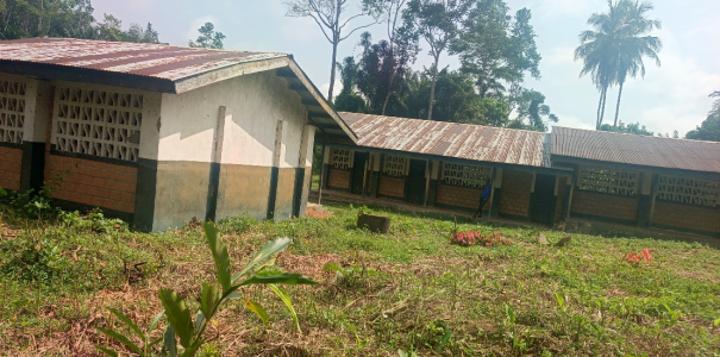
The school building was later constructed in 2010 by the Government of Liberia(GoL) through the Liberia Agency for Community Empowerment (LACE).
The school initially operated from nursery to sixth grade, serving children in Suasu and surrounding communities.
However, due to the lack of teachers and limited support, the school has been forced to cut down its academic program.
It now operates only from nursery to grade two, leaving many students without access to continued education within the community.
Harriton Kwarbo, a 40-year-old C-Certificate holder — a basic teacher training qualification — is currently the only teacher at the school.
He serves as principal, vice principal for administration, vice principal for instruction, registrar, dean of students, and classroom teacher.
About 40 students are enrolled across nursery to grade two.
The school’s infrastructure is also in poor condition. In 2018, a heavy storm swept through the community, uprooting a large rubber tree that fell on the school building and damaged two classrooms. Since then, the affected classrooms have remained unrepaired.
The zinc roofing of the building is also damaged, allowing rainwater to leak into classrooms and disrupt learning.
“Sometimes when rain falls, we can’t learn because water enters the classroom,” one of the students said.
“So right now, we are not using the two affected classrooms.” Mr. Kwarbo stressed.
In addition to structural challenges, the school lacks basic furniture. There are no armchairs or desks, forcing students to bring their own seating from home. Students who fail to bring seats are left to sit on broken pieces of old armchairs or on the floor during lessons.
Community members say the situation is discouraging parents from sending their children to school.
“We need government to help us with teachers and repair the school,” said Madam Jestina Derrick, a PTA member.
Residents also expressed concern about students who complete grade two, noting that they must travel long distances to continue their education.
Students who complete grade two must walk for about one hour along the main road, exposing them to potential safety risks, to attend either Warteken Public School near River Gee or Karloken Public School in Karloken City.
Speaking to FrontPage Africa over the weekend, Amos N. Clark, District Education Officer of Karluway Education District #1, acknowledged the challenges facing Suasu Public School, noting that the institution is among several schools in the district experiencing staff shortages.
Clark said that when he was assigned as District Education Officer last year, he met Suasu Public School operating with a single teacher and a deteriorating building condition — issues he said were reported to the Ministry of Education’s central office.
He disclosed that the district education office plans to shut down three schools in the district, including Kablaken Public School, a nearby institution currently operating with two teachers. According to him, the teachers from Kablaken Public School will be reassigned to Suasu Public School once the closure takes effect.
“This is not a secret. We met Suasu Public School with a single teacher. What happens is that most of our people in high school are not interested in becoming teachers, but we keep encouraging them,” Mr. Clark said.
“What we have planned is to close down three schools in the district by next year. One of them is Kablaken Public School. The two teachers there will be added to Suasu Public School since Suasu is the central town in that local region. For the building condition, the government is aware and we are sure improvement will be made,” he added.
Until then, nearly 40 students in Suasu continue to learn under leaking roofs, broken seats and the guidance of a single teacher — a situation residents say threatens the future of education in the community.
For More News And Analysis About Liberia Follow Africa-Press