
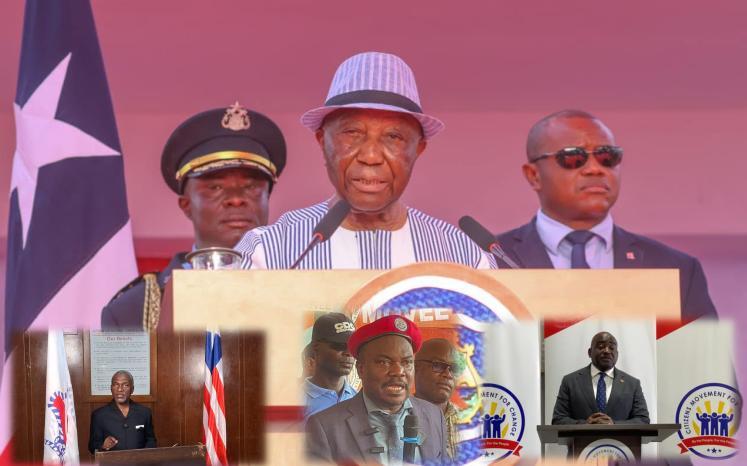
Monrovia — Liberia’s opposition political parties have sharply criticized President Joseph Nyuma Boakai’s 2026 State of the Nation Address (SONA), dismissing the administration’s claims of progress as overstated and accusing the government of prioritizing rhetoric over tangible improvements in the lives of ordinary Liberians.
In separate statements responding to the address, leaders of the Coalition for Democratic Change (CDC), the Alternative National Congress (ANC), and the Citizens Movement for Change (CMC) questioned the President’s assertions on economic recovery, job creation, and fiscal discipline, arguing that the much-touted “Rescue Mission” has failed to deliver meaningful results.
CDC National Chairman Janga Augustus Kowo described the administration’s performance as an “Excuse Mission,” saying the government has shifted away from its campaign promises without producing measurable outcomes.
“Leadership requires clarity, consistency, and honesty—not confusion and inconsistency, as with the FOYA projects and many policies of the Boakai regime,” Kowo said. “We measure governance by the condition of households, the security of institutions, and the durability of services. On those measures, the Rescue Mission has fallen short.”
Kowo said the CDC’s rebuttal to the SONA focused on bread-and-butter issues affecting Liberians, arguing that claimed gains have not translated into improved living standards, stronger institutions, or reliable public services.
In a detailed response titled “Building on Whose Progress?”, the CDC, through its Acting National Chairman, Janga A. Kowo, argues that much of the progress highlighted by President Boakai under his “Rescue Agenda” was laid during the previous CDC-led government under former President George Manneh Weah.
Kowo insists that the Boakai administration has relied more on rhetoric than results while presiding over worsening economic hardship, weak job creation, rising insecurity, and deepening political divisions.
“Progress Did Not Start in 2024”
The CDC seized on President Boakai’s own admission that his government is “building on progress already made,” asserting that such progress originated under the CDC through investments in road corridors, electricity expansion, education access, health infrastructure, and macroeconomic stabilization during challenging global conditions.
“What we reject,” Kowo said, “is the political deception of pretending that the foundation was not built by the CDC, while inherited projects are repackaged as Rescue achievements.”
The opposition further questioned President Boakai’s credibility over conflicting public statements regarding the financing of a reported US$10 million villa project in Foya.
According to Kowo, the President has alternately claimed the project was funded by the Mano River Union and by the Government of Liberia, statements the party says cannot both be true.
“Leadership requires clarity, consistency, and honesty,” the statement said, warning that conflicting explanations on matters involving public funds erode trust domestically and internationally.
Growth Without Relief
While President Boakai highlighted improved revenue performance and macroeconomic indicators, the CDC countered that rising revenue alone does not amount to effective governance if it fails to ease household hardship.
“Behind every statistic is a struggling household,” the CDC said, noting that high prices, weak purchasing power, and job scarcity continue to define daily life for civil servants, market women, students, and young graduates.
The opposition party Chairman challenged the President’s claim that 70,000 youth have been employed, demanding public disclosure of employment locations, payrolls, and beneficiaries.
Kowo also pointed to a shortfall in ICT training targets, noting that only about 1,000 youths were reportedly trained out of a promised 10,000.
“This is not opposition rhetoric; it is arithmetic,” the CDC stated.
Chairman Kowo further argues that President Joseph Nyuma Boakai’s State of the Nation Address sounded more like a campaign speech than a constitutional report on deliverables, recycling promises rather than presenting measurable outcomes.
He pointed to contradictions in the administration’s job-creation narrative, citing the alleged interference with ECOWAS’ appointment of former Foreign Minister Ambassador Dee-Maxwell Saah Kemayah, Sr. to Sierra Leone—an action they describe as politically motivated and punitive toward perceived opponents.
“Is President Joseph Nyuma Boakai still campaigning in his SONA, renewing promises instead of reporting deliverables?
Even more contradictory on the President’s claims of Job creation was the flagrant interference with the ECOWAS Appointment of Liberia’s former Foreign Minister, Ambassador Dee-Maxwell Saah Kemayah, Sr as ECOWAS Ambassador to Sierra Leone.
He was resisted as a persecution of perceived political opponents. This job eventually landed in the hands of a Ghanaian National.
What a betrayal of a Liberian Citizen and the constitution,” Chairman Kowo intoned.
On infrastructure, Chairman Kowo accused the Boakai administration of rebranding CDC-initiated road projects while failing to meet campaign promises, including the pledge that “no car would get stuck in the mud after 100 days.”
Rural communities, the party Chairman said, remain isolated during the rainy season, with farmers facing high transport costs and limited access to markets.
The CDC also disputed government claims of rapid expansion in paved road networks, calling the figures exaggerated and inconsistent with observable realities.
The opposition further criticized what it described as the absence of a coherent job creation strategy nearly three years into the Boakai administration, arguing that temporary projects and future promises cannot substitute for a sustainable employment engine.
Agriculture, which supports more than 60 percent of Liberians, was described as “neglected in real terms,” with farmers lacking inputs, storage, irrigation, and extension services despite repeated announcements.
Education and Health Under Strain
Kowo contrasted education investments made under its tenure, including school construction, tuition-free public universities, teacher regularization, and digitized systems, with what it called declining momentum under the current government.
It cited deteriorating conditions at the University of Liberia, Tubman University, and rural community colleges as evidence of administrative neglect.
In the health sector, the opposition accused the Boakai administration of rolling back agreed salary adjustments for health workers, leading to low morale, protests, and reduced service delivery.
He also questioned rising security allocations amid stagnant health budgets in the FY2026 national budget.
Chairman Kowo noted that the CDC raised alarm over what it described as the increasing politicization of security institutions, citing the demolition of its national headquarters while the matter was still before the courts and the arrest of protest leaders following the December 17 demonstrations.
“These actions reinforce public perception that security agencies operate with partisan bias,” the party warned.
The opposition also accused the administration of undermining judicial independence, pointing to constitutional disputes involving the legislature and alleged executive disregard for Supreme Court authority.
Perhaps in the most politically charged section of the rebuttal, which addressed reconciliation, the CDC argued that, following the narrowly decided 2023 elections, President Boakai missed a critical opportunity to pursue national healing.
While acknowledging the symbolic reburial of former Presidents William R. Tolbert and Samuel Doe, the party said reconciliation with the dead cannot substitute for dialogue with the living.
He criticized the government for what he described as selective prosecutions, mass dismissals of civil servants, and the denial of privileges to former President Weah as evidence of divisive governance.
The CDC concluded by urging President Boakai to move beyond “recycled promises” toward measurable outcomes that improve livelihoods, restore trust, and promote reconciliation.
“Liberia does not need campaigns disguised as SONA speeches,” the statement said. “It needs honesty, competence, reconciliation, jobs, justice, and leadership that speaks clearly and acts consistently.”
ANC: Record Budget, Little Impact
Echoing similar concerns, Alternative National Congress (ANC) Political Leader Alexander Benedict Cummings has questioned the Boakai administration’s record budget and the priorities reflected in public spending, challenging the government to show how increased allocations are improving health, education, and social services.
“Where is the proof that this record budget is improving lives?” Cummings asked. “Public hospitals lack gloves and schools lack chalk, yet the Legislature’s budget has increased to over US$51 million, and the National Security Agency’s budget has ballooned by 50 percent to US$22 million.”
He further raised concerns about anticipated windfalls, including the reported US$200 million ArcelorMittal signature bonus, arguing that such resources are being absorbed into what he described as a bloated budget that primarily benefits the political class rather than ordinary citizens.
Speaking at a news conference on Tuesday, January 27, Cummings strongly disagreed with President Joseph Nyuma Boakai’s account of his stewardship of the state, describing the administration’s narrative as disconnected from the lived realities of most Liberians.
US$1.2 Billion Budget Questioned
Cummings took particular issue with the President’s announcement of a US$1.2 billion national budget—the largest in Liberia’s history—describing the figure as misleading in a country that remains among the poorest globally.
He noted that Liberia ranks as the world’s ninth poorest nation, with more than 2.5 million people unable to meet basic needs and rural poverty estimated at 80 percent.
“We are supposed to receive major windfalls, yet these resources are being absorbed into a bloated budget to fund the luxury lifestyles of the political class,” he said.
ANC’s Budget Recommendations
To improve the daily lives of ordinary Liberians, Cummings urged the government to cap the budgets of both the Legislature and the Executive, a move he said would end the era of excessive spending on luxury vehicles and extravagant travel.
He called for a reallocation of resources toward health, education, and security personnel—particularly the police and military, whom he described as the frontline defenders of peace and stability.
“We need transparency and county-level reporting,” Cummings said. “If a budget cannot be explained to a market woman, it was not written for her.”
Agriculture and Food Security
Cummings described agriculture as Liberia’s true engine of growth but criticized the sector’s allocation in the current national budget. He urged the Unity Party-led government to honor international commitments by allocating at least 10 percent of the national budget to agriculture.
He further recommended that windfall revenues be invested in agro-processing facilities—including rice mills, cassava processing plants, and fisheries cold storage—to enable farmers to move from subsistence farming to profitable enterprises.
“We need to upgrade feeder roads because they are the economic lifelines that connect farms to markets,” he said. “Without them, harvests simply rot in the fields.”
Business, Women, and Youth
Citing data that women own 55 percent of small businesses in Liberia, Cummings said many remain excluded from the banking system and denied economic opportunity. He proposed a dedicated credit and guarantee scheme for market women and small Liberian-owned businesses.
“We cannot talk about ‘Women First’ while rape and sexual violence continue to haunt our communities,” he said, calling for urgent judicial reforms to fast-track sexual and gender-based violence (SGBV) cases.
On youth employment, Cummings warned that temporary jobs do not provide sustainable futures. He proposed a National Youth Service Program that would employ graduates as assistant teachers, health workers, and community service providers while offering training and a living wage.
He also called for a nationwide expansion of technical and vocational education and training (TVET) and apprenticeship programs to equip young people with practical skills.
Energy, Decentralization, and Governance
With large portions of the country still without reliable electricity, Cummings urged the government to deploy community solar and off-grid energy solutions for clinics and schools, stressing that energy should drive agro-processing and small manufacturing, not just household lighting.
He welcomed the passage of the Local Government Act but said true decentralization requires devolving financial resources—not just authority—to counties, enabling them to plan and implement development projects independently.
“The government must strengthen County Service Centers so citizens don’t have to spend their last savings traveling to Monrovia for basic services,” he said.
Anti-Corruption Measures
Cummings argued that the fight against corruption must go beyond indictments. While President Boakai cited 11 indictments and two convictions, Cummings said corruption continues to undermine service delivery.
He proposed the establishment of special anti-corruption courts to fast-track cases and prevent delays that allow impunity to persist.
“Recovered assets must be reinvested into water systems, schools, and roads,” he said. “There should be no protected species—integrity institutions must be fully autonomous.”
CMC: ‘Spectacular Progress’ Overstated’
For his part, CMC Political Leader Musa Hassan Bility said the President’s address relied on selective data points and optimistic rhetoric while failing to confront Liberia’s deeper structural economic challenges.
“Despite the positive rhetoric, the economic and social progress reported in the SONA is abysmal,” Bility said. “The underlying issues—dependence on commodities, vulnerability to external shocks, slow economic diversification, and continued reliance on donor support—remain largely unaddressed.”
Bility argued that while some steps taken by the administration may be necessary, they are far from transformative and do not justify what he described as a narrative of “spectacular progress.”
Speaking on Monday, January 26, Bility said the President’s address relied heavily on “selective data points and celebratory rhetoric” while failing to confront Liberia’s deep-rooted structural problems, including poverty, unemployment, weak healthcare, poor education, and continued dependence on foreign aid.
Bility said the CMC’s response was not intended as an adversarial rebuttal but as a “constructive critique grounded in the urgent challenges confronting the nation,” adding that Liberia, now in its 179th year of independence, could not afford “platitudes about modest gains while the majority of citizens remain trapped in poverty.”
Poverty Amid ‘Accomplishments’
The CMC questioned how Liberia could still rank among the ten poorest countries in the world despite what the President described as economic progress. Citing a Human Development Index (HDI) score of 0.481, ranking Liberia 177 out of 194 countries, Bility asked why the average Liberian continues to survive on less than US$2 a day after more than two decades of post-war peace and billions of dollars in foreign aid and investment.
“Only three out of ten Liberians have access to electricity, and nearly 99 percent lack access to pipe-borne water,” Bility said. “Many still drink from polluted streams. Minor illnesses kill thousands yearly, and more than half of our population goes to bed hungry every night. Can we honestly say we have made progress? The answer is a resounding no.”
Investment Figures: A Figment of Imagination’
The opposition sharply disputed the President’s claim of US$4 billion in committed investments, particularly those linked to the ArcelorMittal and HPX concession agreements. According to Bility, expert reviews suggest ArcelorMittal’s actual investment would not exceed US$900 million over several years.
He also dismissed claims that the Total and Oranto petroleum agreements would generate US$800 million in investments, arguing that Oranto lacks both the technical and financial capacity for deep-water exploration. Bility alleged that the allocation of oil blocks to Atlas Oranto appeared designed to “enrich a few hidden benefactors, both foreign and high-level Liberians.”
Revenue Growth ‘Policy-Induced, Not Organic’
While acknowledging the reported rise in domestic revenue, the CMC said the increase was largely driven by the transition from the General Sales Tax (GST) to the Value Added Tax (VAT), which, according to the party, merely shifted the tax burden onto ordinary citizens rather than expanding the tax base.
“The VAT does not reflect genuine economic expansion or improved compliance,” Bility argued. “It simply increases the cost of living for already struggling Liberians.”
Growth Without Transformation
The President’s claim of 5.1 percent economic growth in 2025 was also challenged, with the CMC noting that growth remained heavily dependent on extractive industries such as mining and agriculture, offering limited job creation and little improvement in living standards.
The party described the administration’s reported creation of 70,000 jobs as “grossly exaggerated,” adding that most of the jobs cited were temporary and project-based, not sustainable private-sector employment.
“This administration failed to provide any meaningful update on private sector development,” Bility said. “That omission speaks volumes about its priorities.”
Inflation, Health, and Social Services Questioned
The CMC further questioned the credibility of reported inflation figures, arguing that the Consumer Price Index (CPI) is limited to Monrovia and fails to capture the higher costs faced by rural communities, where about 75 percent of Liberians live.
On healthcare, the opposition rejected the President’s claim of “significant improvements,” citing national surveillance data indicating that an average of six to seven women still die weekly from pregnancy-related causes. By EPI-week 31 in 2025, Liberia recorded 152 maternal deaths and 643 neonatal deaths.
“This is not a victorious health sector,” Bility said. “It is deeply worrisome.”
Call for Honest Reflection and Reform
In conclusion, the CMC said the SONA painted an overly optimistic picture that masked Liberia’s continued vulnerability to external shocks, weak diversification, and heavy reliance on donor support. The party cited a recent NAYMOTE report indicating that the government had achieved only 0.8 percent of its development agenda.
The CMC called on the Boakai administration to adopt a more inclusive, transparent, and accountable approach to governance, engage meaningfully with opposition and civil society, and prioritize reforms that deliver tangible improvements in the lives of citizens.
“The narrative of spectacular progress is overstated,” Bility said. “What Liberia needs now is courage to confront uncomfortable truths and the resolve to act. The time for action is now.”
The opposition leaders, in separate statements, warned that without clear policy direction, transparent use of public resources, and measurable improvements in jobs, incomes, and public services, public confidence in the government’s reform agenda would continue to erode.
President Boakai, in his 2026 SONA, highlighted what he described as gains in macroeconomic stability, revenue mobilization, infrastructure development, and governance reforms under the ARREST Agenda. However, the opposition insists that such gains remain largely theoretical and disconnected from the daily realities of most Liberians.
As debate over the address continues, political observers say the sharp reactions underscore deepening divisions over the administration’s performance midway through its mandate, setting the stage for intensified political scrutiny ahead of future electoral contests.