Africa-Press – Malawi. Police will not shield any officer of that caliberPolice cells are, by their nature, not courtrooms where instant justice is meted out on those that have undergone the due process of trial. However, a 13-year-old boy has been treated like a villain in a cell at Misanjo Police Unit in Mulanje District and, as THOMAS KACHERE writes, the right hand has now been amputated and fingers on the remaining hand surgically removed at Queen Elizabeth Central Hospital (QECH) in Blantyre, where questions are being asked about progress of the much-touted Malawi Police Service Reform Programme.
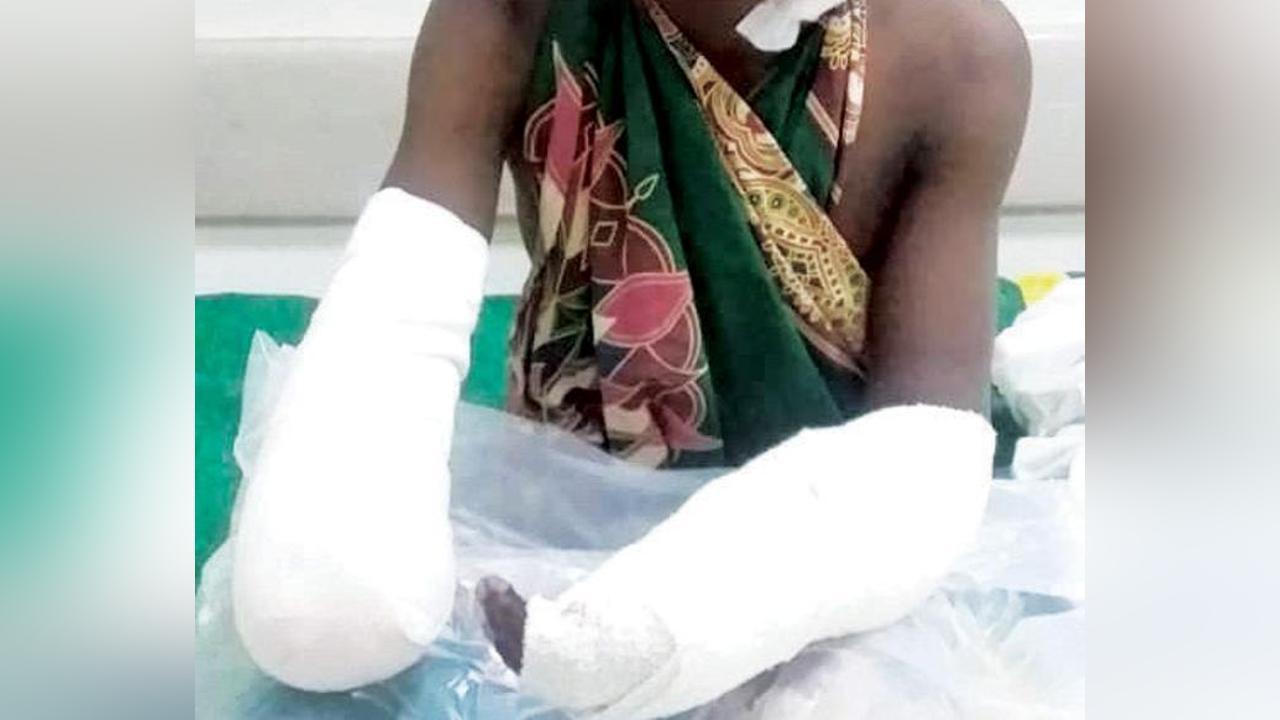
Innocent (not real name) is struggling with excruciating pain at QECH in Blantyre after losing his right hand and two left hand fingers to amputation.
Given a choice, QECH medical experts would not have surgically removed the body parts but, as it were, a police officer [name withheld] at Misanjo Police Unit in the Southern Region district tied his hands with rubber bands (malamba) for days on end, such that they developed wounds.
So extensive were the wounds that they affected some vital parts of the body, compromising the boy’s chances of survival. When Friday Shaker visited QECH and found the boy, he looked helpless, with ‘marks’ of fear about what the future holds written all over his face.
One of his guardians, Rhoda, said medical personnel told them that the boy was badly wounded because rubbers that were used for tying his arms blocked blood circulation.
Rhoda said the boy’s ordeal started on January 30 2024, when the boy got nabbed by some community members for allegedly stealing money from one of the businessmen whose goats he sometimes cares for.
She said although the businessperson recovered some of the money after the boy was arrested, he allegedly tied the boy using rubber bands (malamba) and took him to Misanjo Police Unit, where it is alleged that he ordered police personnel not to untie him.
“We went to the police unit to visit him but officers who were on duty denied us the chance to see him. Instead of letting us see the boy, they chased us, such that days elapsed without us seeing him.
“We started questioning police officers on why they were not allowing us to look at the boy, let alone visit him. Fortunately, one police officer (name withheld) took us aside, behind a toilet block, where he advised us to start making noise while approaching the main door of the police unit. He said if other police officers would hear the noise, they would think that we were demonstrating and let us see the boy. The trick worked,” Rhoda said.
“They finally brought him out of the cell and the damage inflicted on his tender body made us cry loudly. We could not believe what we were seeing,’ she added.
Rhoda said the boy’s arms looked like they had been scalded. “In fact, they were so swollen that you would not have looked at them twice. We, then, took him to Mulanje Police Station to lodge a complaint.
“Officers at Mulanje Police Station took us to Mulanje District Hospital, where we were referred to QECH,” Rhoda, who was suppressing tears throughout the interview, said.
Hospital details indicate that one of Innocent’s hands was badly damaged that it would be difficult for him to use it— again. This also applied to some of his fingers. Yesterday, the dreadful decision was made to amputate the right hand and two fingers from the remaining left hand.
If, ever, the boy had ambitions to pursue an education and be better one day; this is it. Without the right hand and with only three fingers on the left hand, how can he write?
Among other things, the Child Care, Protection and Justice Act outlines clearly that a police officer effecting the arrest of a child shall ensure that there is no harassment or physical abuse of the child.
Its provisions also stipulate that the child must be provided with, where necessary, medical attention. One other thing provisions of the Child Care, Protection and Justice Act stipulate is that a child must not be mixed with adults.
Meanwhile, child rights activist Memory Chisenga has described the police officer who made sure that the child’s hands remained tied in a police cell as “a bad apple in the Malawi Police Service”.
“He must be brought to book immediately. The child suffered inhumane treatment.
“To begin with, no child is supposed to be detained in a police cell. Police officers treated the child as an adult and that is unfortunate. We would want the police to hand over the officer that did this and get him punished accordingly,” she said
Chisenga added that law enforcement officers who deal with children must know that they have a responsibility to abide by laws when arresting children suspected to be in conflict with the law.
KALIMA— Minors are not supposed to be detained in police cellsOn his part, Centre for Human Rights Education, Advice and Assistance Litigation Officer Ruth Kalima said they are saddened to note that a police organisation that changed its name from force to service still has “bad apples that go scot-free when exposed”.
She then appealed to the Inspector General of Police Merlyn Yolamu to deal with all those that are involved in the torture of the boy, adding that “it is clear that they planned to punish the minor” in a country that has courts that are duly established to deliberate on law-related issues.
“They know very well that minors are not supposed to be detained in police cells. They also know that they are not supposed to keep suspects in cuffs or tied while in police cells. The act has become another physical challenge to the boy and that is unfortunate,” she said.
The boy’s circumstances have baffled Human Rights Defenders Coalition Chairperson Gift Trapence, who has since called on the Malawi Human Rights Commission and Independent Complaints Commission to urgently investigate the allegation and take necessary measures to see that justice is served.
TRAPENCE— No one is above the law“We are calling on the Inspector General of Police to take up this case and treat it with the seriousness it deserves. She must also continue orienting police officers on issues of ethics and professionalism,” Trapence said.
He added that the police establishment should not shield officers who are suspected of doing wrong. “No one is above the law,” Trapence added. Meanwhile, Commissioner of Police for the South East Region Chikondi Chingadza has confirmed that her office received a report of the incident “with sadness”.
She said police is now reformed, such that it promotes respect for human rights. “It’s a sad development because the boy was not handled in a professional manner. We, as Malawi Police Service, are very saddened with reports that this happened and we regret that our officer failed to perform duties accordingly,” Chingadza said.
The commissioner said she noted gross negligence on the part of the police. “We are police officers and, as such, we are not above the law. The expectation is that we need to be professional in what we do. Police will not shield any officer of that caliber and officers should remember that nobody is above the law,” she said.
Chingadza has, therefore, assured the public that police management will not shield any officer found to be, or suspected of being, in conflict with the law. Whatever the case, what is clear is that Innocent has joined the list of people with disabilities in the country.
According to Malawi’s 2018 Population and Housing Census, which the National Statistical Office published, there were 1,734,250 persons with disabilities in Malawi aged five years and older, representing about 11.6 percent of the total population
At 13 years, disability, hitherto unanticipated, has come too early for Innocent. No one knows if he has the mental stamina to handle the psychological torture that comes with realising that he will never write again.
For More News And Analysis About Malawi Follow Africa-Press