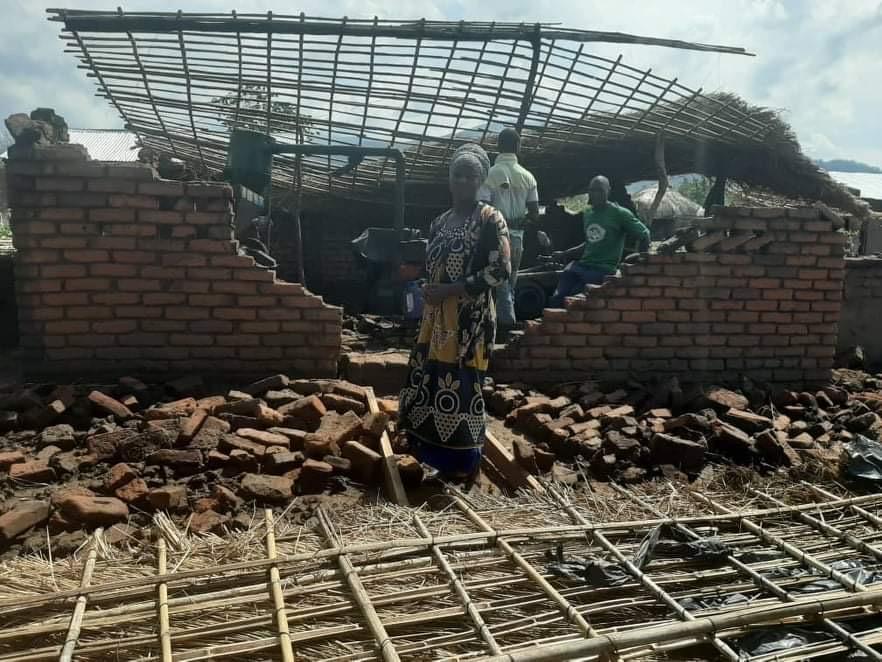
Africa-Press – Malawi. Malawi has lost at least $1.427 billion (about K2.5 trillion) to major climate-related disasters in just eight years, a crushing toll that exposes a country trapped in a cycle of destruction, incomplete recovery and deepening poverty.
An aggregation of official post-disaster assessments shows a relentless pattern of loss: $335 million from the 2015 floods, $365.9 million from the 2016 drought, $220.2 million from Cyclone Idai in 2019, and $506.7 million from Cyclone Freddy in 2023—a cumulative financial hemorrhage that has steadily eroded national resilience.
But the real burden is even heavier.
Reconstruction and recovery needs over the same period exceed $2.04 billion, underscoring a widening gap between what Malawi loses and what it can realistically rebuild—leaving roads, schools, hospitals and livelihoods partially restored or abandoned altogether.
This is no longer a series of isolated disasters.
It is a structural crisis.
Across affected districts—from Chikwawa and Nsanje to Zomba, Machinga and Lilongwe—each shock compounds the last, striking before recovery is complete and locking vulnerable households into repeated cycles of loss.
Infrastructure is hit, patched, then hit again. Crops fail, are replanted, then destroyed. Families displaced by floods or drought struggle to rebuild, only to be uprooted once more.
The 2016 drought alone pushed about 8 million Malawians into hunger, nearly half the population at the time, with many still struggling to regain stability years later.
Now, fresh flooding has once again torn through key transport corridors in the Shire Valley, submerging sections of the Chikwawa–Nsanje road, paralysing movement and disrupting trade—another blow layered onto an already weakened system.
The economic consequences are cascading.
Repeated disasters are:
Destroying agricultural output, the backbone of rural livelihoods
Disrupting transport networks, inflating the cost of goods
Diverting public funds from development to emergency response
Eroding household assets, forcing families into chronic vulnerability
The result is a deepening poverty trap where recovery is temporary, but loss is permanent.
Even where rebuilding occurs, it is often partial and slow. Years after major disasters, critical infrastructure remains damaged, while communities continue to live in fragile conditions with limited capacity to absorb new shocks.
Each new disaster does not just reset progress—it pushes it further back. With climate variability intensifying—swinging between drought, dry spells and destructive floods—Malawi is facing a compounding crisis where natural shocks are no longer episodic but continuous.
At $1.4 billion in losses in less than a decade, the numbers tell a stark story: Malawi is not just vulnerable to disasters—it is being economically drained by them.
And unless the cycle is broken, the cost will not only keep rising—it will continue to be paid by the poorest, who are hit first, recover last, and are struck again before they can stand.
For More News And Analysis About Malawi Follow Africa-Press