
Every tobacco season, thousands of farmers travel to auction floors with hopes that the crop they spent months cultivating will finally reward them with income for school fees, food, fertilizer, rent, and survival.
Yet beneath the excitement of the tobacco market lies a growing divide between contracted and non-contracted farmers — a divide that is becoming more visible with every sales season.
On May 19, 2026, an observation study was conducted at the Lilongwe Auction Floors to understand how tobacco sales were taking place and how different categories of farmers were experiencing the market. The visit followed official permission obtained from the Floors Manager on May 18, 2026.
The observation focused on two groups of farmers. The first group consisted of contracted farmers. These are farmers who grow tobacco under agreements with tobacco companies such as Alliance One, JTI, and Limbe Leaf. Under these arrangements, the companies provide support in the form of fertilizer, seed, chemicals, technical advice, and sometimes financial assistance. In return, the companies have first rights to purchase the tobacco produced by the farmer.
The second group consisted of non-contracted farmers, commonly known as independent farmers. These farmers finance their own farming activities and bring their tobacco to the auction floors without guaranteed buyers or sponsorship.
– Advertisement –
What emerged from the observation was not simply a difference in marketing systems, but the existence of two completely different economic and emotional realities operating within the same tobacco market.
On the auction floor, tobacco arrived in tightly packed bales. Each bale carried a ticket containing detailed information such as the ticket number, farmer registration number, lot number, weight, floor number, tobacco type, classification, and sale details. Contracted tobacco could easily be identified by labels from sponsoring companies. Every bale was partially opened at the top to allow buyers, graders, and classifiers to inspect the tobacco leaves inside.
One striking observation was the overwhelming dominance of contracted tobacco on the market floor. Only about 142 bales of non-contracted tobacco were laid for sale that day, while contracted tobacco occupied much larger sections of the floor. The imbalance raised serious questions about whether independent farmers are slowly being pushed out of the tobacco market.
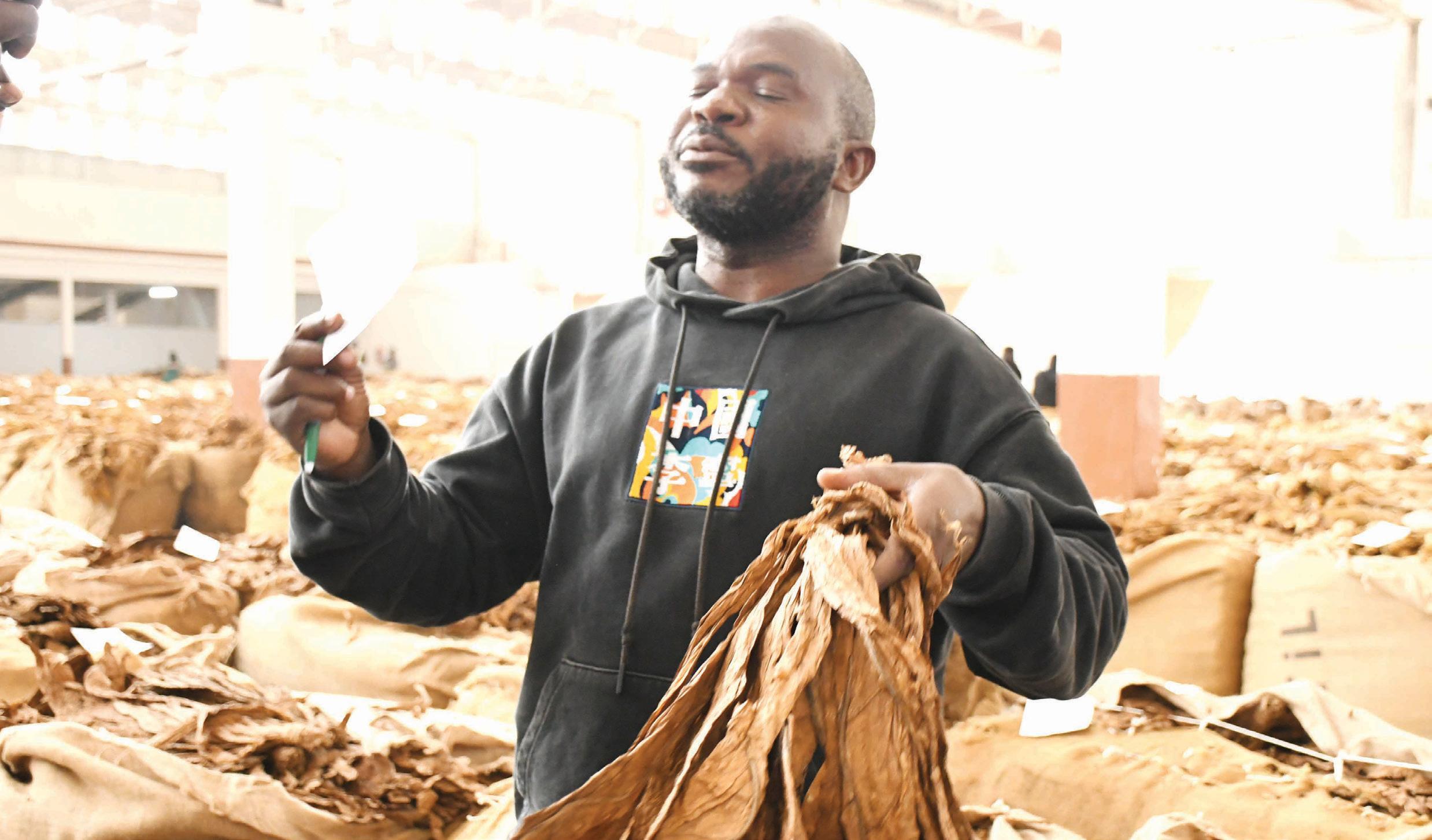
PLACE OF BOTH ANGUISH AND JOY—Tobacco auction floors in Lilongwe
The atmosphere on the floor revealed sharp behavioural differences between the two groups of farmers even before buyers made decisions. Independent farmers appeared tense and anxious. Many stared continuously at buyers’ tablets and clipboards, desperately trying to read signs of acceptance or rejection. Some paced back and forth, rubbed their hands together, or whispered nervously to fellow farmers. Their faces reflected exhaustion, uncertainty, and fear. For many of them, the tobacco bale represented the entire year’s investment and family survival.
– Advertisement –
– Advertisement –
Contracted farmers, however, displayed far less stress. Their body language was relaxed and calm. Most already knew that their tobacco had guaranteed buyers and stronger chances of acceptance. The security of contracts appeared to remove much of the emotional pressure experienced by independent growers.
The most dramatic moment came when buyers began making final decisions on the tobacco bales. Out of the 142 non-contracted bales observed, 126 were rejected. This represented an alarming rejection rate of 88.7 percent. Most of the rejected bales were classified as mouldy because they exceeded the acceptable moisture threshold.
An official operating the testing equipment explained that tobacco bales are checked using temperature probes inserted deep inside the bale. If the internal temperature exceeds 23 degrees Celsius, the tobacco is rejected because the heat indicates excess moisture. Such moisture encourages mould development and damages leaf quality. Tobacco below 23 degrees Celsius is accepted.
This technical rule may appear simple, but for independent farmers it has become a devastating trap. Many smallholder farmers lack proper tobacco barns, modern ventilation systems, or adequate storage facilities. Some rush to pack tobacco before it fully dries because of urgent financial pressures at home. Once moisture becomes trapped inside compressed bales, fermentation begins and internal temperatures rise. At that point, rejection becomes almost automatic.
The emotional impact of rejection was painful to witness.
When buyers rejected their bales, many independent farmers froze in shock. Some stepped closer to buyers and officials, pleading for reconsideration. Others switched from Chichewa to English while speaking to officials, possibly hoping that sounding more formal or educated might help their situation.
What stood out most was what the rejected farmers did not do. One might expect that rejected farmers would immediately untie bales, sort leaves again, or attempt corrective measures on the floor. Instead, most did absolutely nothing. Some sat quietly against pillars while others stood motionless in silence.
This stillness reflected more than disappointment. It revealed emotional paralysis. Watching nearly all independent bales rejected within a short period created a powerful sense of hopelessness. Farmers appeared overwhelmed by the realization that their annual income had effectively disappeared within minutes.
The crowded movement of successful contracted sales only deepened the psychological blow. At the same time, contracted farmers were enjoying significantly better outcomes. The average selling price for contracted tobacco was approximately US$2.50 per kilogram, with some lots reaching as high as US$3.00 per kilogram.
Independent farmers who managed to pass the moisture tests received much lower prices averaging around US$1.20 per kilogram.
Such differences expose a widening inequality within Malawi’s tobacco industry. Contract farming increasingly provides protection, market certainty, technical support, and stronger bargaining power. Independent farmers, meanwhile, carry all production risks alone while facing stricter rejection rates and lower prices.
Yet despite these inequalities, one remarkable aspect of the observation was the strong sense of social restraint and cultural respect among farmers themselves. There was no evidence of jealousy or conflict directed toward successful contracted farmers. Independent farmers did not insult or attack those receiving higher prices. Likewise, contracted farmers celebrated quietly and modestly. Many appeared careful not to display excessive excitement in front of struggling fellow farmers. This silent empathy reflects the enduring Malawian value of umunthu — the recognition of shared humanity even during personal success or hardship.
The auction floor itself also reflected increasing modernization and surveillance within tobacco marketing. Tobacco Commission officials accompanied buyers closely, recording accepted and rejected bales using both mobile devices and paper records. The process was highly regulated and closely monitored.
Private security guards, rather than state police, maintained order throughout the floor. Their presence ensured that operations continued efficiently, especially within the fast-moving contract sales sections. However, the same system also seemed to isolate struggling independent farmers, pushing them to the margins both physically and emotionally.
The current situation raises serious questions about the future of independent tobacco farming in Malawi.
If rejection rates continue rising while price differences widen, more independent farmers may eventually fail to sustain tobacco production altogether. Without access to contracts, technical support, proper drying facilities, or affordable financing, many smallholder farmers remain trapped in cycles of vulnerability.
There is need for urgent intervention.
First, the Tobacco Commission and other stakeholders should establish farmer support desks at auction floors specifically to assist independent farmers whose bales are rejected. Guidance on corrective procedures, moisture management, and re-handling options could reduce confusion and emotional distress.
Second, government and agricultural extension officers must strengthen farmer education on tobacco curing, drying, and storage techniques. Since excessive moisture caused most rejections observed during the study, better post-harvest management training could significantly improve acceptance rates.
Third, policymakers should explore ways of expanding fair contract opportunities to more smallholder farmers while ensuring that contract systems remain transparent and non-exploitative.
Finally, Malawi must confront a difficult but necessary question: can the tobacco market continue to survive sustainably if independent farmers increasingly feel excluded from meaningful participation?
The scenes witnessed at Lilongwe Auction Floors were not merely about tobacco sales. They reflected deeper realities about inequality, vulnerability, survival, and dignity within Malawi’s agricultural economy. Behind every rejected bale stands a household waiting for hope, income, and another chance to survive the season.