
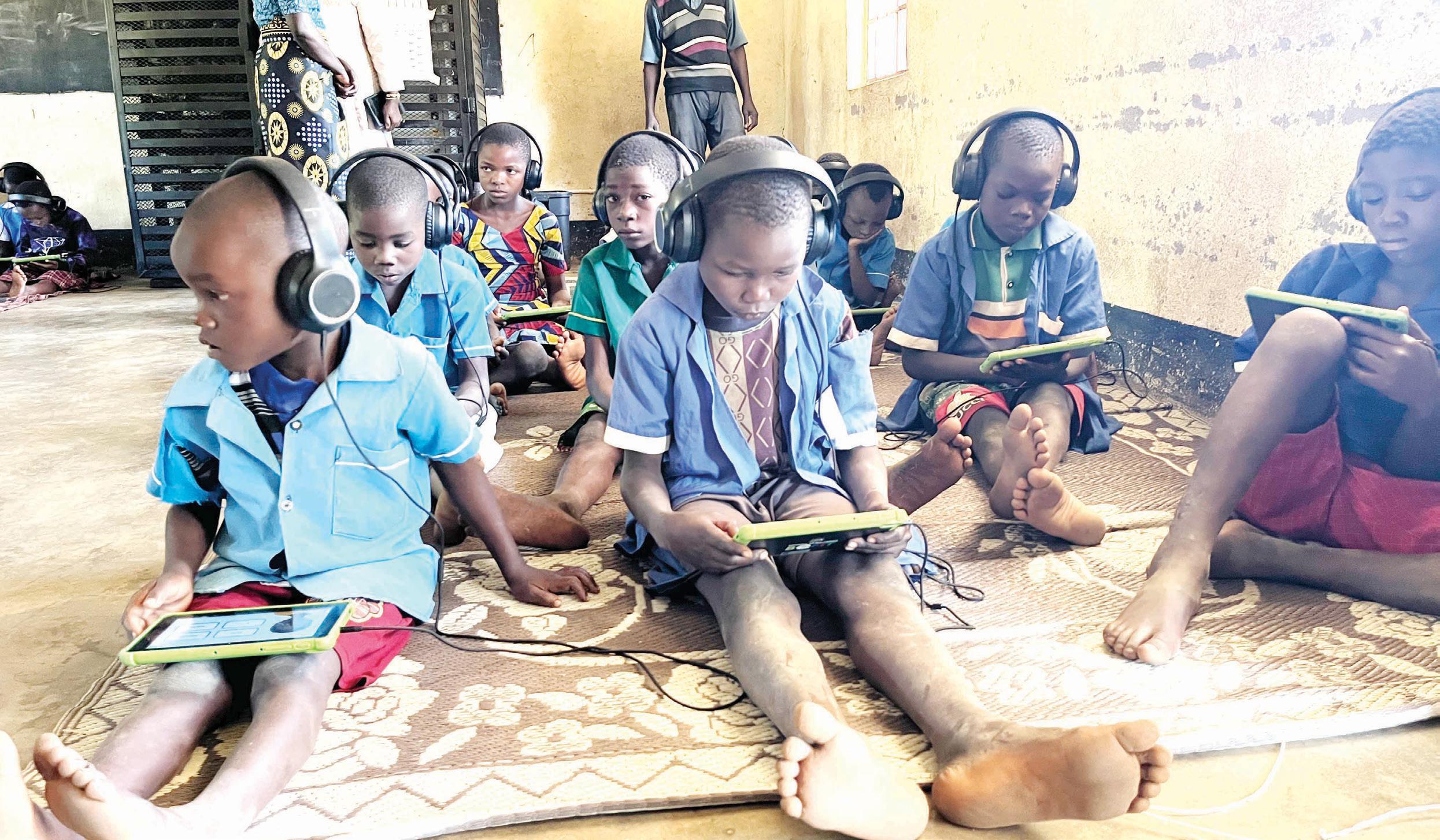
EDUCATION BY TOUCH—Government is distributing the tablets to enhance learning in lower primary schools across Malawi
By Mercy Matonga
For years, lessons in most rural classrooms in Malawi have been defined by chalkboards, worn-out textbooks and crowded desks.
But some shift is redefining early education. Small hands are now swiping across tablet screens, replacing chalk dust with digital touch during some lessons.
The government’s introduction of tablets Building Education Foundations through Innovation and Technology (Befit) programme for learners in lower primary classes is opening up a new way of learning, particularly for children in a country where access to digital technology has been almost non-existent.
Tania Phiri, a Standard Four learner at St. Joseph Primary School in Kasungu District, says it was her first time using a tablet or any digital device because her parents do not own a smartphone.
– Advertisement –
“I am happy with the tablets because learning through them gives me an opportunity to learn at my own pace unlike in the classroom where the teacher is in control,” Tania says.
She adds that the tablets make learning fun as she is able to choose lessons she is interested in and follow them independently.
Chisomo Malinje, also a Standard Four learner, says she struggled to read before the introduction of the tablets, but now she is able to read and solve mathematics problems.
“I am now able to calculate and do mathematics on the tablets, which was very challenging for me before,” Chisomo says.
– Advertisement –
– Advertisement –
In some districts such as Salima, parents and guardians did not sit back when the project was introduced in their communities. School committees volunteered to support teachers and learners to ensure the programme succeeds.
Fynes Juziwell, a Standard Eight dropout from Bwatha Village in Salima, is part of the committee and says she admires the initiative because during her time in school she never had access to digital learning materials.
“As a parent, I felt it was necessary to be part of this programme in my community. We are very grateful that our children now have access to digital learning materials,” Juziwell says.
She says due to community involvement, some children voluntarily go to school during weekends just to access the tablets and spend more time learning.
Patrick Batiyoni, chairperson of the school committee for Chitiwiri School in Salima, is a 54-year-old parent who has been part of the school leadership for the past three years. He believes the tablets have helped increase school attendance among learners.
“As a community, we are the beneficiaries of this project. Teachers come and go, but the school remains part of us. That is why we as parents are part of this initiative,” Batiyoni says.
Head teacher for the school, Redson Sauka, says since the project started in 2025, about 350 children have benefited from the programme.
“We have seen a decrease in the number of school dropouts and we believe these gadgets are helping to encourage children to come to school,” Sauka says.
Salima District Principal Education Officer Eliam Edwin Banda said the implementation of the programme has been successful as it has contributed to improved performance and increased school enrolment.
“Salima District has improved its performance at the national level and we believe the project is one of the contributing factors,” Banda says.
However, Banda observes there is still a need to recruit more teachers as the teacher-to-pupil ratio remains high in many schools.
Though learning through tablets appears to be improving children’s performance, the programme’s reach remains low. For example, out of the 256 primary schools in Dedza District, only 32 schools are part of the project.
District Education Manager, Joseph Mponda, says they are satisfied with how the programme is helping improve children’s education.
“We are impressed with the progress being made through this programme because learners are showing greater interest in education and teachers are also able to deliver lessons in a more interactive way,” Mponda says.
KAMPANI—We are encouraged by the impact of the programme
One of the parents with a child at Linthipe Primary School, Chikondi Ndalama, says at first people had doubts about the programme, but this has now changed. She said learners are now going to school on their own because of the initiative.
“At first, many parents were uncertain about the tablets, but now we have seen the benefits because children are eager to go to school and learn,” Ndalama says.
Ministry of Education spokesperson Lily Kampani says they are satisfied with how the programme is benefiting learners, especially in improving their writing and reading skills in Chichewa.
“We are encouraged by the impact the programme is having on learners, particularly in literacy and numeracy skills. Many learners are now able to read and write better through the digital lessons,” Kampani explains.
The digital learning programme has so far been launched in 1,089 schools across 34 education districts, benefiting over 689,762 learners. More than 166,689 tablets and related accessories have been procured and distributed to public primary schools.
Government has also trained over 2,000 education officers at national, district and zonal levels, while more than 17,900 teachers have been trained at school level to support implementation of the programme.
In addition, over one million community members, including local leaders, have been sensitized on their roles and responsibilities in supporting digital learning, while 1,089 solar power systems have been installed in schools to support the initiative.
According to Unesco, the Befit programme aims to improve foundational literacy and numeracy skills for about 3.8 million children annually in Standards 1-4 across all 6,000 public primary schools.
It says the programme addresses Malawi’s critical challenge of learning poverty, where only 19 percent of children aged 7 to 14 possess foundational reading skills and 13 percent have foundational numeracy skills.