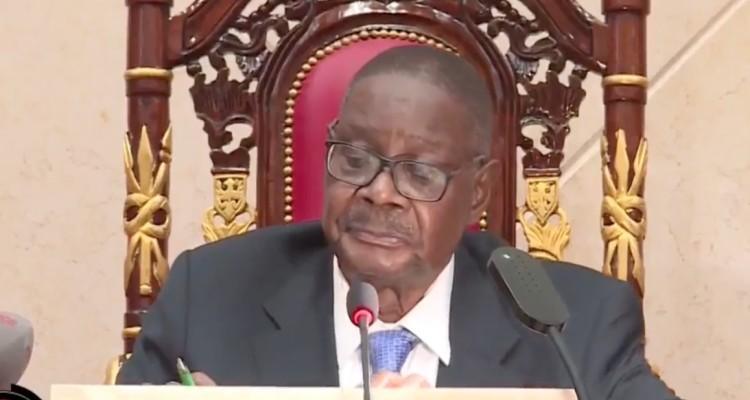
Africa-Press – Malawi. A social media post by outspoken Zimbabwean journalist Hopewell Chin’ono has ignited a political storm in Malawi after he alleged that President Peter Mutharika is battling a serious illness—claims that, if left unaddressed, risk fuelling uncertainty at the highest level of power.
In a strongly worded statement, Chin’ono did not mince his words, asserting: “The president is not well. He is battling a serious illness, which is why he keeps travelling to South Africa for treatment.”
He went further to criticise what he described as a culture of secrecy, arguing that in transparent democracies, such matters are openly communicated to citizens. “In functioning democracies, such matters are communicated openly… rather than leaving citizens to speculate and imagine the worst,” he said.
The claims, though unverified by Malawian authorities, strike at a sensitive nerve—presidential health and the constitutional order. Under Malawi’s Constitution, if a sitting president is incapacitated, power automatically transfers to the Vice-President, currently Jane Ansah.
Chin’ono alleges that this constitutional reality is triggering behind-the-scenes manoeuvres within the President’s inner circle. “His condition is also said to be at the centre of political manoeuvres… pushing for the removal of the constitutional Vice President,” he claimed, suggesting that those close to power may be attempting to influence succession dynamics.
Such assertions, if proven, would point to a high-stakes power struggle unfolding quietly behind closed doors—one driven not by policy, but by proximity to authority.
He added a sobering warning: “Those around him are fully aware that his health is deteriorating, and they are likely aware of the prognosis.”
The Presidency has yet to respond publicly to the claims, leaving a vacuum that is rapidly being filled by speculation and public anxiety.
Chin’ono’s comments also widened into a broader critique of governance, drawing parallels between Malawi and Zimbabwe. “I hope things improve for Malawi… it is a country that has endured deep poverty and prolonged governance failures,” he said, adding that conditions in Malawi appear “even more severe,” citing struggling public services and under-resourced hospitals.
While his remarks reflect an external perspective, they amplify long-standing domestic concerns about transparency, accountability, and the state’s obligation to keep citizens informed—especially on matters that directly affect national stability.
At the heart of the issue is a simple but uncomfortable question: if a leader’s health has implications for governance, does the public not have a right to know?
Until there is an official response, Chin’ono’s claims remain just that—claims. But their impact is already real, sharpening scrutiny on the Presidency and raising fresh doubts about what may be unfolding behind the curtain of power.
For More News And Analysis About Malawi Follow Africa-Press