
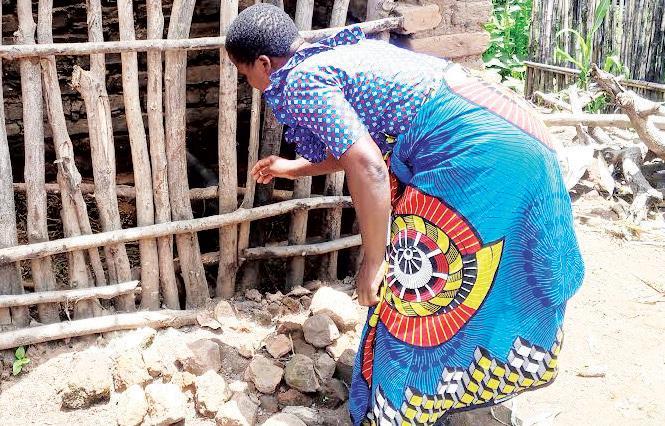
IN RUINS—Mpasa Irrigation Scheme inletBy Pemphero Malimba:
When Tropical Cyclone Freddy struck Malawi in March 2023, it left a trail of devastation, killing nearly 1,000 people, displacing more than 659,000 others, leaving over 500 people missing, and destroying crops, trees and critical infrastructure.
Phalombe District was among the hardest-hit areas.
Within the district, the area under Traditional Authority (TA) Nkhumba suffered extensive damage.
Notably, the eight-hectare Mpasa Irrigation Scheme, an essential lifeline for irrigation farming in Group Village Headman Chimenya’s area, was completely destroyed.
Established in 2004, the scheme had been the primary source of irrigation water for over 40 farming households from six villages.
The cyclone swept away canals and water pipes used for drawing water from Phalombe River, leaving the scheme in ruins to this day.
Its destruction effectively shut down year-round food production, severely undermining food security for beneficiary households.
“It was difficult to tap water from our water source, Phalombe River, because all the canals were destroyed. This affected us, stopping us from growing our crops effectively. This culminated in poor harvests. We started suffering because when we used to grow crops through irrigation, we were getting additional produce for consumption and sale.
– Advertisement – CHIZOMBE—We want to grow more tomatoes“If we grew crops using rain-fed agriculture, sometimes we would get low rains and eventually see drought. In that case, the scheme was able to support us to grow maize and other crops several times a year. However, the cyclone created more problems for us, thereby escalating the situation,” said 35-year-old Mirriam Chizombe, a member of the scheme.
According to the Phalombe District Disaster Contingency Plan for 2021-22, TA Nkhumba is highly prone to flooding, with 73 percent of the total population in the catchment area at risk of floods every year.
Chizombe, a married mother of four, recalls mobilising fellow farmers to seek assistance from government institutions and non-governmental organisations to rehabilitate the damaged scheme.
“No organisation came to our rescue,” she recalls.
The Malawi 2023 Tropical Cyclone Freddy Post-Disaster Needs Assessment—conducted by the Government of Malawi with financial and technical support from the World Bank, Global Facility for Disaster Reduction and Recovery, the United Nations, and the Delegation of the European Union to Malawi—estimated that about $35.14 million was required for the recovery, reconstruction and rehabilitation of partially damaged irrigation infrastructure nationwide.
However, in areas such as TA Nkhumba, many irrigation schemes remain in ruins.
Hope resurfaced more than a year after the disaster when Oxfam in Malawi intervened, supporting about 26 irrigation clubs in Phalombe District through its Climate Just Communities Project.
Funded by Development Alternatives Incorporated (DAI Global UK) and the Scottish Government, the project is being implemented in five districts— Salima, Zomba, Machinga, Phalombe and Karonga—alongside nationwide advocacy covering seven thematic areas of Disaster Risk Management (DRM), Livelihood Security, Loss and Damage, Resilient Schools, Water, Sanitation and Hygiene, Advocacy, and Gender Equity and Social Inclusion.
Valued at £1.6 million (approximately K3 billion), the project aims to strengthen community resilience to the material and social impacts of extreme weather events and environmental disasters such as floods, prolonged dry spells, and cyclones.
In Phalombe, Oxfam is implementing the DRM component of the project in partnership with Circle for Integrated Community Development.
Among the beneficiaries is Tikondane Irrigation Club, which received a mobile solar-powered pump, certified maize, tomato, vegetable seeds as well as training in group organisation and irrigation water management.
LIFELINE—Ofesi (second right) and club members prepare solar-powered irrigation equipmentAt Chilungamo Mpasa Irrigation Club, where Chizombe is now a member, Oxfam constructed a solar-powered water system for irrigation and an 8-by-30-metre greenhouse connected to the same system.
The 30-member club grows tomatoes, onions and leafy vegetables such as rape three times a year, with production cycles running from January to April, May to August, and September to December.
“During the first season, we grew tomatoes and sold them for K880,000 and part of the money was used for buying maize seed, which we planted and, thereafter, harvested 30 bags. Our members also shared some bags because the area faced hunger.
“We grew onions and sold them for K650,000, which we are keeping in our account. We expect to use it for buying tomato seed because we want to grow more tomatoes this year,” Chizombe said.
She explains that proceeds of produce are shared among members, with the priority given to those facing urgent needs.
“For example, my child is in standard 8. So, at the beginning of her first term in September 2025, I had no money to buy school-related materials. I managed to secure K50,000 from the group and managed to buy school uniforms, exercise books, shoes and a school bag and my child is happy in school.
“So far, I have managed to buy a pig and, last season, I bought four bags of fertiliser which I have applied to maize and I expect to harvest more yield this year,” she said.
Chizombe remains optimistic that even during dry spells, farmers in the area will continue to achieve high yields, as water is now available throughout the year through the solar-powered system.
CHIMENYA—We have planted at least 2,500 treesGroup Village Headman Chimenya has welcomed the irrigation and greenhouse interventions, noting visible improvements in livelihoods.
He is also leading community efforts to restore the environment as a climate change mitigation measure.
“We have planted at least 2,500 trees since the project was introduced. We believe this will help us counter some of the challenges that befall us due to climate change. Currently, plans are underway to plant more trees because we do not want to see what happened in 2023. We lost trees, houses and many lives due to Cyclone Freddy,” Chimenya said.
To curb practices that contribute to deforestation, traditional leaders, in collaboration with district council officials, have introduced by-laws to enforce environmental protection regulations.
“The by-laws are clear, whosoever is found cutting down trees should, if found guilty, be punished through various ways, including court action,” he said.
Naminjiwa Extension Planning Area Agriculture Extension Development Officer Charles Mzika says his office provides technical support to farmers on best practices in irrigation and greenhouse farming to enhance productivity and long-term resilience.
“We train farmers in the best ways they can take when growing crops in this green house. The farmers are also assisted with knowledge on the best use of proceeds they obtain from this greenhouse so that they can sustain the green house and enable the next generation to benefit also,” Mzika said.
According to Mzika, greenhouse farming has brought relief to farmers by regulating temperature and weather conditions, thereby addressing food insecurity caused by recurring disasters.
Tikondane Irrigation Club Chairperson Moreen Ofesi highlighted the economic gains from irrigation farming, which is conducted two to three times a year.
“For example, in June 2024, we managed to produce 39 forty-litre buckets full of tomato and sold it at K897,000. We also sold green maize at K973,3892 and, lastly, sold vegetables at K198,457. In 2025, we sold maize at K1,280,000 and K880,000 was realised from the sale of vegetables. Some money was shared among members and some of it was deposited in our village savings and loans account and the money was shared in December of that year. It was just like a dream for me to get K189,000 after sharing the sales. During the time we were yet to get the solar-powered water pump, we were getting at least a quarter of what we are getting now because we were failing to irrigate on a large piece of land,” Ofesi said.
Ofesi, a mother of five from Nachipo Village under Group Village Headman Chipsa in TA Nkhumba, said the initiative has transformed the lives of her club’s 35 members—24 women and 11 men.
“Women, to be specific, are able to take care of their families without waiting for their husbands to provide their families with basic needs. This is something we, as a group, are proud of. Others like me have been able to transform from a grass-thatched house to a standard house with iron sheets and, through the 16 chickens I have, I get manure to apply to crops at my farm, which helps me get bumper yield,” the divorcee said.
The community-driven interventions, supported by non-governmental organisations, align with the Sustainable Development Goals—particularly SDG 11, which promotes inclusive, safe, resilient and sustainable human settlements. The goal emphasizes reducing exposure and vulnerability of the poor to disasters through resilient infrastructure and disaster-risk reduction.
“Disaster risk reduction (DRR) is an integral part of social and economic development, and is essential if development activities are to be sustainable,” the goal states.
KULIYAZI—We have seen communities producing enough foodOxfam in Malawi Livelihoods and Resilience Programme Manager Steve Kuliyazi expressed satisfaction with the project’s outcomes.
“We have seen communities that are now into irrigation and are able to produce enough food. We have seen even communities engaging in modern technologies such as greenhouses powered by solar energy. So far, we are satisfied. In other districts, we have supported communities to construct evacuation centres such that if there is flooding—for example, in Salima—this would serve as a safe haven,” he said.
Kuliyazi is confident that the interventions will be sustained due to strong local partnerships and capacity building.
“The project is working with local delivery partners and these are going to be there beyond the life span of the project.
“Secondly, the project is working closely with district councils so that the interventions we have can be handed over to district councils for them to continue implementing the project,” he said.
He added that the deliberate focus on women has amplified the project’s impact.
“If you look at the impacts of climate change, women bear the burden the most because they have got the duty to care for their home. So they are the ones that bear the heaviest burden from climate change. That is why we have made it a deliberate policy to target women and, by targeting the women, we feel that the project is going to have the most impact on communities,” Kuliyazi says.