
POWER OF ELECTRICITY—Kacheka printing examinations at her schoolBy Sphiwe Dorias:
Milumbe Community Day Secondary School in rural parts of Mulanje District is basking in the glory of an historical achievement.
For the first time since its establishment, it now has in its records a student who scored an impressive 17 points in the 2025 Malawi School Certificate of Education (MSCE) examination results.
The force behind this achievement, alongside generally improving results at the school, is installed in the head teacher’s office – an electric bulb in the roof that gives the room a well-lighted, charming ambience and a panel of electric fittings on the wall powering computers, a printer and heavy-duty photocopier in this office.
That solar power system has brought illumination to a school that was once in the dark and stuck in underperformance. With that illumination, progress.
Now that the school is able to print materials for lessons and examinations, it has cut operational costs, brought convenience to teachers and made it possible for the school to cater for its growing number of learners.
There is something else more impactful though.
“We run both morning and afternoon classes. [When we were] without electricity, lessons often ended early, especially on cloudy days or during shorter daylight periods. This affected student performance,” said Grace Kacheka, head teacher for the school.
“With solar power now in place, we conduct evening classes, which have significantly improved learning outcomes,” she said.
In the darkness that it was in, Milumbe CDSS wasn’t necessarily in an unfamiliar position. Across many parts of Malawi, life begins before sunrise but ends long after sunset. For millions of people and public service institutions such as schools and health centres in rural areas, darkness isn’t only confined to nightfall; it is a daily reality, aided by lack of connection to the national electricity grid and other public conveniences.
Yet, above them, the sun beats hard every day – free energy that is can be converted to light homes, power public service facilities and electrify national progress.
That is how Milumbe CDSS and six other rural facilities got their redemption.
In 2024, National Bank of Malawi (NBM) plc, in partnership with Press Trust, stepped in with clean energy initiative.
Under its Corporate Social Investment (CSI) programme, the bank allocates at least 2 percent of its profits every year towards implementation of initiatives aimed at uplifting lives of communities in Malawi.
Through the programme, National Bank of Malawi and Press Trust have installed solar systems for electricity and water supply in seven facilities – four community day secondary schools and three health centres.
The initiative has not just brought light and water; it has also extended study hours of studying and learning, brought better care for medical equipment and made healthcare service delivery for patients more efficient, and improved the work environment for teachers and healthcare workers.
SEEING LIGHT—Chilomo says performance of girls at her school has improved since the
installation of solar power systemTiwonge Chilomo, one of the learners at Milumbe CDSS, added that the solar power installation at her school has resulted in a fundamental shift on the scales of gender-influenced class performance.
“Before [the installation], boys often performed better because studying at home is difficult for girls due to household chores. Now we study at school in the evenings, and this has greatly improved the performance of female students here,” she said.
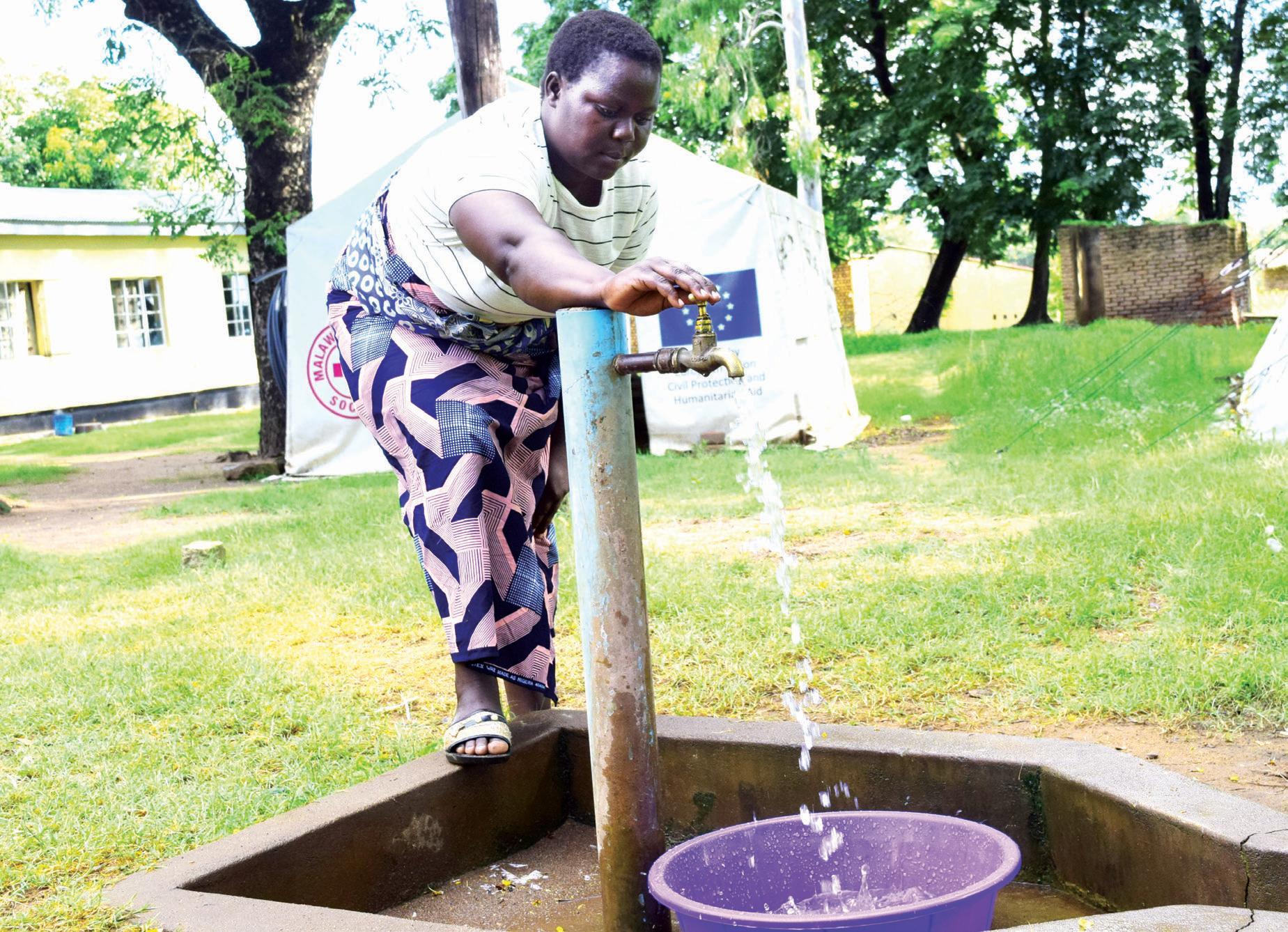
In Chikwawa District, Gaga Health Centre is located in a hard-to-reach area. For four years, it has not had running water since a pipe supplying water to the facility broke down. This situation compromised service delivery, according to Senior Medical Officer, Mike Ngoma.
“A health facility cannot function properly without water. We are advised to wash our hands before attending to patients, but this was barely possible. Patients were forced to fetch water from community boreholes, and during congestion, the situation was unimaginable,” Ngoma said.
So are the tales of previous struggles replaced by efficiency and improved conditions at Matundu CDSS in Dedza, at Kabuwa CDSS in Nkhotakota and Njerenje CDSS in Balaka and Namkumba and Chimwamkango health centres in Mangochi and Mchinji respectively.
At these sites, newly-installed solar-powered systems for water and electricity have brought new energy among workers and a sense of delight among service users as they support Malawi’s efforts to achieve both local and global development targets.
Gibson Ngalamila, Executive Secretary for Press Trust, said the National Bank of Malawi initiative aligns with its founding purpose as a public trust established to mobilise resources for community development.
“We were founded to mobilise funds from the private sector for the benefit of communities. When National Bank of Malawi approached us, we were very pleased.
“This partnership has enabled us to roll out a programme that is truly changing lives. We see it as an opportunity to reach deserving communities that are often overlooked,” Ngalamila said.
Project Manager for National Bank of Malawi, Chimwemwe Lipato, said access to basic needs such as electricity and water remains critical to national development.
“Beyond banking, we consider ourselves an enabler of sustainable development. Our strong commitment to corporate social responsibility drives us to invest in initiatives that deliver real and lasting impact to communities facing persistent challenges,” said Lipato.
He said the selection of beneficiary schools and health facilities under the initiative prioritised remote areas with pressing needs but most likely to be overlooked in development programmes.
In 37 years’ time, Malawi aspires to be an inclusive wealth- creating and self-reliant nation.
Among the blocks the country is mobilising for the construction of that future in 2063 include public sector performance, human capital development and private sector dynamism. For development policy experts, the concrete for the making of such bricks can come from fixing the basics such as access to power and improved water supply.
Across the seven sites, light and water are doing more than powering buildings; they are improving outcomes, strengthening institutions and reshaping futures.