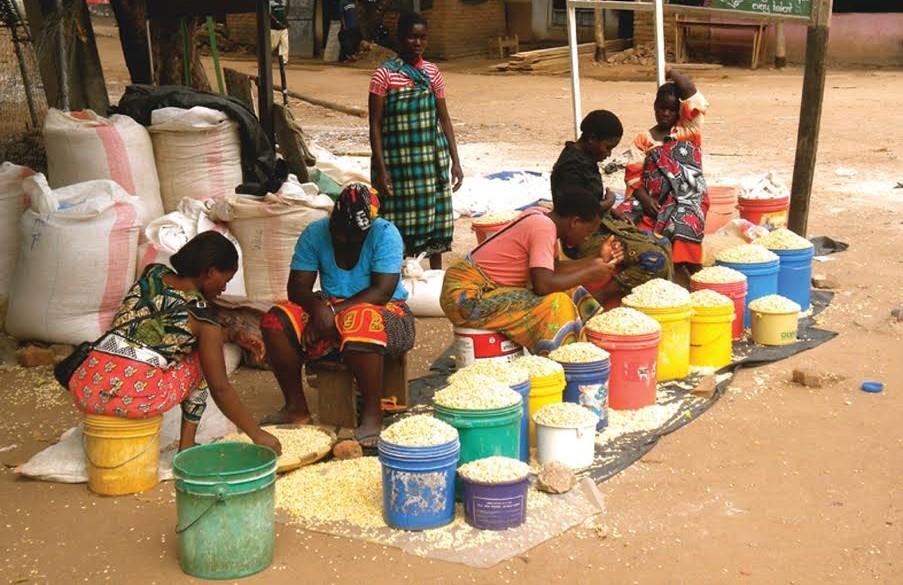
Africa-Press – Malawi. In a baffling twist that raises urgent questions about government oversight, Malawi is reportedly exporting maize to Zambia through Mchinji District—despite a formal maize export ban and ongoing plans by Lilongwe to import the very same staple from its neighbour.
The International Food Policy Research Institute (IFPRI) confirmed in its November 2025 Maize Market Report that “large quantities of maize started flowing out of the country through Mchinji border towards Chipata.” Yet, IFPRI also notes that Malawi remains dependent on imports from Tanzania, Zambia, and Mozambique to stabilize its local markets.
The anomaly exposes a glaring disconnect: while officials publicly insist the export ban safeguards national food security, maize continues to leave the country unchecked. Retail prices within Malawi even dropped by six percent from late October to November, suggesting that local supply is not only sufficient but also moving in ways that contradict official policy.
Forex Over Food Security?
Grace Mijiga-Mhango, president of the Grain Traders Association of Malawi, sheds light on the incentive behind the exports. Traders are exploiting foreign exchange opportunities, she says, as maize is cheaper in US dollar terms locally than across the border. “This shows traders have reasonable stocks,” she explained, “but it does not mean we have enough maize for the country.”
Civil Society Agriculture Network chair Driana Lwanda adds that demand in eastern Zambia and price disparities are further fuelling exports—putting local food security at risk.
Meanwhile, the government’s export ban appears largely symbolic. Agricultural policy expert Tamani-Nkhono Mvula observes that farmers and traders are holding onto maize, waiting for prices to rise before releasing stocks. “Ban enforcement has proved costly and oftentimes ineffective,” confirms agriculture economist Steve Kayira, who argues the focus should be on creating credible local market participation rather than relying on punitive measures.
Imports While We Export?
Compounding the confusion, Transporters Association of Malawi spokesperson Frank Banda revealed that the Ministry of Agriculture, Irrigation, and Water Development has already engaged the association to transport maize from Zambia—potentially 300 trucks of between 15 and 30 metric tonnes.
As if the contradictions were not enough, Malawi is also reportedly considering maize imports from Tanzania, while a letter from Uganda’s Ministry of Agriculture suggests Kampala is seeking to export maize, beans, soybeans, sesame, and rice to Malawi.
Attempts to reach Minister of Agriculture Roza Mbilizi were unsuccessful, and Secretary for Agriculture Erica Maganga says she has not yet seen the Uganda letter.
Questions Linger
The situation exposes a troubling circus of contradictory actions: maize leaves Malawi even as officials prepare to bring in more from neighbouring countries. Price manipulation, foreign exchange speculation, and weak enforcement leave ordinary Malawians questioning whether their government is safeguarding national food security—or simply watching traders profit at their expense.
Who is really controlling the maize market? And how long before these contradictory policies translate into hunger at home while Malawi’s staple grains flow out the border?
For More News And Analysis About Malawi Follow Africa-Press