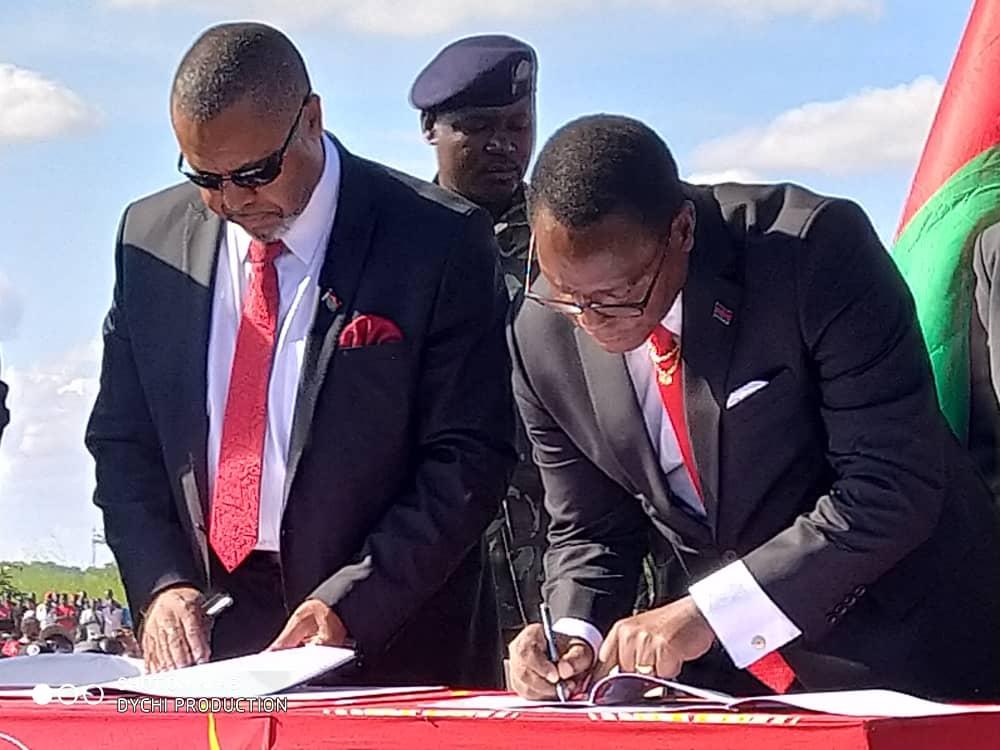
Africa-Press – Malawi. A statement signed by 32 Malawians mainly in the Diaspora has been submitted to Malawi President Lazarus chakwera stating their displeasure with his leadership style and the ongoing crisis and corruption in the country since he assumed power after court ordered elections.
The signees demand accountability and ask the government to rise to the occasion and fulfill the responsibility bestowed on it by the electorate on 23 June 2020
STATEMENT ON THE LEADERSHIP CRISIS AND CORRUPTION IN MALAWI
We, Malawian academics, and professionals in the diaspora, note with great concern the growing leadership crisis in Malawi and the worsening socio-economic conditions which have made life unbearable for ordinary Malawians. We are disappointed that the promise of a new dawn represented by the decisions of the High Court, sitting as the Constitutional Court, and the Malawi Supreme Court of Appeal, which nullified the 2019 presidential election and ordered a fresh presidential election, remains unfulfilled.
The Tonse Alliance government revealed, upon assuming power, mindboggling levels of looting and corruption committed under the previous government. Malawians expected that the new government would draw a line behind state looting and corruption, firstly, by investigating and prosecuting all those implicated and, secondly, by putting in place mechanisms to prevent the recurrence of such crimes. Indeed, in his own words, the newly elected president repeatedly proclaimed that one of his government’s priorities was to “clear the rubble” of corruption that had permeated the Malawian body politic. Malawians were hopeful that, at last, they had voted into power a government that would fight corruption not just with empty words but with concrete actions.
However, almost two years down the line, corruption and looting are getting worse. We are alarmed at the regularity with which revelations about new corruption and looting scandals are being made. These scandals have implicated those at the very top of the government, businesspeople, civil servants, police, and military officials. In response, the government has, at best, exhibited an indifferent attitude and, at worst, behaved in a manner that suggests a coverup or an intention to obstruct the course of justice.
Institutions legally empowered to investigate and prosecute corruption, such as the Anti- Corruption Bureau (ACB), have been weakened and isolated. Intimidation tactics have included public emasculation of the Director General of the ACB and the deployment of mercenary protesters. Presidential instructions to the ACB also undermine its independence.
Moreover, the police and other law enforcement agencies are pursuing investigations and prosecution of alleged perpetrators of massive theft and abuse of state resources only half-heartedly or, at any rate, without any apparent sense of urgency. The Ministry of Justice, which is supposed to be the bastion of the rule of law, has lost direction.
At the centre of this depressing state of affairs is the absence of political leadership. Within government, there appears to be no political will to address for the last time the growing socio-economic and other problems the country faces. On its part, the opposition is fragmented and lacks the legitimacy and credibility to serve as a rallying point for change. For the ordinary person, there is no hope. Malawi faces an existential crisis as a country, a crisis which is human-made, and is therefore humanly resolvable. The erosion of faith in the ability or willingness of the government and political leaders to address the country’s mounting socio-economic crisis does not augur well for the future of politics in our country.
Aside from the promise of a new dawn that was ushered in by the election of the Tonse Alliance, there was also the promise of an enhanced form of civic engagement in political and public affairs by ordinary Malawians. Civil society – represented by non-governmental organizations, religious and faith-based organizations, professional associations, youth and
women’s organizations, individual social and political activists, among others – played a significant role in keeping the previous government under a watchful eye and subjecting it to legitimate criticism on issues of corruption and bad governance. We note with disappointment, however, that while some of these civil society voices have remained vigilant in identifying the failures of leadership and the broken promises of change under the Tonse Alliance government, others have become muted, willfully, or otherwise, or seem to have been co-opted into the culture of corruption that they previously decried.
We call upon the government to rise to the occasion and fulfill the responsibility bestowed on it by the electorate on 23 June 2020. We believe that the legal and policy tools to fight corruption are in place, and concrete action in this regard does not need to wait for future public consultations, including a conference on corruption. We urge:
For More News And Analysis About Malawi Follow Africa-Press