
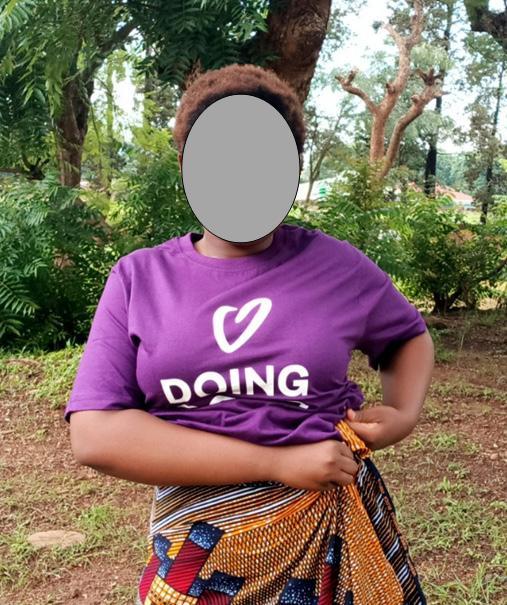
INADEQUATE—Toilets at the schoolBy Patrick Nditi Nyirenda:
Her stomach hurts. Suddenly, she feels her underwear and school uniform becoming wet.
Quickly, she removes her sweater and ties it around her waist, hoping to hide the stain from her male classmates who often mock girls going through her condition.
She runs to the toilets. Before entering, she claps her hands three times to check if anyone is inside.
A friend claps back from within, a signal that it is occupied.
– Advertisement –
Now desperate, she checks the remaining toilets. They are all taken. The only other facilities are for boys.
Anxious to understand what is happening to her body, she looks around. The nearby bush seems to be her only option.
She runs towards it, unaware that several male classmates are following her.
Inside the bush, she hurriedly wipes her underwear. When she looks down, she sees blood.
– Advertisement –
– Advertisement –
“It is blood,” she whispers in shock.
Before she can process what is happening, she hears laughter. She lifts her head and sees boys staring at her.
They surround her, teasing and chanting until tears roll down her face.
“Go away! Leave me alone!”
Filled with humiliation and anger, she chases them away like a wounded elephant surrounded by hungry hyenas.
That day, Shyreen leaves school early, missing six learning periods.
“Had I known, I wouldn’t have gone to school that day. It took four days for it to stop,” she recalls.
She remembers feeling unusual signs that morning but did not fully understand them.
Shyreen is a 14-year-old Standard 5 learner at St Dominic Primary School in Boma Education Zone, Mchinji District.
The school has an enrolment of 1,688 learners, 836 boys and 852 girls, all sharing only two functional toilets. There is no changing room for girls.
The surrounding bush has become an alternative sanitation facility, a reality that threatens the learning environment.
Shyreen’s experience reflects the hardships faced by many girls across Africa when they begin menstruation. Cultural beliefs, stigma and socio-economic challenges continue to hinder their right to education.
According to the World Bank, more than 300 million women worldwide are menstruating on any given day.
An estimated 500 million lack access to menstrual products and adequate facilities for menstrual hygiene management.
Effective menstrual management requires access to clean water, sanitation and hygiene (Wash) facilities, affordable and appropriate menstrual materials, accurate information and a supportive environment free from stigma and embarrassment.
Reports further indicate that poor menstrual hygiene management in Africa, largely due to inadequate Wash infrastructure and lack of affordable products, contributes significantly to school absenteeism.
For up to 60 percent of girls in sub-Saharan Africa, menstruation restricts daily activities.
In response to the crisis at St Dominic Primary School, Adezy Chirwa, Utricia and Ella Mwangala, MasterCard Foundation Scholars from United States International University–Africa (USIU-Africa) in Nairobi, Kenya, stepped in through their Community Action Project.
The MasterCard Foundation emphasises leadership, service and community engagement among its scholars.
Through their initiative, an additional toilet has been constructed at the school, increasing the number from two to three.
However, the need remains urgent.
The scholars have since appealed to well-wishers, development partners, non-governmental organisations and corporate sponsors to support the construction of more toilets and a dedicated changing room for girls.
Msachembe Ward Councillor Esnart Chitawo says the issue has already been included in the District Development Plan and the council is awaiting funding allocation.
“Once funds are available, we will build additional sanitation facilities,” she says.
Kastern Zimomo, the School Health and Nutrition Coordinator for the district, provides a broader picture of the situation in Mchinji.
MATEMBA—They should be easily accessible“We have 224 primary schools and 21 secondary schools. Out of these, only 64 have changing rooms and just 42 are functional,” Zimomo explains.
He adds that limited menstrual health information has allowed myths and misconceptions to persist, leading some parents to keep their daughters at home during menstruation.
Education and health rights activists Foster Lungu and Maziko Matemba respectively echo similar concerns.
Lungu believes parents carry significant responsibility in educating their daughters about menstruation.
“Menstruation should not be viewed as a problem but as a natural biological process. Parents must provide information and guidance so girls can manage themselves confidently and avoid emotional abuse from peers,” he says.
Matemba stresses that communities and government must ensure menstrual health materials are affordable and easily accessible.