Africa-Press – Malawi. Malawi’s economy is bleeding through trade, with new data showing that the country is buying far more from the rest of the world than it is selling—an imbalance that is worsening pressure on prices, jobs and the value of the kwacha.
Figures from the National Statistical Office (NSO) show that Malawi’s cumulative trade deficit for the 11 months to November this year widened by 20 percent to $2.4 billion (about K4.2 trillion), up from $2 billion (about K3.5 trillion) recorded during the same period last year.
The growing gap underscores deep structural problems in production, exports and foreign exchange generation.
According to the latest International Merchandise Trade Statistics, Malawi imported goods worth $3.27 billion (about K5.7 trillion) during the review period, up from $2.91 billion (about K5 trillion) last year.
In contrast, exports fell to $875.4 million from $882.8 million, showing that the country is exporting less while importing more—an unsustainable trend for a foreign-exchange-starved economy.
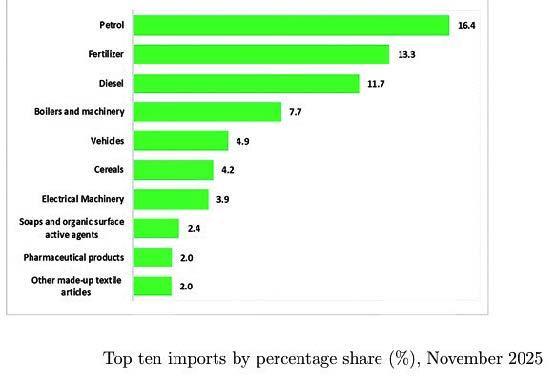
The imbalance worsened further in November alone, when the monthly trade deficit rose to $238.9 million (about K418 billion) from $228.7 million (about K400.6 billion) in October. NSO data show that Malawi continues to spend heavily on imports such as fuel, fertiliser and pharmaceuticals, while relying on a narrow and fragile export base dominated by tobacco, tea and pulses.
The report shows that exports in November 2025 dropped sharply to $109.4 million (about K191 billion), a 26.7 percent decline from $149.1 million (about K261 billion) recorded in November last year. At the same time, imports climbed by 15.6 percent to $348.3 million (about K609 billion) from $301.2 million (about K527 billion) in November 2024.
Economists say the widening deficit is not just a statistical problem but one that directly affects Malawians through rising prices, fuel shortages, job losses and persistent forex scarcity.
Mzuzu University economics lecturer Christopher Mbukwa said the figures reflect deep-seated weaknesses in Malawi’s economy. He said declining export earnings from key crops such as tobacco, groundnuts and tea have reduced the country’s ability to earn dollars, while heavy import dependence continues unabated.
Mbukwa also said changes in transaction patterns—particularly increased use of the kwacha instead of the US dollar in some trade deals—have worsened the recorded deficit and exposed the economy to further currency pressure.
Although Malawi’s foreign exchange reserves slightly improved to $526.8 million (about K921 billion) in October—equivalent to 2.1 months of import cover—economists warn this offers little comfort in the face of a widening trade gap.
Scotland-based Malawian economist Velli Nyirongo said the modest rise in reserves does not signal a recovery in export performance. He warned that without export diversification, value addition and stronger enforcement of export proceeds repatriation, the country will remain trapped in chronic deficits.
Export Development Fund (EDF) managing director Frederick Chanza said the core problem is Malawi’s failure to produce and process goods at scale. He said exporting raw commodities while importing expensive finished products keeps the economy locked in a losing position.
“The economy will remain trapped if we continue exporting raw materials and importing finished goods,” Chanza said, adding that EDF is investing in industrial parks, mining and high-value processing to address the imbalance.
The worsening trade figures come despite the government imposing an import ban in April 2025 on a wide range of goods—including maize flour, rice, fresh milk, fruits, vegetables, peanut butter, honey, meat products, bottled water and furniture—to promote local production.
Yet NSO data suggest imports remain stubbornly high, raising questions about enforcement, local supply capacity and the effectiveness of the policy.
Last year alone, Malawi imported goods worth $3 billion (about K5.2 trillion) against exports of $1 billion (about K1.7 trillion), resulting in a $2 billion (about K3.5 trillion) trade deficit.
For ordinary Malawians, the numbers translate into a weaker kwacha, higher fuel and food prices, reduced industrial activity and fewer jobs—signs that the country’s trade imbalance is no longer just an economic statistic, but a daily lived reality.
For More News And Analysis About Malawi Follow Africa-Press