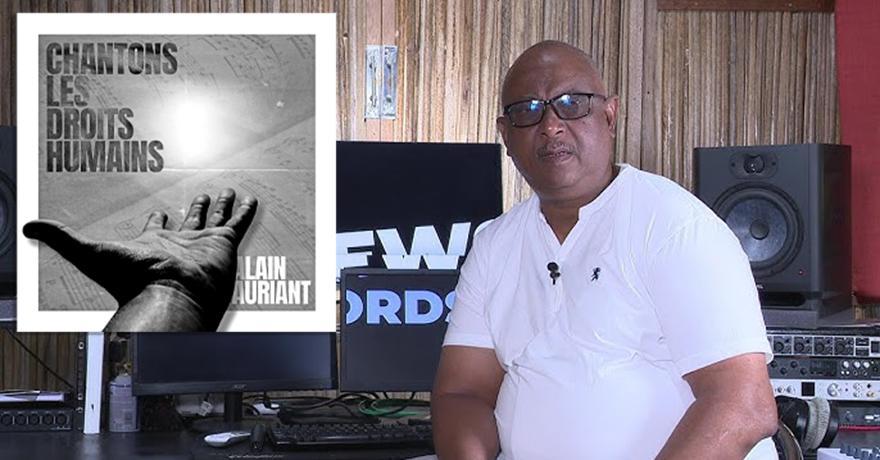
Africa-Press – Mauritius. Following his 2009 album DIDI (Déclaration Universelle des Droits de l’Homme), Alain Auriant returns with a new musical project: Chantons les droits humains (Let’s Sing Human Rights)—produced with the support of the National Human Rights Commission (NHRC) and the Indian Ocean human rights NGO DIS-MOI.
The album features ten songs in French, each dedicated to one of the ten fundamental human rights. More than just a musical creation, it is designed as an educational and awareness-raising tool. This collaboration also reflects the renewed commitment of the NHRC’s leadership to work hand-in-hand with civil society and artists to promote human rights.
After a career in the hospitality industry, Alain Auriant shifted his focus to social work through his NGO Sa Nou Vize in Rose-Belle—yet never stopped singing. A long-time member of Amnesty International and later DIS-MOI, he has been using music to advocate for human rights for over 17 years. Among his notable works are DIDI and Par mwa rasis pa pou pase. In 2005, he won the prestigious Kora Award—honoring Africa’s top musical talent—for his song Je t’aime encore, featured on the French Kiss compilation.
Reflecting on this new venture, Auriant explains that the idea began three years ago when the United Nations Development Programme (UNDP) in Mauritius commissioned him to write a song about human rights. That sparked the vision for a full album. “Each track addresses a core human right,” he notes, citing examples such as Grand-père, grand-mère, les enfants ont des droits (Grandpa, Grandma, Children Have Rights) and Jeunesse et droits de l’Homme (Youth and Human Rights), the latter inspired by the energy and commitment he witnessed among young people across the Indian Ocean islands.
Originally planned as an eight-track album, two additional songs were later added. The tragic Melrose prison incident in July moved him to compose the poignant bonus track Entre ces quatre murs (Within These Four Walls). Another song, Drwa de lom divan (Rights of the Human Being), originally written for UNDP, was re-recorded as a duet with Mario Justin.
Auriant stresses that his activism extends beyond music. Through Sa Nou Vize, he provides direct support to underprivileged families in his community. “When people live in poverty, their rights are violated,” he says. It was this reality that led his NGO to launch a nursery and preschool, recognizing that many children were failing the PSAC exam due to gaps in early childhood development. “We wanted to give them a stronger start in life.”
Even before the school, Sa Nou Vize had established after-school tutoring and, from its inception, a music workshop where children learn to play various instruments—fostering both creativity and confidence.
Auriant expresses deep pride in partnering with the NHRC and DIS-MOI for this project and hopes that during this festive season, people will take time to listen to songs that celebrate human dignity.
For Me Satyajit Boolell, Senior Counsel and Chairperson of the NHRC, this collaboration aligns perfectly with the Commission’s mission to promote and educate on human rights. “Traditional methods aren’t always enough,” he explains. “Human rights can seem abstract, legal, or distant—especially to young people or those disconnected from institutions. For those who’ve never had the words to name their experiences, a song can convey human dignity more powerfully than a long speech.”
That’s why, he adds, the NHRC champions human rights education rooted in real life, tailored to diverse audiences, and open to creative expression. “Human rights education doesn’t only happen in classrooms—it happens in families, neighborhoods, media, cultural spaces, and music.”
By supporting Chantons les droits humains, the NHRC fulfills its role in fostering innovative educational programs. “This partnership—between a committed artist, a civil society organization, and a national human rights institution—is exactly the kind of cooperation we advocate,” Me Boolell affirms. He hopes the album will be widely played—in schools, homes, and public spaces—to nurture a generation that is more aware, respectful, and united.
Kashif Imambaccass, Programme Manager at DIS-MOI, echoes this sentiment: “It’s an honour to collaborate with the NHRC and Alain Auriant on this project. Music is a powerful way to help people understand human rights—and this album covers them all.” He notes that Auriant, who joined Amnesty International in 2008, has been a core member of DIS-MOI since its founding.
The album was recorded live at Views Records studio in Rose-Belle by sound engineer Jean-Marc Constance, with contributions from musicians of Ottentik Groove, The Prophecy, and Jason Heerah.
Chantons les droits humains is available on all major streaming platforms, and a physical version—presented on a USB drive—is distributed through the NGO Sa Nou Vize.