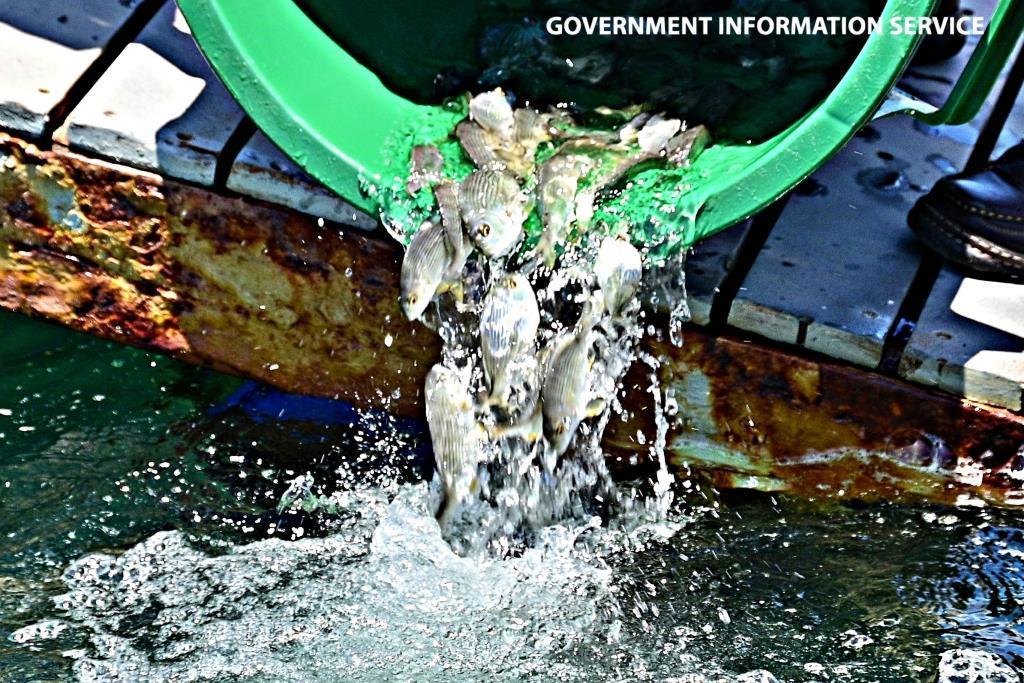
Africa-Press – Mauritius. The Albion Fisheries Research Centre (AFRC), operating under the aegis of the Ministry of Agro-Industry, Food Security, Blue Economy and Fisheries, released 10,000 sea bream fingerlings – locally known as ‘Gueule Pavée’ – into the Blue Bay Marine Park on Friday 20 February 2026.
This release forms part of the Centre’s ongoing Marine Ranching Project, which aims to replenish and strengthen fish populations within the lagoon ecosystem, while contributing to national food security objectives.
Some 50,000 sea bream fingerlings are also being released in other Marine Protected Areas around the island.
The Marine Ranching Project supports biodiversity conservation and ecosystem sustainability through the reintroduction of depleted species. It further seeks to rehabilitate degraded marine habitats by restoring key species that play a vital role in maintaining ecological balance.
Species targeted under the Marine Ranching Project include ‘Cordonnier’, ‘Gueule Pavée’ and mud crab.
The AFRC implements two marine ranching approaches: the harvest-type method and the recruit-type method. Under the harvest-type approach, wild fry is collected during the spawning season and reared in controlled pond environments until they attain suitable size for release. The recruit-type method involves induced spawning in hatchery facilities, with juveniles subsequently reared before being released into the lagoon.
Fingerlings produced by the AFRC have been released at several locations around the island, namely, Grand Gaube, Pointe aux Piments, Trou d’Eau Douce, Mahébourg, Bambous Virieux, Le Morne, Petite Rivière Noire, Albion and Poudre d’Or.
The silver sea bream holds significant commercial value in Mauritius and presents strong potential for aquaculture development. The species is able to reproduce under controlled hatchery conditions during the spawning season, thereby supporting sustainable stock enhancement initiatives.