What You Need to Know
The Duke of Edinburgh Award programme celebrated 129 young achievers in Mauritius, presenting them with Gold Awards at a ceremony attended by dignitaries including the President and Minister of Youth and Sports. The awards recognize the participants’ dedication to personal development through various challenges, emphasizing the importance of education beyond traditional classrooms.
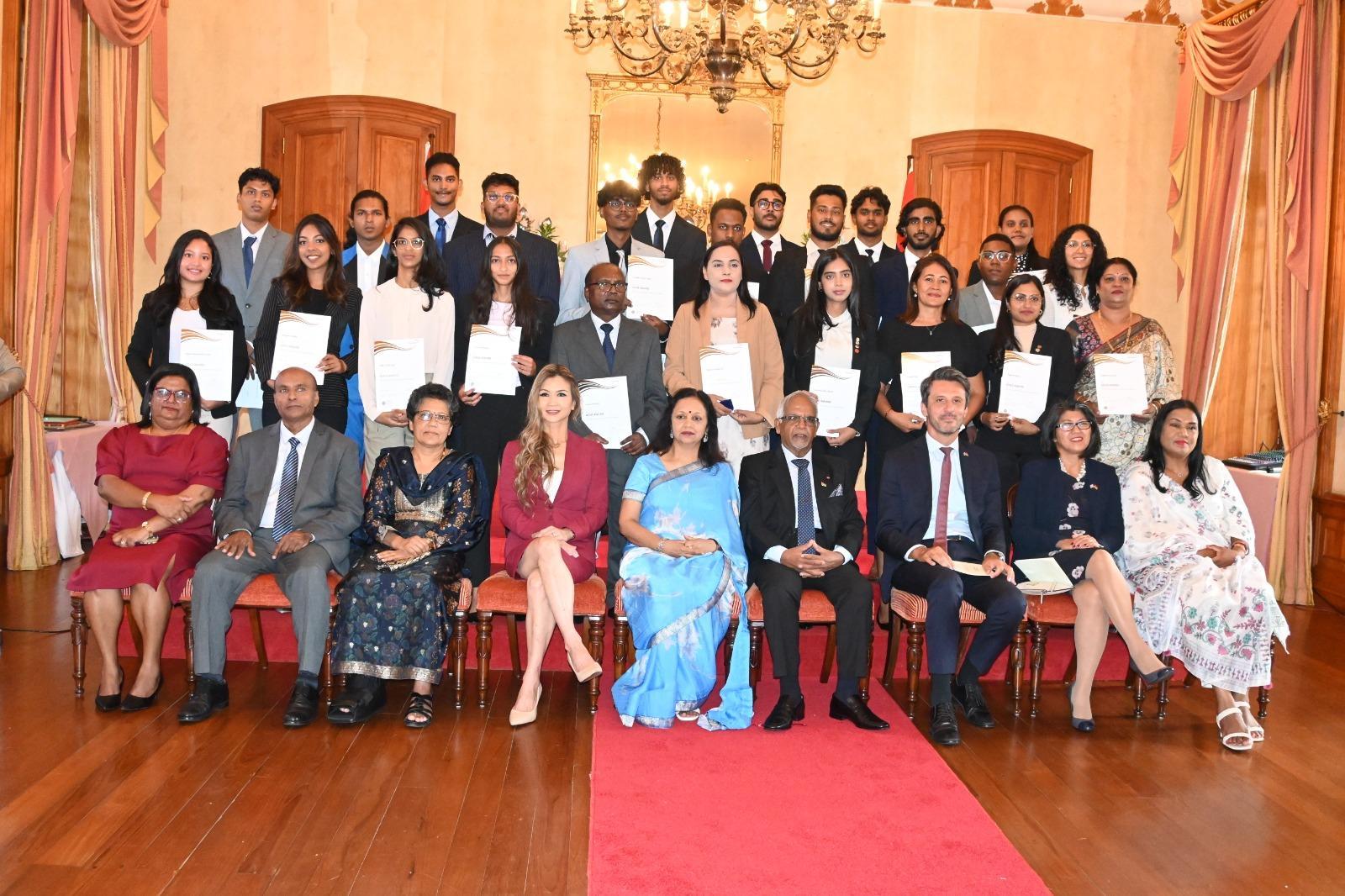
Africa-Press – Mauritius. A total of 129 participants of the Duke of Edinburgh Award programme were presented with Gold Awards and certificates, today, during a ceremony held at the State House in Réduit.
The awards were presented by the President of the Republic of Mauritius and Patron of the Duke of Edinburgh’s International Award-Mauritius, Mr Dharambeer Gokhool, alongside the Minister of Youth and Sports, Mr Darmarajen Nagalingum, and the Junior Minister, Mrs Eileen Karen Lee Chin Foo Kune-Bacha.
The ceremony was also attended by the British Deputy High Commissioner, Mr Goran Mandic, as well as families of the award recipients and other distinguished guests.
In his address, President Gokhool underscored that the Duke of Edinburgh’s Award is celebrating a double milestone this year: 70 years since its establishment in 1956 by His Royal Highness the late Prince Philip, Duke of Edinburgh, and 60 years since its launch in Mauritius.
He extended warm congratulations to the 129 recipients (67 girls and 62 boys) from 16 Award Centres, including public and private schools, universities and community groups. “Each of you has completed a demanding journey — through volunteering, learning new skills, participating in physical and adventurous training, and undertaking a residential project away from home,” he said.
The President also commended parents and families for their steadfast support, describing it as instrumental in laying a strong foundation for the participants’ learning and development.
Reflecting on the broader purpose of education, President Gokhool emphasised that it cannot be confined to the four walls of a classroom or reduced to textbooks, examinations and certificates. He highlighted that education must nurture critical thinking, ethical judgment, creativity, emotional intelligence, civic responsibility and informed agency.
In this context, he recalled the launch last year of the National Essay Competition and the Learn-AI School Innovation Challenge, initiatives aimed at encouraging learners to reflect on national issues, explore their identity as Mauritians and engage responsibly with technology in a globalised world. Both projects, he noted, proved highly successful and will be relaunched this year.
Concluding his address, President Gokhool reminded recipients that the human qualities cultivated through the programme — empathy, compassion, integrity, discipline, resilience, and moral and ethical judgment — cannot be reduced to any digital shortcut, certificate or medal. “In today’s age, life-long and life-wide learning are sine qua non conditions for surviving and thriving,” he stressed.
For his part, Minister Nagalingum congratulated the Gold Award recipients, stating that the certificates and medals symbolise the courage, determination, resilience and spirit of commitment demonstrated throughout their journey.
He emphasised that Mauritius and the world need young people who are strong, resilient, upright, bold and compassionate. Acknowledging the real challenges facing youth, he stressed that addressing them is a shared responsibility.
Minister Nagalingum also called on the awardees to act as ambassadors of the Duke of Edinburgh programme by promoting its values and encouraging other young people to participate, noting that the greater the youth engagement in the initiative, the more society as a whole will flourish.
Duke of Edinburgh’s International Award–Mauritius
The Duke of Edinburgh’s International Award–Mauritius is a non-formal education programme for young people aged 14 to 24 that promotes personal development, community engagement and life skills. Operating in over 130 countries, it offers three levels—Bronze, Silver and Gold—built around four sections: Voluntary Service, Skills, Physical Recreation and Adventurous Journey, with a Residential Project at the Gold level.
Through sustained commitment, participants enhance their resilience, employability, physical and mental well-being, and make a positive impact in their communities.
The Duke of Edinburgh’s International Award was established in 1956 by Prince Philip, Duke of Edinburgh, to promote personal development among youth. The programme has expanded globally, reaching over 130 countries, including Mauritius, where it has been active for 60 years. It encourages young people to engage in community service, develop skills, and participate in physical activities, fostering resilience and leadership qualities among participants. The awards serve as a recognition of their efforts and achievements in these areas.