What You Need to Know
The Ministry of Agro-Industry, Food Security, Blue Economy and Fisheries in Mauritius received updated hydrographic charts for the Balaclava Marine Park and Port Louis Fishing Reserve. These charts, produced from surveys by the Indian Navy, will enhance marine conservation efforts by providing crucial data for sustainable management and protection of marine ecosystems.
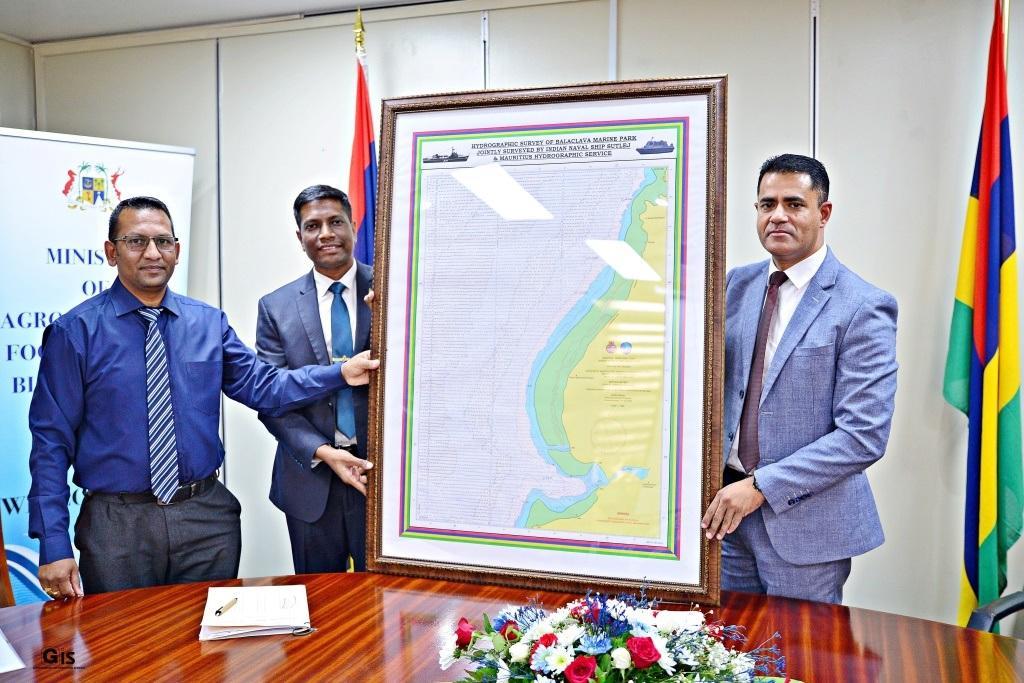
Africa-Press – Mauritius. In a key step towards strengthening marine conservation and management, the hydrographic charts of the Balaclava Marine Park and the Port Louis Fishing Reserve were officially handed over to the Ministry of Agro-Industry, Food Security, Blue Economy and Fisheries by the Ministry of Housing and Lands, yesterday afternoon, in Port Louis.
The ceremony was held in the presence of the Junior Minister of Agro-Industry, Food Security, Blue Economy and Fisheries, Mr Gilles Fabrice David; the Officer-in-Charge of the Mauritius Hydrographic Service (MHS) of the Ministry of Housing and Lands, Commander Poomari Kartik Muthukumar; and other personalities.
The updated charts follow multidisciplinary hydrographic surveys conducted in Mauritian waters by Indian Navy Survey Ship Sutlej between 29 September and 23 October 2025, carried out at the request of the Fisheries Division.
Covering both the Balaclava Marine Park and the Port Louis Fishing Reserve, the surveys produced detail bathymetric and navigational data to support sustainable management and protection of marine resources.
In his address, Junior Minister David emphasised that the MHS, under the Ministry of Housing and Lands, is responsible for nautical charting and providing hydrographic services to support development activities and scientific research in Mauritius’ maritime domain.
He highlighted the importance of surveys in Marine Protected Areas (MPAs) for mapping seafloor topography, ensuring safe navigation, and generating reliable data to guide conservation efforts and sustainable use of marine ecosystems.
The Junior Minister also explained that bathymetric surveys deliver precise information on seabed depths and features, enhancing understanding of marine habitats where fish and other species feed, live, and reproduce.
He added that the surveys help identify and monitor sensitive ecosystems such as coral reefs and seagrass beds, establishing a scientific baseline for ongoing monitoring of MPAs.
The initiative, he noted, supports evidence-based policy, protects fragile ecosystems, conserves biodiversity, and strengthens long-term stewardship of Mauritius’ marine environment.
For his part, Commander Muthukumar spoke about the operational collaboration between MHS and the Indian Navy Survey Ship Sutlej, including the deployment of Indian survey boats to address urgent requirements of the Fisheries Division.
He underscored the capacity-building benefits derived from the initiative, with fisheries officers receiving practical, hands-on training. He also referred to ongoing technical trials and forthcoming surveys aimed at further strengthening national hydrographic capabilities, while reaffirming MHS’s continued commitment to supporting the Fisheries Division.
Mauritius has a rich marine biodiversity, with numerous species relying on its coastal and marine ecosystems. The establishment of Marine Protected Areas (MPAs) has been a significant step in conserving these resources. The recent collaboration with the Indian Navy to conduct hydrographic surveys marks an important development in enhancing the scientific understanding and management of these vital marine environments. Accurate hydrographic data is essential for effective conservation strategies and sustainable use of marine resources.