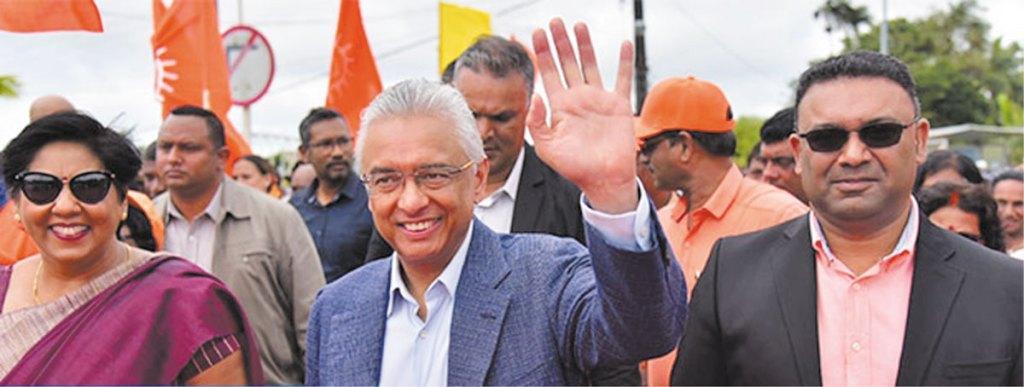
Africa-Press – Mauritius. This is the ‘talk of the town’, Suren Dayal’s appeal challenging the elections of Pravind Jugnauth, Leela Devi Dookun-Luchoomun and Yogida Sawmynaden ‘for having been obtained by reason of bribery, treating, undue influence, illegal practice and/ or any other valid reason” will be heard at the Privy Council next Monday at 2 p.m. Mauritius time. The mobilization of the opposition, as a whole, began a while ago. Some diaspora groups are, for example, calling for rallies outside the Privy Council during the hearing.
Other social media groups have started countdowns over Pravind Jugnauth’s impeachment. The political parties of the parliamentary opposition, for their part, remained extremely discreet about this ‘hearing’.
Apart from a few Facebook posts wishing good luck to the SurenDayal lawyers, there has been no official posting from the PTr. Just like the MMM and the PMSD for that matter who have remained silent on this ‘hearing’ until now.
This position bears witness to a wisdom that only long political experience can provide. Not only is the verdict of the Law Lords uncertain, but the consequences of this verdict are not necessarily a godsend for the traditional parties.
There are two possible outcomes to this judgment. Either SurenDayal wins his case, or he loses it. And these two issues open up different scenarios, radically different even, concerning the path towards the next elections.
In the first case, it seems certain that we are heading towards an election. But what elections? The invalidation of the election of Pravind Jugnauth should be accompanied by an invalidation to stand for re-election in the next elections.
But the Mauritian Constitution is not clear on a crucial question: is an invalidation and disqualification of a candidate only valid in one constituency, number 8 in this specific case, or in all constituencies?
Thus, a SurenDayal victory opens the way to the following two scenarios: Scenario 1: The election of Pravind Jugnauth and his two running mates is invalidated and the electoral commissioner must organize partial elections within the time limits granted by the Constitution.
In the event of invalidity of the unsuccessful candidates, the PM will not be able to stand again, which means that the MSM will have to field three new candidates.
But this does not necessarily mean the withdrawal of Pravind Jugnauth as PM since he could very well have one of his deputies from another constituency resign and be elected there in another by-election, which would allow him to return to the National Assembly and to take over the prime minister’s portfolio, and thus push back the deadlines for a general election as late as possible.
A scenario that involves risks, however, because the battle will be tough. The question of a candidacy of Navin Ramgoolam will arise in this case. Will he be a candidate for the partial of No 8 or for another possible partial, in direct competition with PravindJugnauth? This would be an opportunity for him to justify his ambitions to become a PM again.
By throwing himself into the arena and getting elected, he could also become Leader of the Opposition again. But this scenario carries enormous risks for him if he does not manage to get elected, and the PTr strategists will no doubt be warmer for a younger candidacy, in particular a youngster who is difficult to position himself at No 8 in his ambition to one day replace the son of the father of the Nation.
Such a scenario will thus be for him the occasion of a life-size test which will send a strong signal of his ability or his inability to become the next leader of the reds.
Scenario 2: The current leader of the MSM could very well be tempted to dissolve the National Assembly and call Mauritians to the polls in early general elections within a maximum of 5 months.
In this case, the question of the invalidity of a candidacy of the PM should not arise, since the term of office where his election was invalidated will be over.
The question will then arise of his ability to occupy the same constituency. But nothing will prevent me from changing constituencies. Moreover, it is rumored that No 7, his father’s former bastion and where Maneesh Gobin is losing ground, would be his preferred choice.
In this case, it becomes urgent for the opposition parties to finalize their alliance and propose a project to Mauritians for the next electoral contests.
Moreover, it is clear that the extra-parliamentary parties are currently in a particular turmoil, with the multiplication of meetings in the different constituencies.
They feel that it is now that things are being played out in reality; and that they must step up a gear if they wish to be more than mere extras whose only function is to break the bases of the traditional parties in the next general election.
There is obviously a third scenario, that of a defeat of SurenDayal. This scenario would be dramatic for the PTr. Navin Ramgoolam has constantly justified his position as leader of the PTr by the fact that the 2019 elections had been tainted with suspicions too serious for the MSM to have been able to win them legitimately.
All of the PTr’s rhetoric has revolved around this since late 2019, even forcing the MMM to submit election petitions when, according to insiders, they didn’t really want to.
These petitions have not been upheld by the courts, leading to the current situation where only the SurenDayal petition has passed the PrivyCouncil test. If SurenDayal is dismissed next week, Jugnauth will then have the opportunity to choose the timing of the next elections with complete peace of mind.
For More News And Analysis About Mauritius Follow Africa-Press