
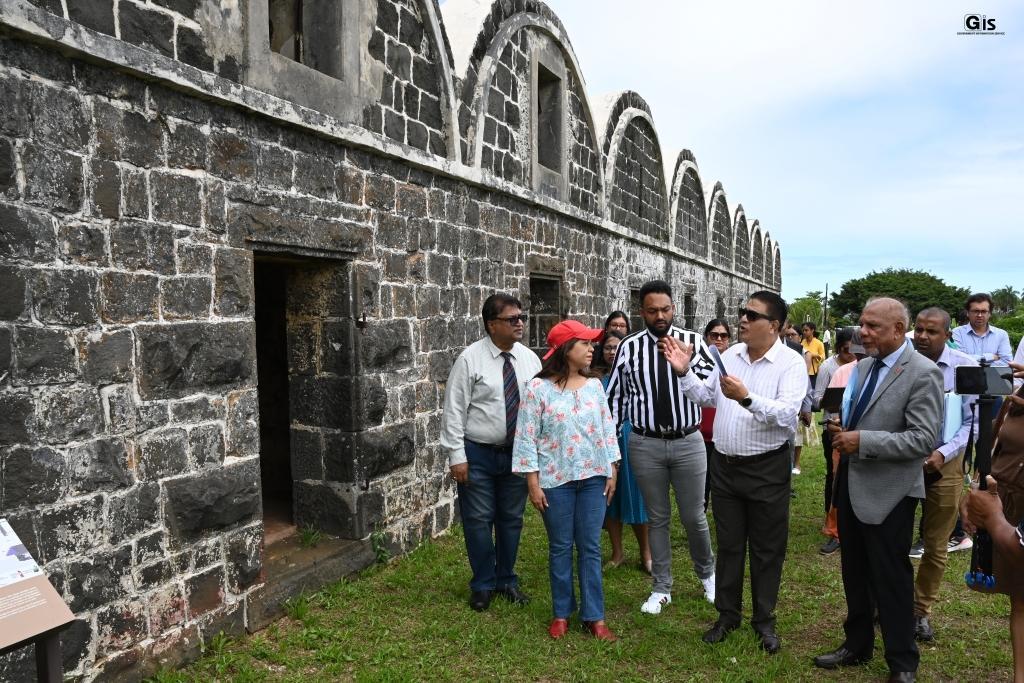
Africa-Press – Mauritius. The Minister of Arts and Culture, Mr Mahen Gondeea, conducted a site visit, yesterday, at the Old Labourers’ Quarters in Trianon, as parts of major efforts to recognise and safeguard the tangible and intangible heritage linked to indentured labour.
The Minister was accompanied by the Government Chief Whip, Ms Stéphanie Anquetil, and senior officials from his Ministry. They were joined by representatives from the Ministry of Housing and Lands, the Municipal Council of Quatre Bornes, and the Aapravasi Ghat Trust Fund, among others.
The Old Labourers’ Quarters, consisting of 15 chambers, were built between the 1860s and 1870s as part of the Trianon Sugar Estate. Unlike the typical dwellings of indentured labourers, which were often simple thatched huts or barracks made from earth, wood, cow dung, and cane straw, these quarters were constructed in stone. Recent archaeological research suggests that these barracks may have been reserved for Sirdars, or overseers.
Along with the Aapravasi Ghat, the Vagrant Depot of Grand River North West, and Antoinette Phooliyar in Barlow, the Old Labourers’ Quarters is considered one of the most significant sites of its kind. It is the only well-preserved and complete structure from that era.
In a statement, Mr Gondeea expressed his admiration for the building and the site, noting that it has the potential to host cultural and educational events, such as a Geet Gawai night. He affirmed that, with the collaboration of all stakeholders, efforts will be made to restore the site to its true historical and cultural value, as it is currently somewhat neglected.
The Minister also raised concern over the site’s lack of proper access, adding that a meeting with relevant authorities is scheduled for next week to address this issue and find an amicable solution.
For her part, the Government Chief Whip highlighted the extraordinary significance of the site as a symbol of the indentured labour experience. She highlighted the need to raise awareness of the site, not only among residents of Quatre Bornes but also among the community, and to revive this highly symbolic heritage location.