What You Need to Know
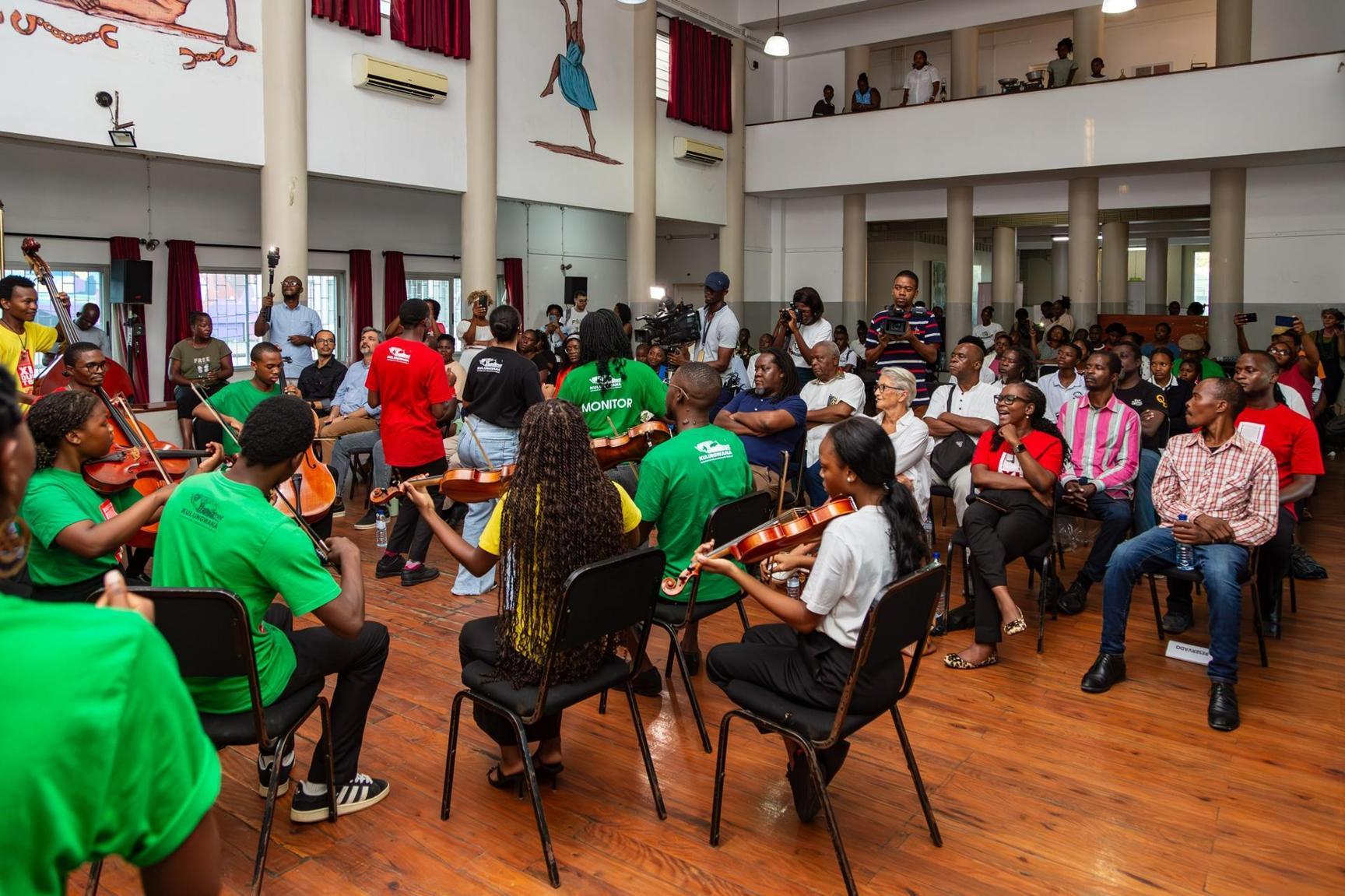
The Xiquitsi project has launched music training at the historic Ntsindya Cultural Centre in Maputo, aiming to enhance youth development through orchestras and choirs. This initiative, a partnership with the Kulungwana Association, provides local children with access to quality music education, fostering community engagement and talent development.
Africa-Press – Mozambique. Music education in orchestras and youth choirs is entering a new phase in the city of Maputo. The Kulungwana Association and the Ntsindya Municipal Cultural Centre have recently signed a partnership to expand training in these arts in the capital through the Xiquitsi project.
It marks the beginning of a new era for the Xiquitsi project beyond the so-called ‘city centre’. Music education now has a new space and a new approach.
The Xipamanine neighbourhood, with itshistoric Ntsindya Cultural Centre, is the new training hub for children, who will learn music as well as other activities that contribute to their development.
The iconic Ntsindya Cultural Centre will host choral, percussion and wind instrument classes promoted by Xiquitsi.
“And with this we intend to give back what was born in this very house. For those who do not know, this is a place where residents of Xipamanine used to meet and still meet, although less frequently, and we want to intensify this. We want our children to come here not only to play football, as they already do, not only to walk the streets, but to enter here with motivation and regularity, and in doing so to keep them away from other less suitable activities for their age,” explained Eldevina Materula, founder of Xiquitsi.
With this expansion, Xiquitsi reaffirms its purpose of identifying and nurturing talent in communities where access to instruments and specialised technical training is traditionally limited.
“This will allow children in this area not to have to travel long distances. It will energise the community, and we will offer this opportunity to access quality music education, with classes in choir, percussion and wind instruments. We also believe we will be able to revitalise the Ntsindya cultural centre,” said Henny Matos, Executive Director of Kulungwana.
Since its foundation, the Xiquitsi project has been a beacon in promoting classical music in Mozambique.
The Ntsindya Cultural Centre, previously called the “Centro Associativo dos Negros de Moçambique”, was a cradle of nationalist ideas and the struggle for independence. In 1949, Eduardo Mondlane, who was to become the first President of Frelimo, founded NESAM (Núcleo dos Estudantes Secundários Africanos de Moçambique) within the centre. NESAM was a group of intellectuals resisting colonial power. Its leaders included Mondlane, Joaquim Chissano and Armando Guebuza, among others. The activities were considered disruptive to the political and social order of the time, and the centre was closed down in 1965 by the police.
During the subsequent years, the building served as a health centre, a home for the Mozambican Writers’ Association, and finally became a warehouse for the shoe merchant “Rei do Chinelo” [King of the Flip-flop].
Citizens were infuriated by the degradation of this historically significant site. The centre was eventually reopened in 2006 by the President of the Republic, Armando Guebuza, and designated a Municipal Cultural Centre. It was named “Ntsindya”, which means “centre of attention” in Ronga.
Xiquitsi is a social transformation programme implemented by Kulungwana, made possible through sponsorship from the Embassy of Norway, KIA, MOZAL, MPDC, the Camões Institute, Montebelo Hotels, the Embassy of Ireland, Manica, AVM Consultores, Hollard Seguros, Portucel, and with support from World Vision, CCMC, Brithol Michcoma, Teatro Avenida, ProData, Vumba, Clubnet, Logos, Sumol Compal, Neoquímica, G4S, Savana, Dalima, Club of Mozambique, and Amigos do Xiquitsi.
The Ntsindya Cultural Centre has a rich history as a hub for nationalist ideas and the struggle for independence in Mozambique. Founded in 1949 by Eduardo Mondlane, it was a meeting place for intellectuals opposing colonial rule. After being closed in 1965, it served various purposes before reopening in 2006 as a Municipal Cultural Centre, revitalizing its cultural significance. Today, it stands as a beacon for community engagement and artistic development, now hosting the Xiquitsi music training program.