
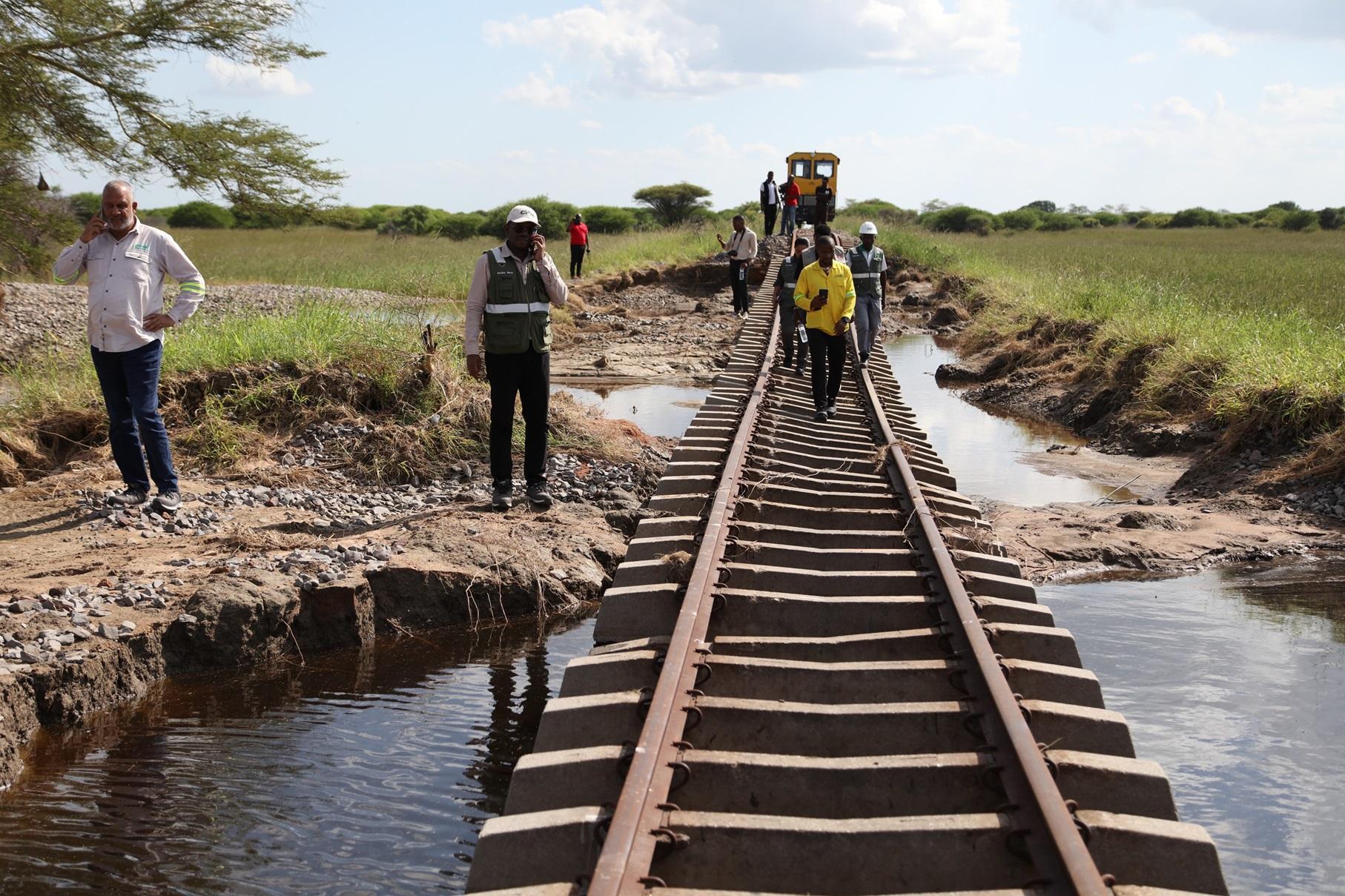
The publicly-owned Ports and Rail Company (CFM) has recorded losses exceeding 40 million US dollars following damage caused by heavy rains that affected the Limpopo, Ressano Garcia, and Goba railway lines.
According to Frederico Jorge, CFM engineering director, interviewed by AIM, during a technical assessment visit to critical points on the Limpopo line in Gaza province, the most critical situation is on the Limpopo line, which provides rail links between Mozambique and Zimbabwe, where kilometers of track have been submerged, extensive cuts have been made, culverts have been destroyed, and sections have been suspended, seriously compromising train traffic between the two countries.
This information was provided this week by the CFM’s engineering director, Frederico Jorge, in an interview with AIM, during a technical assessment visit to critical points on the Limpopo line in Gaza province.
“We are currently at a cost of approximately 40 million dollars, but this is not yet a precise assessment. We need the water level to recede to have a more accurate evaluation. The preliminary analysis reveals a scenario of significant destruction across several districts, particularly Magude, Chókwè, Mapai, and Chicualacuala, directly affecting rail traffic and the Mozambique-Zimbabwe international corridor”, he said.
“At the moment, we have about 22 kilometers of track submerged in the southern zone and, in total, almost four kilometers of suspended line. The damage is very extensive”, he added.
During the on-site inspection, the CFM technical team, composed of members of the company’s board of directors, directors, and engineers, traveled approximately 173 kilometers, from Maputo to the Mutasse area, the border between the districts of Magude and Chókwè, where one of the first visible cuts was identified.
“Here we have a cut extending for about 100 meters, but further on there are several others. At this moment we are not yet able to quantify exactly all the damage”, he explained.
The damage results essentially from the technical phenomenon known as ‘washaway’, caused by the excessive volume of water that exceeded the capacity of the existing hydraulic passages, placing the infrastructure in a critical situation, with destroyed embankments and suspended rails, requiring extensive interventions.
“We had a larger volume of water in the adjacent areas of the line. The hydraulic passage system did not have the capacity to handle it, and what happened was the washing away of the entire system that makes up the railway line, from the embankments to the substructure”, he said.
He said that the rehabilitation work could last between 30 and 40 days, being carried out in phases. Despite the severity of the damage, some of the railway material may be reused. “To avoid similar situations in the future, CFM advocates for the expansion and resizing of the hydraulic passages, taking into account changes in the region’s hydrology.”
In addition to the Limpopo line, the Ressano Garcia and Goba lines also experienced critical situations as result of the floods.
On the Ressano Garcia line, there were cuts at kilometer 15, in the area known as Daniel, and at kilometer 71, near a bridge, forcing the temporary suspension of trains.
Source: AIM