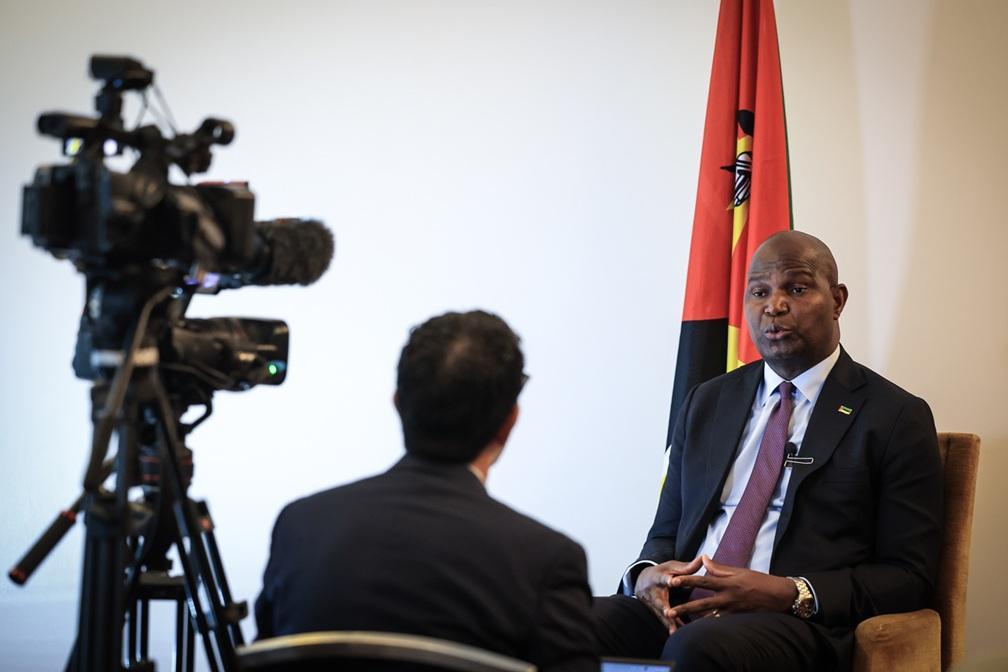
Africa-Press – Mozambique. Mozambican president Daniel Chapo has said in an interview with Lusa that he would not rule out a solution through dialogue to terrorism in the north of the country, because what Mozambique wants “is peace”.
“We will continue to work and, with this line of thinking, this possibility, there will be no problem in finding a solution. What we want is peace for the Mozambican people,” said Chapo in Porto, in an interview on Monday, on the sidelines of the summit with Portugal, in which he is participating this Tuesday.
“What we want is peace, and Mozambique is a nation with extraordinary experience in this area. If you remember, we had a war [between government forces and Renamo guerrillas] that lasted about 16 years, killed more than a million people, destroyed public and private property, but ended through dialogue. That is how the General Peace Agreements were signed in Rome on 4 October 1992,” he added.
He therefore argued that Mozambique has “experience in dialogue” to achieve peace: “Conflicts around the world, in one way or another, always end through dialogue (…) The most important thing is to resolve conflicts, so that there is peace and security to develop the country.”
He stressed that on the ground, the Mozambique armed forces (FADM), with the support of Rwandan forces, are working to combat terrorism, which he emphasised is “an international phenomenon”.
“But in the specific case of Mozambique, we need to understand the leadership, the motivations behind terrorism, who really finances it, the logistics, all these aspects. So that we can also find, perhaps, this path [of dialogue], so that we can find solutions,” he said.
“The situation has improved compared to what it was in the previous years. There were towns that were occupied, such as Mocímboa da Praia, Macomia, Quissanga, in the northern part of Cabo Delgado province. At the moment, the towns are free, we have managed to recover, but there are still some sporadic attacks on villages,” he explained.
He acknowledged that these attacks “end up causing mass displacement” of people, not only in Cabo Delgado, but also in attacks in recent weeks in the neighbouring province of Nampula: “Sometimes they cross the Lúrio River to Nampula, the region of Memba and Eráti, also causing mass displacement of our people”.
“In these displacements, the biggest challenge has been providing humanitarian assistance to the people. Fortunately, we have had the support of the international community and through this support we have been able to assist people, but as soon as the situation passes, they quickly return to their areas of origin,” Chapo concluded.
Gas-rich Cabo Delgado province has been the target of extremist attacks for eight years, with the first attack recorded on 5 October 2017 in the district of Mocímboa da Praia.
Around 25,000 people fled attacks by terrorist groups in the last days of November in the Mozambican province of Nampula, bringing the number of displaced persons in three weeks to almost 108,000, according to the International Organisation for Migration (IOM).
According to the latest report by the IOM, previously reported by Lusa, joint verification between the United Nations agency and local authorities “confirmed the displacement of 22,202 families,” totalling 107,784 people, between 16 and 30 November, who left the administrative posts of Mazua, Chipene and Lúrio, in the district of Memba.
In the agency’s previous assessment, based on data from 11 to 25 November, 82,691 displaced persons were registered, mainly from the region of Memba to that of Eráti, both in Nampula province.
The ACLED organisation estimates that the Mozambican province of Cabo Delgado recorded 14 violent events between 10 and 23 November, involving Islamic State extremists and causing 12 deaths, and warned of the worsening situation in Nampula.
According to the latest report by the Armed Conflict Location and Event Data Project (ACLED), of the 2,270 violent events recorded since October 2017, when the armed insurgency began in Cabo Delgado, a total of 2,107 involved people associated with Islamic State Mozambique (ISM).
These attacks have caused 6,341 deaths in just over eight years, according to the new report, reported by Lusa on 28 November, including the 12 victims reported in these two weeks of November.