By Genézia Germano
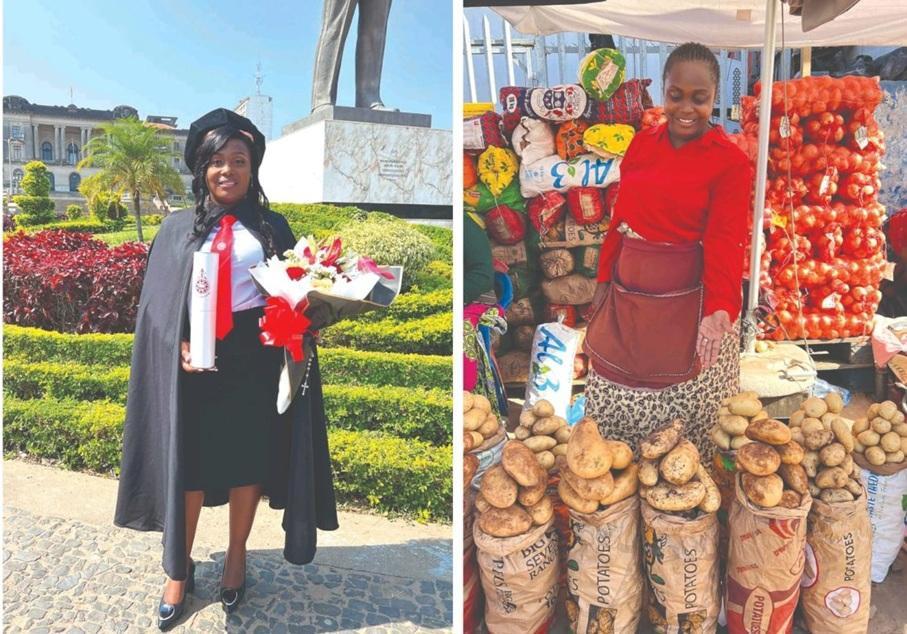
Africa-Press – Mozambique. At 32 years old, mother of two children and holder of a degree in Electrical Engineering, Mércia Fanheiro now occupies a street corner in the Patrice Lumumba neighbourhood, where she sells potatoes and onions to support her family.
At first glance, the activity reveals little about the academic journey she carries, but behind the makeshift stall lies a story marked by dedication, commitment, and persistence.
Mércia completed her degree in Electrical Engineering at the Polytechnic University, after a failed attempt to study Meteorology at Eduardo Mondlane University.
The young woman explains that she abandoned the first course due to administrative hurdles. “I went there to try to finish the course, but there was a lot of bureaucracy. In trying to recover my records, they ended up losing my documents, and I gave up,” she recounts.
The solution was to look for a private institution, where she completed her studies in 2025. Her academic effort earned her recognition. Mércia was named the best student of the course and received a monetary prize from a travel agency, which previously offered trips to Johannesburg to the best students. “They decided to give the prize in cash instead, because students complained about the lack of support for accommodation and food. That’s how I received the cheque,” Mércia Fanheiro explains.
Her defence of the final [graduation] project coincided with a sensitive period in the country, marked by movement restrictions. Even so, Mércia did not miss her academic commitment. “I defended my project on one of the days when it was declared that no one should leave home after seven o’clock. I left home at five in the morning to get to the city and defend my final project,” she recalls.
Entrepreneurship to stay afloat
Having completed her degree, the expectation of joining the formal job market gave way to frustration. Mércia states that the lack of opportunities pushed her into small-scale trading. “I started my business after my defence, because the job market is always closed. In life, we have to look for other opportunities,” she says.
The decision to sell food products came as a way to keep her mind occupied and avoid the emotional strain caused by prolonged unemployment. “It’s frustrating to study and wake up every day with nothing to do. We just sit there thinking, ‘What did I study for?’” she states.
For Mércia, staying active was a matter of psychological survival. “To avoid falling into worse situations, we look for something to keep our minds busy,” she says. With a small loan, she started the business at the corner where she currently works.
She recognises that the income is limited and the business environment competitive.
“In a country where everyone sells, those who should buy are also traders. One day they don’t buy, the next they do,” she observes, emphasising that persistence is essential. “The important thing is to keep your head up and have faith that things will work out.”
The entrepreneurial spirit is not new to her. Mércia grew up in a low-income family where business always guaranteed survival. “My parents were traders. They sold sweets and popcorn, then moved on to food products. That’s how they paid for my schooling,” she recalls. Later, her father got a job, which improved the family’s living conditions.
Despite this, Mércia admits she never imagined herself in trade. “It was never my strong point, but the lack of jobs forces us to reinvent ourselves.” Looking to the future, the engineer outlines a goal aligned with her training. “If one day I manage to open an electrical supply store, I will, in a way, be working in the area I studied,” she states.
The project includes selling electrical materials, offering installation services, and eventually supplying large buildings. “Even if it’s not in a big company, I will be employing other people and contributing,” she adds. Mércia advocates for greater recognition of women in technical fields. “In a country like this, women who study Engineering should be highly valued, because it is a challenge,” she argues.
Inspired by her aunts, trained in Industrial and Electronic Engineering, she found in them an example of overcoming challenges in a male-dominated sector. Although she dreamed of studying Medicine as a child, she ended up following a different path due to fear of dealing with blood and accidents.
The exact sciences became her natural refuge. “I’ve always had an aptitude for Mathematics, Physics, and Chemistry. There was nothing in Chemistry I didn’t understand,” she says.
Today, between her market stall and her diploma kept safe, Mércia Fanheiro represents many young Mozambicans who, despite their academic training, face the harsh reality of the job market. “Not everything we dream of comes true. If one day a decent job appears, I will be grateful,” she concludes.
Source: Domingo