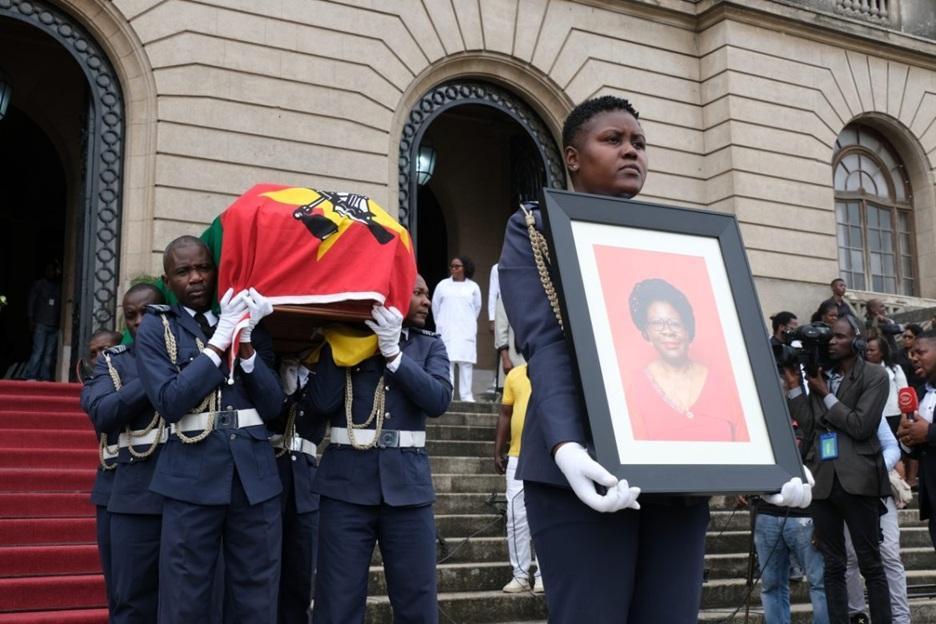
Africa-Press – Mozambique. Mozambique’s late Prime Minister, Luisa Diogo, who died a week ago, was a national, regional and international reference point, and her departure “has left a wound in our collective memory”, declared President Daniel Chapo on Friday.
Giving the eulogy at Luisa Diogo’s funeral, in Maputo City Hall, Chapo asked “How can we accept that she has gone, if the construction of the state and the stability of our institutions still need her excellent contributions? How can we accept that Luisa Diogo is no longer among us, when we still had so much to learn from her?”
Her life “was service, it was State, it was history, it was witness”, he declared. Her life “was not just a life, it was work, it was competence, it was dedication, it was solidarity, it was love for one’s neighbours, it was a sense of mission, it was an inspiration for all Mozambicans”.
When she studied economics at university, said Chapo, “she fell in love with the subject, not as theories, but as a tool to assist in the construction of a prosperous and inclusive Mozambique”.
The President recalled that, during her university training, Diogo was recruited into the army, and did her military service, demonstrating “discipline, patriotism and willingness to defend the motherland”.
Chapo recalled that Diogo was often absent from her family because of the work she was doing for the Mozambican state. “This is the silent price of public service”, he said, “service for the Mozambican people. When the motherland called, she always replied, with total commitment and sense of mission”.
Chapo said that Diogo’s rise in government service to deputy minister, minister and eventually prime minister, “happened at a time when the country was facing profound challenges, led by President Joaquim Chissano, when public service required not just titles, but character, responsibility, competence and meritocracy”,
In this period, Mozambique had embarked upon far-reaching economic reforms. “This was a time when one system was ending and another was beginning”, said Chapo, “a time of difficult choices and historic transitions”.
During these transitions, “Luisa Diogo was there, helping Mozambique to remain standing, when it was easier to fall”.
Before the era of political pluralism “and when the emancipation of women did not have the weight it has today, Luisa Diogo already stood out because of her competence, her discipline, her dedication, and her sense of mission”, said Chapo.
Diogo led the Chissano government’s successful negotiations for debt relief, notably through the HIPC (Heavily Indebted Poor Countries) debt relief initiative.
“Where many saw numbers, Luisa Diogo always saw people”, Chapo recalled. “Where many saw accounts, she saw the future of Mozambique. Where many saw constraints, Luisa Diogo saw paths”.
In her work, inside Mozambique and abroad, she fought for gender equality and for the empowerment of women. “She did not only speak of emancipation, but she practised emancipation, opening doors through her own exemplary journey”, added Chapo.
The Mozambican people are bidding farewell to Luisa Diogo “with gratitude, respect and pride”, said the President, “because she was a woman who served, without serving herself, and who marked history without any need for exhibitionism”.
“Her work remains with us, it remains in the institutions she helped to build, it remains in the credibility she helped consolidate”, Chapo concluded. “It remains in the women she inspired. Luisa Diogo remains in the soul of our people”.