Africa-Press – Mozambique. Today (May 3) is World Press Freedom Day. In the Portuguese-speaking African Countries (PALOPs), Angola is clearly countering the downward trend in the World Press Freedom Index, while Mozambique is falling slightly and Guinea-Bissau is in free fall.
The World Press Freedom Index is authored by the non-governmental organisation (NGO) Reporters Without Borders (RSF). Published today, it indicates that Angola, which last year was the worst ranked of the PALOP countries on the press freedom map, rose 21 positions to 104th place (125th in 2023).
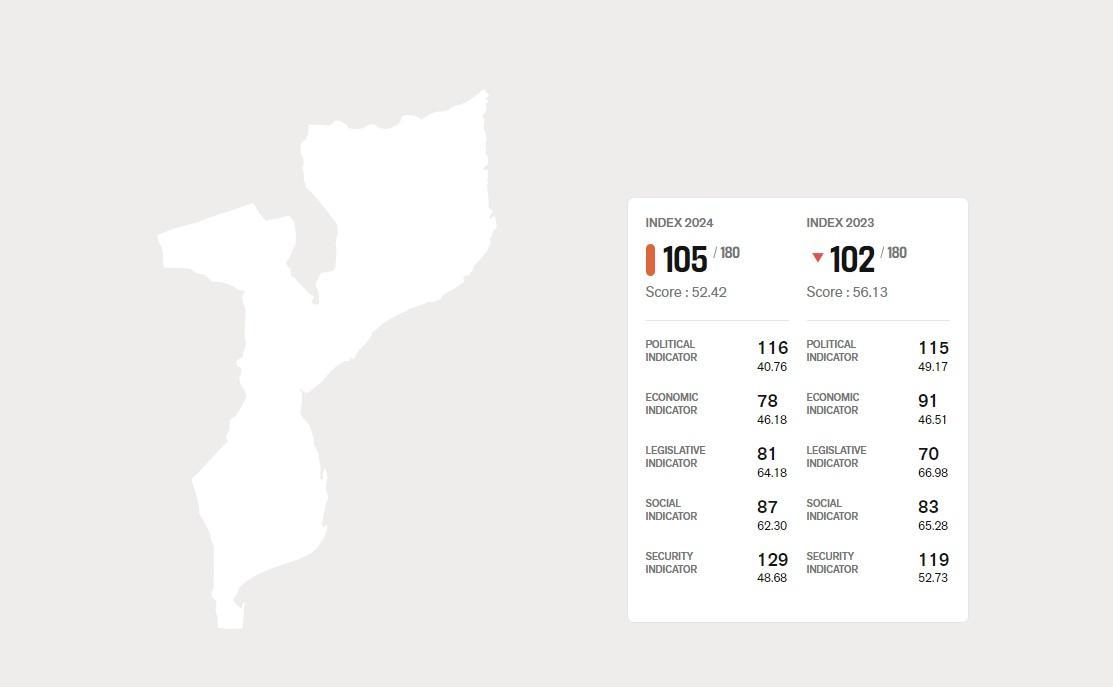
Mozambique registered a drop of three positions, now occupying 105th place in the index.
In 92nd position is Guinea-Bissau, which dropped 14 positions compared to the previous year. Equatorial Guinea dropped seven places to 127th position, and Cape Verde also slipped, to 41st position (33rd in 2023). São Tomé and Príncipe was not evaluated.
Election periods: Freedom threatened in Africa
RSF says that journalists and media outlets are being subjected to increasing violence from politicians and supporters in sub-Saharan Africa, especially during election campaigns.
More than 8% of African countries are now marked in red in the 2024 World Press Freedom Index. RSF highlights Nigeria, where, despite the country rising 11 places to 112th, around 20 journalists were attacked in early 2023, and Madagascar (100th), where ten journalists were targeted during pre-election protests.
In the Democratic Republic of Congo (123rd), the detention of journalist Stanis Bujakera, awaiting trial on an allegedly “trumped-up” charge, is given as an example of politicians’ frequent attempts to intimidate the media.
In other cases, the NGO highlights, politicians try to instrumentalise social communication by creating their own platforms, as in Senegal (94th), DR Congo and Nigeria, or, in the case of Togo, use regulators to take “arbitrary and disproportionate measures” against journalists and employers.
Election periods: Greater control and restrictions
Zimbabwe (116th), Gabon (56th) and Guinea-Conakry (78th) rose in the Index, but RSF says that political authorities in those countries tightened control over news and information in the period before the elections, arbitrarily shutting down the Internet, expelling foreign journalists and interfering with radio and television broadcasts.
Restrictions are often extended to foreign media, as several Sahel countries have done to foreign, mainly French, media outlets such as France 24, RFI and TV5 Monde.
Niger (80th place), Burkina Faso (86th) and Mali (114th) fell in the index as a result of the measures adopted to obstruct the work of journalists by military junta that took power through coups d’état.
Journalists who criticised the continued rule of the president of Tunisia (118th), in power since 2019, were detained and interrogated, as also happened in this northern African country before the 2010/11 revolution.
For More News And Analysis About Mozambique Follow Africa-Press