What You Need to Know
A new school initiative inside Nampula prison allows community students to attend classes alongside inmates, aiming for rehabilitation and social inclusion. While some students embrace the experience, concerns about their safety and psychological well-being have sparked public debate, with calls for reevaluation from educators and specialists.
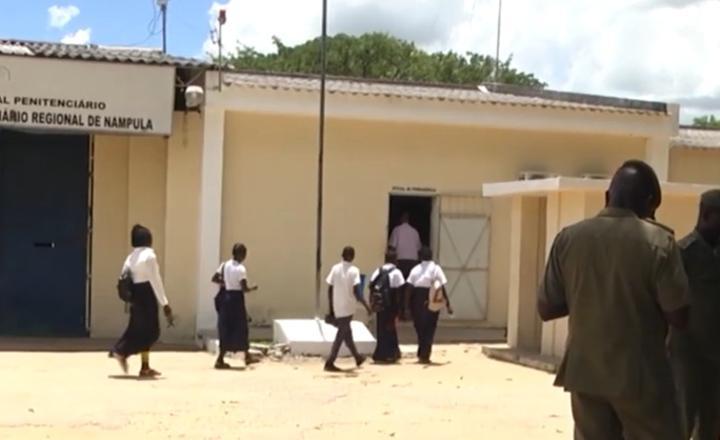
Africa-Press – Mozambique. A school has been established inside the Nampula Northern Regional Penitentiary, where inmates and underage students from the community attend classes together.
The initiative is presented as a commitment to inmates’ rehabilitation and social inclusion, giving them access to education and opportunities for reintegration.
However, concerns about the physical and psychological safety of the young students from the community are generating controversy and dividing opinions.
It is an unusual scenario that is already sparking public debate in Nampula. Within the walls of the Nampula Northern Regional Penitentiary, a space traditionally associated with the deprivation of liberty has also been transformed into a classroom. Here, young secondary school students from the community sit side by side with inmates, sharing desks, notebooks, and the same goal: learning.
For many students, the experience has been approached with normality.
“Is it normal for you?” asks the journalist.
“Yes,” responds one student. Another adds, “Studying is very important for us.”
“Okay. And studying alongside inmates, how does that feel?” they are asked.
“I feel fine,” the boy replies.
On the other hand, the government defends the measure as innovative and necessary. The Minister of Justice, Constitutional and Religious Affairs, Mateus Saize, during a visit to the prison, considers education a fundamental instrument for the social reintegration of inmates.
“We have inmates studying in this secondary school, and we also have the general student population. It is an official, formalised school, and once people complete their studies, they will receive certificates,” said the Minister of Justice.
When asked by journalists about the coexistence of minor students with incarcerated students—“But there it’s all mixed, inmates and students…”—the Minister retorted:
“We are in a resocialisation centre. Being detained is not the end of someone’s life. Some have been convicted, others are in pre-trial detention. We must consider that the fundamental rights of every citizen must be respected.”
Despite this, outside the prison walls, the atmosphere is one of concern. Psychology specialists and civil society members warn of possible emotional impacts on young people, arguing that close interaction with inmates could negatively influence psychological development.
“We are not saying that we are marginalising the inmates. It is not a matter of marginalising a certain group, but rather a matter of protecting the rights of the child—safeguarding their physical and psychological integrity. Therefore, we appeal to the relevant institutions to urgently examine this situation, not just as an infrastructure issue, but also as a situation that could create medium- and long-term consequences for the students of this school.”
The provincial director of education, William Tunzin, assures that all safety conditions have been created, confirming that students study in a controlled environment.
“We do not have very detailed information about who is present in the school. What we do know is that the school is located close to, but not inside, a prison. Therefore, we believe that the children are safe up to now.”
William Tunzin also explained, in another report presented by Focus Televisão, that this initiative aims to bring education services closer to communities.
“Everyone has the right to education. That is why we extend our services to all parts of the country where there is demand for them,” Tunzin concluded.
However, this argument does not convince the National Association of Teachers (ANAPRO), which rejects the decision and demands the immediate removal of students from the school.
“We want the central government, in coordination with the provincial government, to rethink a strategy for allocating these children—who were placed [in this school] abusively alongside some individuals who could be considered delinquents,” said a ANAPRO representative Marcos Lima.
“These children should have a proper physical and educational environment, like so many other Mozambican children across the country. These children are not convicted; they are normal children. They are not criminals. Children should not be mixed with prisoners just to guarantee their right to education,” Lima insisted.
Between expectations and concerns, the school installed in the Nampula penitentiary raises profound questions about the limits and possibilities of inclusive education. It is an experiment that could pave the way for social reintegration or expose new challenges in a context where freedom and incarceration coexist.
The establishment of educational programs within prisons is not a new concept, as many countries have explored similar initiatives to promote rehabilitation and reduce recidivism. In Mozambique, the integration of education within the penal system reflects a growing recognition of the importance of providing inmates with opportunities for learning and reintegration into society. However, such measures often raise ethical questions regarding the safety and well-being of young students who may be exposed to potentially harmful environments.
In recent years, Mozambique has faced challenges in its education system, including access and quality of schooling. The decision to allow community youth