What You Need to Know
A research team has discovered four new species of chameleons in Mozambique’s sky islands, emphasizing the urgent need for conservation. These unique reptiles are already at risk due to severe forest loss from agricultural practices, with estimates suggesting that 80%-90% of their habitat has been destroyed. The findings underscore the importance of protecting these ecosystems.
Africa-Press – Mozambique. Tropical rainforests are known for their unique biodiversity, with species found nowhere else on Earth. But nearly 30% of tropical rainforest has been destroyed or has become seriously degraded since 1990. Many of these forests have not been fully explored for their biodiversity. This means that the world may be losing species before they are even discovered by modern science.
In Africa, forest loss is rapid; about 25% of the continent’s tropical forest has been lost since 1990, against a backdrop of incomplete knowledge of where the biodiversity is located.
Greatly lagging in this respect are the “sky islands” of northern Mozambique: isolated granite mountains that rise sharply out of the savanna plains. They were left standing when softer rock around them gradually eroded, and can be as high as 3,000 metres elevation. Because they rise so steeply, the sky islands attract clouds and rainfall, feeding moisture to the tropical rainforests on their slopes within an otherwise arid terrain. Isolation has allowed unique species to evolve on each mountain, such as geckos, rodents, fishes, crabs, frogs, butterflies and bats.
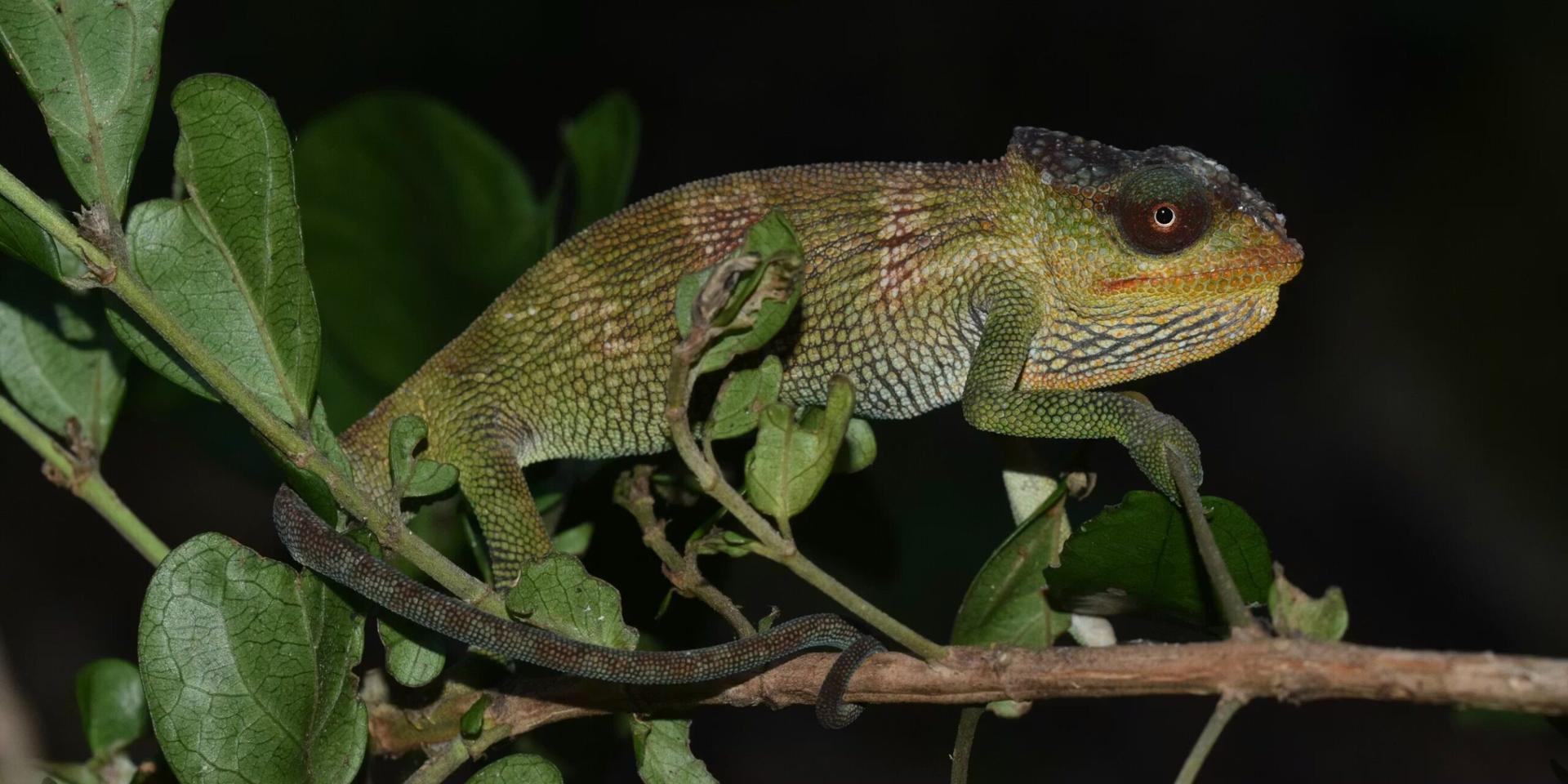
From 2014 to 2018, a research team led by fellow herpetologist Werner Conradie and myself explored these sky island forests to catalogue the species of reptiles found there. We found that each sky island forest is home to a previously unknown species of chameleon within the genus Nadzikambia (forest-dwelling “sylvan chameleons”).
Unfortunately, these chameleons are already at risk of extinction due to the heavy slash-and-burn clearing of the forests, the only place they can call home.
We’ve described these new species, choosing four names to highlight pioneering women scientists whose work inspired us to strive towards new discoveries, but also to call attention to the losses of their forest habitat.
Hunting for chameleons
Over the course of several years, we explored four of Mozambique’s sky islands – Mount Namuli, Mount Inago, Mount Chiperone and Mount Ribáuè – with the aim of cataloguing all reptiles but also in the hopes of finding new species of chameleons. This was because a species of sylvan chameleon had been discovered on one of these mountains during the 1960s, but they were not known from any other mountains.
However, chameleons can be very difficult to find, given their ability to remain camouflaged against the background coupled with their slow movements. They are more easily spotted at night while they are sleeping, as they stand out against the vegetation when illuminated by a strong beam of light. Sylvan chameleons are even more difficult to spot than others, as they usually perch high in the thick forest canopy – tens of metres up.
The search meant dealing with some tough conditions: a long, arduous trek up the hot, arid slopes to reach the forest high up the mountain. Establishing a remote base camp was essential. All food, clothes and gear had to be packed into the camp, and we didn’t know how long it would take to find any animals.
At each of these mountains, we surveyed every night for chameleons – no trails to follow, no GPS signal to guide us, no cell phone signal to call for help.
Sometimes we were lucky and found chameleons on the first or second night. At other mountains we were not so lucky, with fruitless searches making it necessary to return another year.
Eventually these mountains revealed their secrets and we discovered four new species of sylvan chameleon, one on each of the four mountains.
We don’t know how big their populations are, but we assume they are in decline. Most of their habitat has been destroyed by forest clearing to make way for agriculture, with increasingly rapid losses in the last decade. We estimate that in some cases, 80%-90% of their habitat has been destroyed.
When parts of an ecosystem are lost, the whole becomes unstable and is eventually lost.
Choosing names for the new species
To highlight their predicament, we have described and named these chameleons and have forecast that three of these species are at high risk of extinction.
In particular, we highlight Nadzikambia goodallae from Mount Ribáuè. This species has been named in honour of the distinguished scientist Jane Goodall, whose own study species, the chimpanzee, is under similar pressures from loss of its rainforest habitat.
We also honour the renowned discoverer of the structure of DNA, Rosalind Franklin, by naming the species from Mount Namuli as Nadzikambia franklinae. The use of DNA data from these chameleons was essential to confirm them as new species.
We have dubbed the species from Mount Inago as Nadzikambia evanescens, meaning “vanishing” in Latin, acknowledging the state of the forest destruction.
The final species, Nadzikambia nubila, is named for the cloudy aspect of Mount Chiperone. This species has a lower risk of extinction given that the local community view the forest as sacred, and say it should be protected.
This latter case is significant, as it demonstrates that wholesale destruction of these forests is not an essential trade-off for local people to thrive. If encouraged and supported, community support and buy-in can be a solution to protect biodiversity in these sensitive ecosystems.
Mozambique’s sky islands are isolated granite mountains that support unique biodiversity, including various species of reptiles. These ecosystems have evolved in isolation, leading to the development of species found nowhere else. However, rapid deforestation and habitat destruction threaten these unique species, highlighting the need for conservation efforts to protect them from extinction. The recent discovery of new chameleon species underscores the urgency of addressing these environmental challenges.