
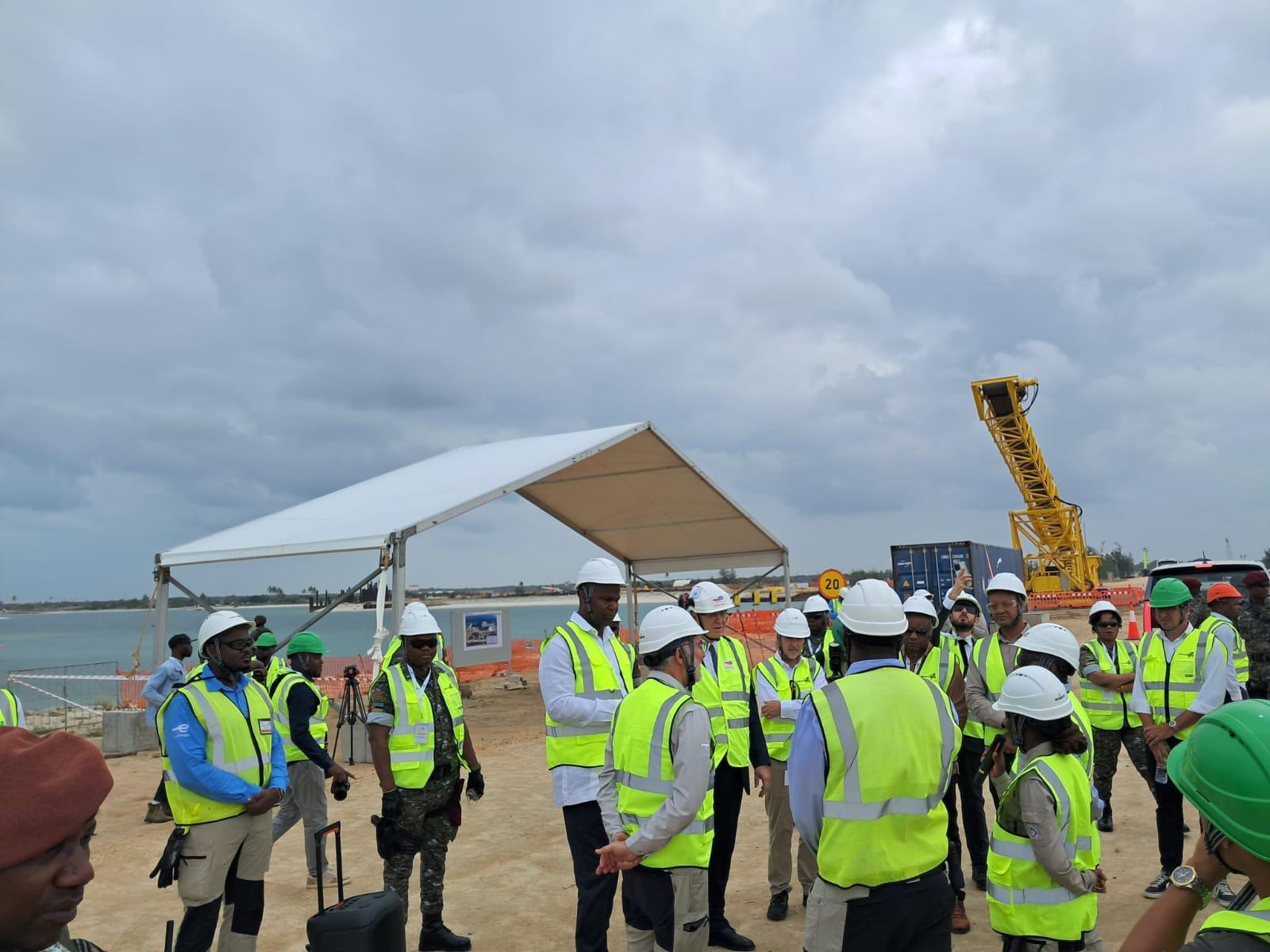
The President of Mozambique, Daniel Chapo, said today that the “prejudice” that Cabo Delgado is “only terrorism” must end, highlighting the resumption of works on TotalEnergies’ gas megaproject in Afungi.
“There is this prejudice that in Cabo Delgado it is only terrorism. When you mention Cabo Delgado, terrorism immediately follows. It was necessary to show the world, the country, the region and the continent that in Cabo Delgado, in Afungi, the work has indeed resumed,” Chapo said at a press conference.
The Head of State and the President of TotalEnergies, Patrick Pouyanné, visited the Afungi complex in Cabo Delgado today to officially relaunch the project, almost five years after its suspension, following the French oil company’s decision, as leader of the Mozambique LNG consortium, to invoke the ‘force majeure’ clause due to terrorist attacks in the region.
The project is valued at US$20 billion (€17.5 billion) with the capacity to produce 13 million tonnes per annum (mtpa) from the offshore Rovuma Basin, now once again under development after TotalEnergies lifted the ‘force majeure’ in October, citing improved security conditions.
“The meaning is very simple. We know very well that when the ‘force majeure’ was invoked, the reason given was terrorism and security in Cabo Delgado (…) At this moment, if I were to say in Maputo, sitting here, that there are 5,000 workers in Afungi, no one would believe it. We were here together, witnessed the equipment, and saw the simultaneous progress on the construction fronts,” Chapo pointed out.
For Patrick Pouyanné, security was the sole reason for the suspension, and today’s event addresses doubts he heard from investors in India this week about whether the Afungi project “was real or not.”
“This day is important. Yes, the project exists. You can see the progress,” said the TotalEnergies President, considering normal the audit decided by the Government on the costs caused by the suspension, confirming that this four-and-a-half-year period will not count towards the concession time attributed to Area 1, and that the priority is to move forward with the project, analysing those costs later.
The forecast announced today is to reach 17,000 workers during the complex’s construction phase, with the first export of Liquefied Natural Gas (LNG) scheduled for 2029. Daniel Chapo assured that opportunities for young people are in Cabo Delgado.
When questioned about guarantees for the future, the President stated that “there are objective conditions in terms of security.”
“We are doing everything possible to ensure the project does not stop again,” Chapo affirmed, underlining that currently, unlike in 2021, “there is no village in any district of Cabo Delgado province that is occupied.”
“This is a clear sign that security has improved in Cabo Delgado, although there have been sporadic attacks on villages. But there has also been extortion, where people are sometimes kidnapped and ransom demanded,” the President added, assuring that the current situation “is better than what we faced before.”
TotalEnergies indicates that the first delivery of LNG from the first production train to be installed in Afungi has been postponed from July 2024, as initially planned before the halt, to the first half of 2029.
Mozambique has three approved megaprojects for the development of LNG reserves in the Rovuma Basin, ranked among the largest in the world, off the coast of Cabo Delgado. These include the TotalEnergies project and another by ExxonMobil (18 mtpa), valued at US$30 billion (€26.1 billion), awaiting final investment decision, both on the Afungi peninsula.
There is also the Italian company Eni’s project, which has been producing around seven mtpa since 2022 from the floating Coral Sul platform, set to be doubled from 2028 with the second Coral Norte platform, in an investment of US$7.2 billion (€6.2 billion).
Source: Lusa