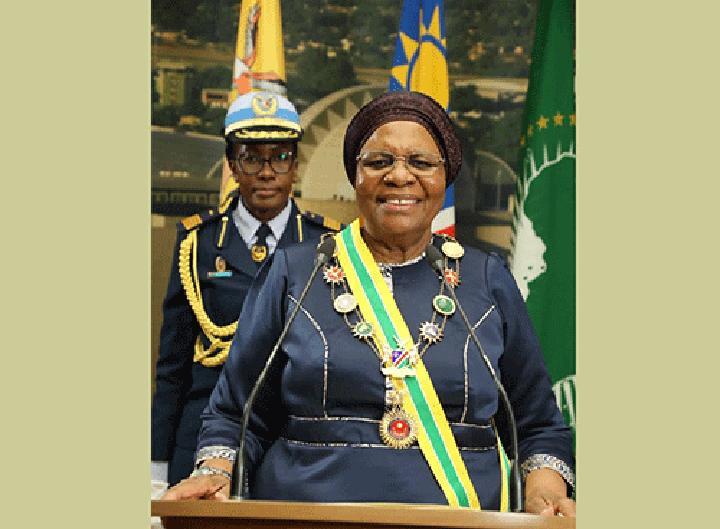
Africa-Press – Namibia.
President Netumbo Nandi-Ndaitwah has urged Namibians to embrace the progress made since independence, while remaining mindful of the challenges that persist.
She made these remarks during her Independence Day address on Saturday in Windhoek.
“As we look ahead, it is essential to celebrate the progress we have made, while addressing the challenges that remain,” she said.
“Over the past decades, Namibia has built strong democratic institutions, expanded infrastructure, and strengthened its human capital.
“Our education system continues to advance and transform. Today, Namibia trains and graduates its own medical professionals — a prospect unimaginable at independence.
“Our young professionals, entrepreneurs and innovators are contributing to the development of our country.”
Agriculture remains a top priority for the administration, with Nandi-Ndaitwah outlining government’s commitment to advancing national goals in line with the Sixth National Development Plan (NDP6).
“In the first year of this administration, government has introduced the National Youth Development Fund and strengthened internship programmes to empower young people,” she added.
The budget allocation for youth development under the Ministry of Education, Innovation, Youth, Sport, Arts and Culture has increased by N$70.6 million, bringing the total to N$750 million for the current financial year.
This forms part of the ministry’s broader N$83.6 billion Medium-Term Expenditure Framework (MTEF) for the 2026/27 to 2028/29 financial years.
In education, government has introduced subsidised tertiary education through free registration and tuition, while also strengthening vocational training and early childhood development.
According to data from public and private institutions, more than 134 000 students have benefited from subsidised tertiary education through the Namibia Students Financial Assistance Fund (NSFAF).
Infrastructure development also remains a priority, with continued investment in roads, energy and other key sectors aimed at connecting communities and supporting economic growth.
For the 2026/27 financial year, government has prioritised the social sector, including healthcare, education and programmes that support citizens’ wellbeing across all 14 regions.
Namibia’s economy remains resilient, with projected growth of 3.1% in 2026, while maintaining macroeconomic stability and low inflation.
The President called on all stakeholders — government, the private sector, civil society and citizens — to work together to achieve these goals.
Commitment to reducing poverty
Nandi-Ndaitwah said tackling poverty, inequality and unemployment remains a central priority of her administration since taking office on 21 March 2025.
“Many of our citizens continue to face poverty and inequality. Families are still seeking meaningful employment, decent housing and access to basic services that allow them to live with dignity,” she said.
“As I often say, we are too few to be poor. These challenges call for collective action and shared responsibility.”
Fight against corruption
The President reiterated her stance on corruption, describing it as a serious betrayal of public trust. “Corruption is not simply a crime against the State; it is a betrayal of the people and can be comparable to treason,” she said.
“When resources meant to improve the lives of citizens are diverted for personal gain, it becomes an injustice to every Namibian.”
She stressed that public officials must serve with honesty, discipline and integrity, and be held accountable if they fail to do so.
She noted that arrests have been made in recent months, adding to ongoing high-profile cases such as the Fishrot and Namcor corruption matters currently before the courts.
Tribalism and racism
Nandi-Ndaitwah also expressed concern over rising tribalism, racism and regionalism.
“These elements are dangerous. They tear nations apart and must be avoided at all costs,” she said. “As a nation and as leaders, we must not allow ourselves to be driven by tribalism or regionalism.”
External challenges
The President highlighted global tensions and conflicts as emerging risks, noting their potential impact on Namibia’s economy.
She referred to escalating conflict involving the United States, Israel and Iran, which has raised global concern.
Rising oil prices — with Brent crude surpassing US$112 per barrel — could have inflationary effects. “Government will continue to monitor the situation and develop strategies to navigate these challenges,” she said.
“Guided by our Constitution, Namibia will continue to stand for peace, dialogue and cooperation among nations.”
She also warned that climate change remains a serious threat that could reverse development gains if not addressed.
“There is an urgent need to protect our environment. In Namibia, we continue to develop programmes for mitigation and adaptation, including energy mix projects and investment in climate-smart agriculture,” she said.
Thirty-six years after independence, Namibia has made notable progress, although challenges remain.
With her business unusual approach, Nandi-Ndaitwah has entered her second year in office as Namibia’s fifth head of State and first female president.
With four years remaining to Vision 2030, she said government remains committed to driving the country towards industrialisation.
For More News And Analysis About Namibia Follow Africa-Press