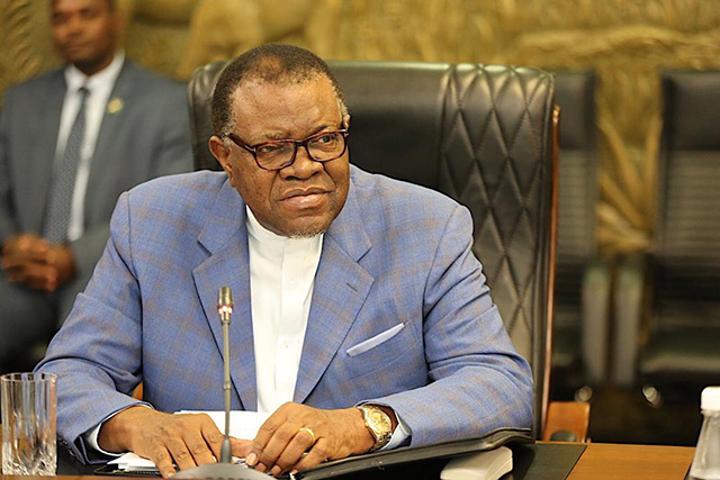
Africa-Press – Namibia. PRESIDENT Hage Geingob has criticised the country’s education system’s capacity to produce employees for the labour market.
He says industrialisation can only be achieved through a fundamental shift in how Namibian children are educated.
Geingob, speaking at the opening of the Namibia fourth Industrial Revolution Conference on Wednesday, said the education sector has a relatively low capacity to react to rapid technological changes.
“The impacts are visible through the low transition into the labour market. Sustainable and inclusive industrialisation can be achieved through a fundamental shift in how we are educating our children,” he said.
“It has become increasingly important to deliver multidisciplinary training in the country’s institutions of higher learning through blended curricula,” he said.
The president said a stronger relationship is required between industries and institutions of higher learning.
Namibia reviewed its school curriculum in 2019 to address the challenges and needs of society by reducing and expanding subjects and reintroducing technical and vocational subjects.
Curriculum reforms for basic education were created by Cabinet directives based on the outcomes of the National Conference on Education in 2011.
Last year, the African Peer Review Mechanism’s (APRM) review on targeted youth unemployment stated that the current curriculum creates a mismatch between Namibia’s basic and tertiary education sector and the requirements of labour.
Landless People’s Movement (LPM) leader Bernadus Swartbooi this week in parliament questioned whether Namibia has academics worthy of being called professors and doctors.
“Some of the academics Namibia has are very nice people, but do they publish and do research and contribute to the body of knowledge, or are they just holders of seats because they need these jobs?” Swartbooi asked in the National Assembly (NA) on Wednesday.
He said this is a concern of some of academics at the University of the Western Cape.
“Today, apart from professors like Du Pisani, Blaauw and some others, you can count the people who want to be in the academic world,” he said.
Swartbooi said the academic rating of the University of Namibia (Unam) continues to drop, and asked what the university’s professors are doing to ensure the continuous improvement of the institution.
“What is the contribution these professors are making to ensure this place becomes better in terms of ranking, capabilities, research and development?” he asked.
Swartbooi raised concerns on academics who have specialised, but then venture into the business sector and political space.
“Is it a question of money that people would want to go into administration?” he asked.
Speaker of the NA Peter Katjavivi said absenteeism is a problem among academics, since they disappear from the classroom.
Recently, media reports stated that students at Unam’s Ogongo Campus are devastated as months and sometimes years pass with no lecturers for some subjects on campus.
“There is also the question of a research culture, which takes a while to build up. There are a lot of these challenges,” he said.
Swartbooi and Katjavivi contributed to a motion raised by South West Africa National Union leader Tangeni Iijambo, who, over a month ago, wanted the NA to debate and consider giving university lecturers more time to teach as opposed to the current rule, which requires them to step down by retirement age.
The current retirement age at Unam is 60 years old, while it is 65 at the Namibia University of Science and Technology.
Deputy minister of higher education, training and innovation Becky Ndjoze-Ojo said there’s a need to recruit the best, retain the exceptional and retire the rest.
“There’s a need for a regulatory role up the employment ladder through the retention of the professors who have proven themselves, beyond reasonable doubt, to have the expertise needed to mentor the upcoming young,” she said.
For More News And Analysis About Namibia Follow Africa-Press