Africa-Press – Namibia. KAKUNGIRUE UA KAUANDJE is our great great grandfather. He was a senior lieutenant general in the Red Flag Regiment led by our great grandfather supreme chief Samuel Maharero.
Kakungirure ua Kauandje led the colonial resistance and fired the first shots against German occupation troops at Okahandja on 12 January 1904.
This happened after the Germans stole land, cattle and confiscated property of the Herero people and were unwilling to stop their unbridled colonial looting.
His battalion killed many Germans in the Schutztruppe, winning battles at Okahandja, Okandjira, Ohamakari and Otjihinamaparero, among others.
FATEFUL DAY
The annals of the Herero-Nama genocide history record that on this fateful day, German troops were warned to stay out of the boundaries of where the Herero people lived at Okahandja, and to not further fuel tensions which were already on the brink of boiling over into war.
The German troops ignored the plea for peace, inflaming the situation by wanting to annex more land and property by brutal means.
Their behaviour deserved the anti-colonial occupation response Kakungirure ua Kauandje guided at Okahandja.
At the battle of Otjihinamaparero, he led the battalion. Among his young fighters was chief Hosea Kutako.
The Schutztruppe were led by one Von Bodenhausen and a Von Estorf who died in this battle.
When he returned to Okahandja, Kakungirure ua Kauandje fearlessly and defiantly expressed that it was he who had fought and won those battles and that he didn’t just shoot any soldier but the top German generals.
The German commanders were infuriated as they were aware of his impeccable gallantry and battlefield skills.
The Schutztruppe imprisoned him. He died overnight – it is presumed from anger causing a heart attack after the Germans wanted to court martial him the next morning.
The Schutztruppe buried him in an unmarked grave under the railroad track at Okahandja.
GERMAN RECALCITRANCE
A day prior (11 January 1904) to the official start of the war, Samuel Maharero wrote to Herero leaders, instructing that war should not be made against the Damara, Nama, Basters, English, Afrikaners and other peoples as the Germans were the provocateurs.
This was a masterstroke from a statesman who led his people’s resistance struggle with full commitment and sacrifice.
Chief Maharero’s many requests for peace fell on deaf ears and the Germans kept violating the principles of proper and peaceful humane conduct.
Twenty years earlier at the Berlin Conference of 1884, major European countries negotiated their entitlements to the African continent and Germany laid claim to then Deutsch-Südwestafrika.
This resulted in the genocide of the Herero and Nama people in Namibia.
Eighty percent of the Herero people and 50% of the Nama people would be annihilated and the first Genocide of the 20th century would be recorded in the annals of human history.
German imperial soldiers continued shooting and killing unarmed Hereros at Otjimbingue and elsewhere as the battles spread across central and southern Namibia.
Berlin wanted nothing less than the unconditional surrender of the Herero and Nama but the resistance prevailed.
They sent the butcher of the Herero and Nama, the notorious general Lothar von Trotha, who arrived on 11 June 1904 to put down the resistance struggle.
The Germans set up concentration camps inter alia in Windhoek, at Swakopmund, and on Shark Island. Herero and Nama women would be raped, people would be starved to death and be put under forced labour.
They were hunted down until Von Trotha issued extermination orders against the Herero in October 1904 and against the Nama in April 1905.
Herero and Nama women in concentration camps would shave off the heads of relatives who died fighting colonialism.
These skulls would eventually be sent to Germany for “scientific studies” based on the racist theories of the infamous doctors Mengele and Fischer.
RECOGNITION
The fallen liberation fighters of the first resistance struggle would never receive proper burials. Nor has there been atonement for the blood they shed.
Von Trotha would put a bounty (which in today’s currency would amount to millions of euros) on the head of Samuel Maharero who would eventually take a large entourage of the first Namibian refugees into Botswana.
Today they form our diaspora in that sister country, South Africa and elsewhere.
The Nama and Herero would be taken by the German army to Togo and Cameroon and a diaspora has also been identified there.
It is time for the government of Namibia and historians to recognise the valiant warrior Kakungirue ua Kauandje who stood up against German colonialism as a hero.
His actions on 12 January 1904 are not only significant to Namibia’s history but the entire African continent and the global struggle against imperialism.
His name must now be entrenched at Heroes’ Acre and in the annals of Namibian history. He left an indelible mark of bravery on our sacred soil.
We implore our government to make this significant history part of history lessons at school and at tertiary level. It is an integral part of the process of reconciliation.
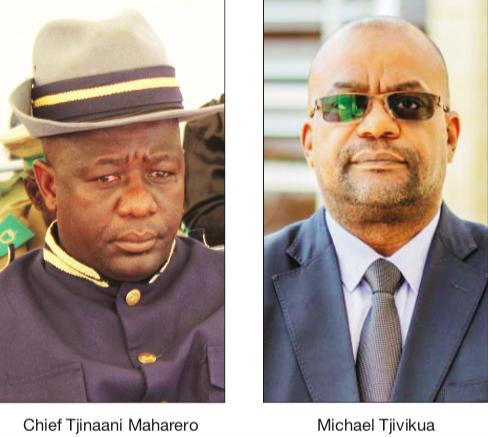
– Dr Michael Tjivikua is an education specialist and great great grandson of lieutenant general Kakungirue ua Kauandje
– Chief Tjinaani Maharero, a great great grandson of Maharero ua Tjamuaha, is chief of the Maharero Royal Traditional Authority (OtjikaTjamuaha)
For More News And Analysis About Namibia Follow Africa-Press