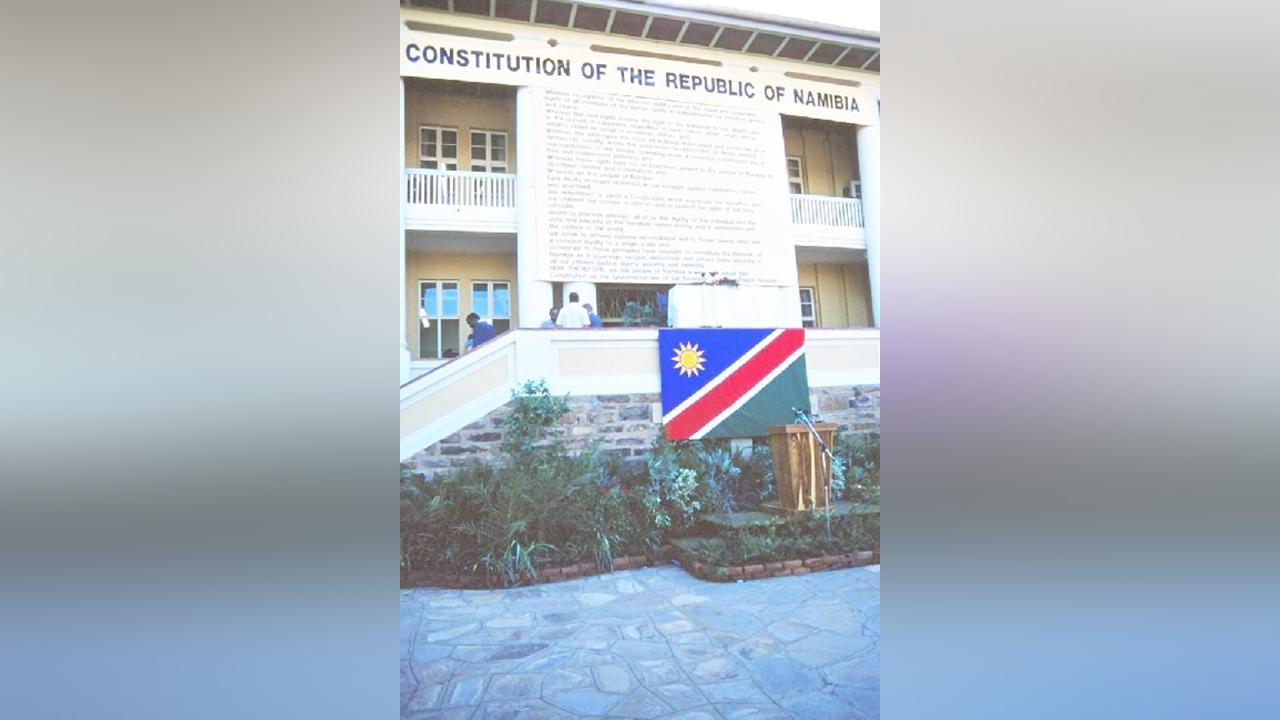
Africa-Press – Namibia. THE Namibian Constitution is not living up to its reputation, commentators have said.
Today, Namibians are observing Constitution Day, which marks 33 years since the adoption of the Namibian Constitution.
One of the key concerns is article 95, which provides for the promotion of the welfare of people, but is seen as a mere political statement and not enforceable.
Herbert Jauch, a socio-economic commentator and labour researcher, stated:
“While the government has good intentions and has many policies, for example, on housing, sanitation, fighting poverty and inequality, there is nothing concrete in the Constitution that citizens can use to enforce that right. And that is a major weakness.”
Echoing Jauch’s sentiment that the Constitution is a legal document and a political statement, ombudsman Basilius Dyakugha says, “Article 95 that says the government will lay down policies that will improve the welfare of the people is a political statement. So politicians can stand on the podium and say we will do this and that, but five years down the line, if they didn’t do anything, nobody will hold them accountable.”
On his part, political activist and academic Job Amupanda noted that while it is revered internationally, the Namibian Constitution is celebrated by a privileged few.
“The Constitution is a travesty of justice and has kept us in the mud and disarmed us for 32 years of flag independence. It has become a polarising instrument celebrated by those benefiting with their privilege maintained, while loathed by those of us who yearn for the completion of the incomplete project of liberation. There has never been a serious national conversation about the state of the Constitution because of fear or manipulation.” Amupanda said.
John Walters, who served as ombudsman for 17 years, paid tribute to the Constitution, but said the Constitution does not guarantee social rights like “the rights of housing, water and sanitation. But all is not lost, Namibia is a state party to the covenant on economic, social and cultural rights, which guarantees all these rights. It supplements our Constitution. We can still go to court if the government does not comply with the guarantees in the covenant,” said Walters.
SHORTCOMINGS
Jauch noted that some provisions in the Constitution are problematic.
“One aspect of the Constitution that is problematic is redistribution. When it comes to land reform, the issue of private property rights is interpreted to prevent the large-scale redistribution of resources. And we see how that interpretation of rights to property has been used to entrench inequality,” he said.
“The system of willing buyer, willing seller was introduced based on market prices of farms. And that was seen as just compensation, instead of saying how about we look at how land was acquired, and improvements made. This is just an example of how a constitutional provision was interpreted in a very narrow way and was then used to protect the rights of those who have the privilege of owning resources.”
Amupanda, a University of Namibia senior academic, pointed out several shortcomings in the Constitution.
“It has beautiful principles of state policy (article 95), but these principles are mere guides and cannot be enforced. The principles of foreign policy are outdated, as they were adopted from the Cold War era. The government itself doesn’t even adhere to these outdated principles,” he said.
He added that, “Article 16 says parliament can prohibit or regulate the ownership of land by foreigners, but never gave direction on the recourse of citizens when parliament doesn’t fulfil the promise. As a result, foreigners now own 1,2 million hectares of our land.”
Rinaani Muutua, a trustee at Social and Economic Justice Trust, said the Constitution has perpetrated inequality and poverty.
“For example, even though article 95 of our Constitution holds the state accountable for the well-being of all Namibians, the state can only be held accountable if there are enough resources to provide people with a decent standard of living,” she said.
For More News And Analysis About Namibia Follow Africa-Press