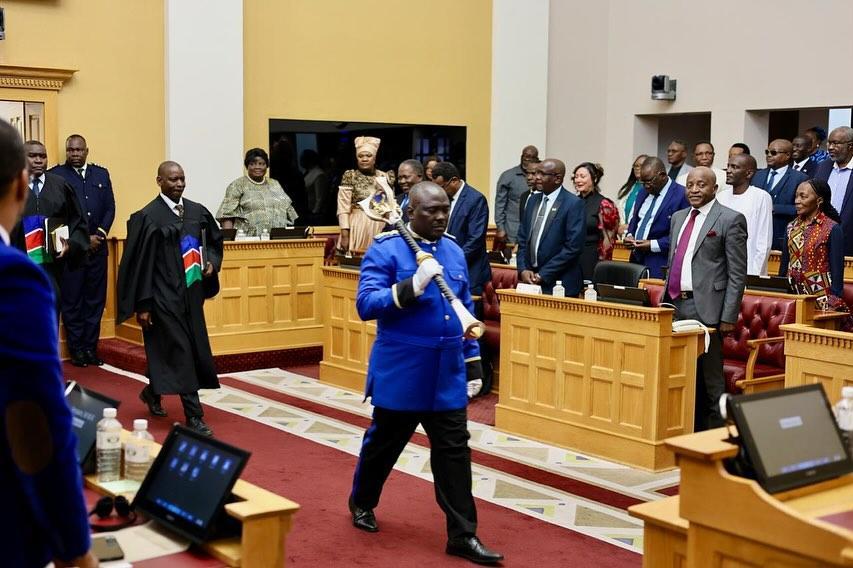
Africa-Press – Namibia. This year, parliamentary debates on various key bills and motions will continue.
Industries, mines and energy minister Modestus Amutse will amend the Petroleum Exploration and Production Act, 1991, to shift several key powers in the petroleum sector from the ministry to the Office of the President.
This publication reported on 13 November 2025 that the powers being transferred include the right to grant, renew, or revoke oil and gas exploration licences and production rights functions that have recently been the subject of Executive disputes.
Soon after her inauguration in March 2025, President Netumbo Nandi-Ndaitwah directed that the country’s oil and gas industries reside under her management in a way that maximises their benefits for all Namibians.
Last year, Nandi-Ndaitwah set out to increase local ownership in mining ventures from 51 % in 2024 to 60 % by 2030.
The plan includes increasing the share of processed mineral exports from 46.6% to 57% by the end of the decade.
Meanwhile, Swapo parliamentarian Tobie Aupindi’s anticipated motions underscore re-examining human capital needs for Namibia’s upstream, middle and downstream oil and gas sectors.
Aupindi described the space as ineffective, “lacking current workforce skills”.
Aupindi suggests the need to identify areas where gaps exist and propose strategies for bridging those gaps.
Meanwhile, another key bill the legislators will put their decision to is the Land Bill, introduced on 30 September 2025 by agriculture minister Inge Zaamwani. It puts a tight noose on the ownership of agricultural commercial land, communal land, and customary land.
The Bill, described as “long overdue”, prohibits the acquisition of commercial agricultural land by foreign nationals through registration of ownership.
The State has priority rights to buy before owners sell. The Bill is at second reading.
Another debate to watch for is on the Public Enterprises Governance Amendment Bill when they commence debate in February.
It was tabled on 8 October 2025 to clarify roles, improve accountability, and give the prime minister oversight by transferring powers from ministers. It is also at second reading. The prime minister will primarily control remuneration levels and benefits for employees of public enterprises and the classes of contracts entered into by a public enterprise.
This will include the final word on joint ventures , acquisition of other businesses and agreements relating to the corporate structure of a partner of a public enterprise.
The bone of contention, suggested by analysts, however, is how this model will move the dial on the poor governance and underwhelming outcomes at many public enterprises.
It is believed that mismanagement and corruption may still thrive in the public sector. Furthermore, the Regional Councils Amendment Bill, tabled on 2 July 2025, is set to update definitions for boundary delimitation, staff appointment, and development committees.
Meanwhile, the new Mental Health Bill, tabled on 14 October 2025 to protect rights and prevent abuse of those who deal with mental health issues, will also be debated.
The Bill, tabled by Esperance Luvindao, empowers the Minister of Health and Social Services to designate any private or public facility as a mental health facility.
It aims to significantly broaden the range of facilities that can provide care to individuals living with mental health conditions.
Importantly, the Bill also tackles the long-standing challenge of medical aid schemes covering only a limited set of mental health conditions, a practice that has perpetuated inequity and stigma in accessing mental healthcare.
The debates will also provide direction on the Anti-Corruption Commission (ACC) and the appointment of its Director General and the Deputy Director General, among others.
The nationalisation of key strategic economic sectors/ resources will also resume.
The topic will dissect the implications of pushing for more state control and ownership in various sectors of the economy. Among these are the country’s mineral resources, such as diamonds, copper and gold, and marine resources.
Meanwhile , after the Presidential and National Assembly elections , the Affirmative Repositioning (AR) movement wants the National Assembly to lower the voting age to 16.
The proponents, including AR’s Tuhafeni Kalola, argue that the teens are ready to vote, while Swapo party parliamentarian Sharonice Busch, among others, last year rebutted that teens at that age do not have the decision-making maturity to vote.
For More News And Analysis About Namibia Follow Africa-Press