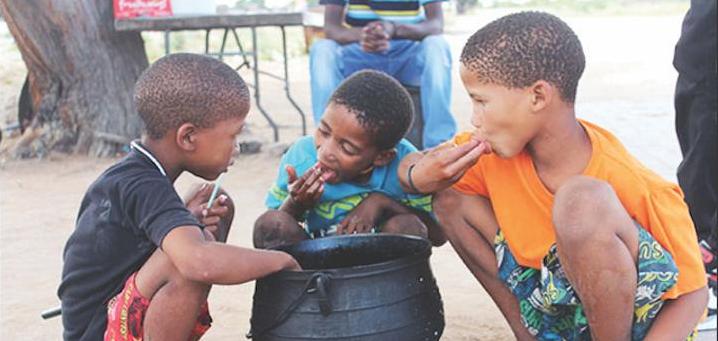
Africa-Press – Namibia. MORE than half of Namibia’s population has experienced moderate or severe food insecurity over the last two years.
This is according to the latest United Nations Food and Agriculture Organisation (FAO) report.
The report, which was released this week, stated that 58% of Namibians are food insecure, which translates to about 1,5 million hungry people.
The FAO report, titled ‘The State of Food Security and Nutrition in the World’ states that food insecurity in the country has continued to increase since 2014, when it stood at 53%.
It says 1,4 million Namibians were unable to afford a healthy diet in 2020.
This was 100 000 more people than in the previous year.
Additionally, 1,6 million people in Namibia are living in poverty, as defined by the World Bank.
This is the result of 200 000 more Namibians being pushed into poverty during the first year of the Covid-19 pandemic, according to the latest World Bank overview of the country.
Namibia has in the last two years been battling the effects of the pandemic while the economy has been ailing due to drought in previous years.
Over 15 000 people were retrenched between 2020 and 2021.
Currently, the country has roughly 773 463 people receiving social grants funded by a budget of N$5,4 billion meant for social safety net programmes.
Namibia ranks third among southern African countries with people who are unable to afford a healthy diet.
South Africa has about 38,7 million people who are unable to afford a healthy diet, followed by Lesotho, with 1,8 million, Namibia with 1,4 million, Botswana with 1,4 million, and Eswatini with 8 000.
ANALYSIS
Economist Salomo Hei says almost 60% of Namibia’s population is insecure and do not know where their next meal will come from.
“There has been a huge erosion of personal disposable income. Those who used to be able to afford goods and services at some point are no longer able to afford food any more, and that subsequently has had an impact on livelihoods,” he says.
Hei says this means the life expectancy of Namibians could potentially be impacted, since it is linked to the ability of having healthy, nutritious meals.
“Certain events have triggered this high number, which include unemployment, Covid-19, and the general difficult economic environment we find ourselves in. Further than that is also the general increase in price, which makes it difficult for households to afford commodities needed on a daily basis,” Hei says.
According to a member of the Basic Income Grant (BIG) Coalition in Namibia, Rinaani Musutua, the intensity of poverty, and child poverty in particular, exemplifies the urgency and magnitude of the problem.
“The FAO’s statistics are not a surprise to us. Hunger and food insecurity is the biggest driver of poverty in Namibia. With 1,6 million poor people in Namibia, coupled with high unemployment, and where food prices have been on the increase, hunger will obviously be a major threat to a lot of Namibian people’s existence,” she says.
“We are aware that the government has introduced a N$500 household Harambee cash grant per month, which targets only 45 600 people, meaning only 2% of the population.
“The Harambee cash grant does not have an impact on malnutrition reduction, since it targets a small portion of the population.
“That is why we recommend that the Harambee cash grant be converted into a universal basic income grant for all Namibians aged 0 to 59, which will cover the entire population to ensure maximum impact on hunger,” she says.
Musutua says the government is called upon to strengthen its fight against poverty through the implementation of a universal BIG of N$500 per person per month for all Namibians up to 59 years old to ensure maximum impact.
PLANT-BASED IS BEST
Local dietician Ridow-Ann English says on average every three out five clients she sees in the public health setting due to diabetes, hypertension, over-and undernutrition, are either unemployed, self-employed or have little to no income.
“This makes it extremely difficult to counsel them on a more nutritious diet, however, with an increased understanding of which affordable foods they can purchase, they are able to make the necessary changes in their diet for a short period of time,” she says.
English says counselling is effective, but not always sustainable as the issue is not a lack of nutrition, but rather a lack of money.
She says most Namibians tend to assume healthy foods are expensive, yet plant-based foods are in fact the most affordable options at local stores, such as soy mince, lentils, brown rice, fruits, other vegetables, nuts and beans.
“Not many are aware that these foods can be part of a healthy diet,” English says.
For More News And Analysis About Namibia Follow Africa-Press