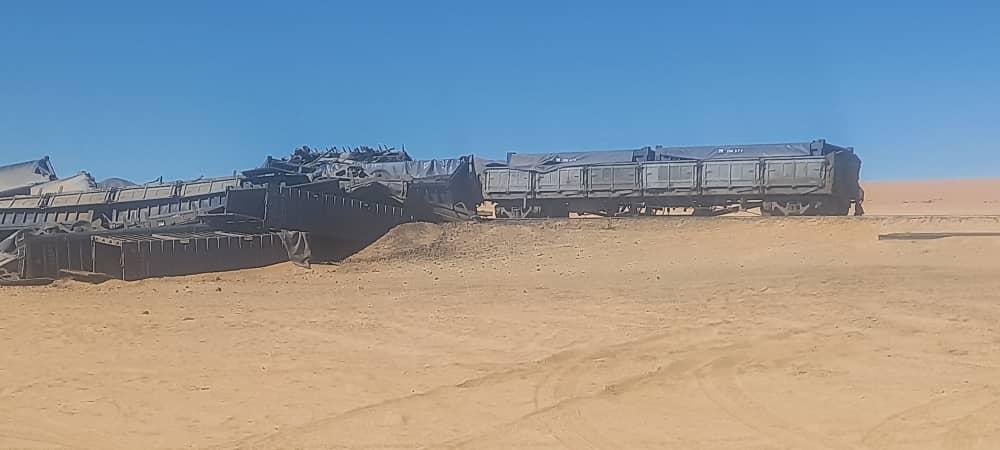
Africa-Press – Namibia. THE substantial backlog in the development, maintenance, and rehabilitation of rail infrastructure has become a matter of life and death for workers who operate on TransNamib’s railway lines. While the 27th of April marks a week for two families robbed of their breadwinners, the national rail liner is still busy cleaning up the manganese spilled by the train which derailed between Aus and Lüderitz.
According to statistics provided by the national rail liner’s spokesperson, Abigail Raubenheimer, TransNamib has had three deaths due to serious derailments, and 12 other deaths in train-related incidents over the past five years. In addition to this, the rail liner has reported approximately 200 derailments over the past five years, with three to four serious mainline derailments.
Raubenheimer explained that there is currently an internal investigation underway to assess what caused the accident on the railway line between Aus and Lüderitz, which had been fixed after a recent derailment in March 2023. “The aged and deteriorating state of the railway infrastructure seriously hampers our operations, as well as the outdated equipment, which is why the acquisition of rolling stock needs to be urgently addressed,” Raubenheimer said. However, she added that the renovation is the responsibility of the government, through the Ministry of Works and Transport.
Robert Kalomo, Namibia’s Director of Railway Affairs in the Ministry of Works and Transport, commenting on the state of Namibia’s railway lines, explained that the total length of the national railway network is about 2,687 km. “Of this, only about 30% is in either A or B standard, that is in reasonably good standard. The remaining 70% needs to be upgraded to bring it to the SADC minimum requirement of 18.5 ton/per axle load standard,” Kalomo said.
He added that measures taken by the government and by TransNamib include securing adequate funding for the improvement of the infrastructure and operating equipment. “Funding for government activities is the mandate of the Ministry of Finance and Public Enterprises. The overall government objective is to have a modern, efficient, and reliable railway transport infrastructure; hence initiatives are always underway to ensure infrastructure improvement. Just recently, the government completed the upgrading of the railway line from Walvis Bay Station to Kranzberg Station (224 km),” Kalomo said.
In the recent budget motivation speech, the Minister of Works and Transport, John Mutorwa, indicated that a total budget of close to N$2.9 billion dollars would be required for the Department of Transport. From this total, the minister explained that under the Railways Network Development and Rehabilitation program, a total amount of N$562 would be budgeted for this department. “The purpose of this program is to ensure the provision of railway transportation services or logistics by rehabilitating through a phased approach and to develop new railway infrastructures that guarantee seamless, efficient, affordable, customer-friendly, and environmentally responsive integrated railway transportation solutions. The specific objectives of this program are planning and constructing new railway lines, maintaining and upgrading existing aged railway networks to the SADC standards for Railway lines (18.5 ton/axle with a minimum speed of 100 km/h),” the minister explained.
For More News And Analysis About Namibia Follow Africa-Press