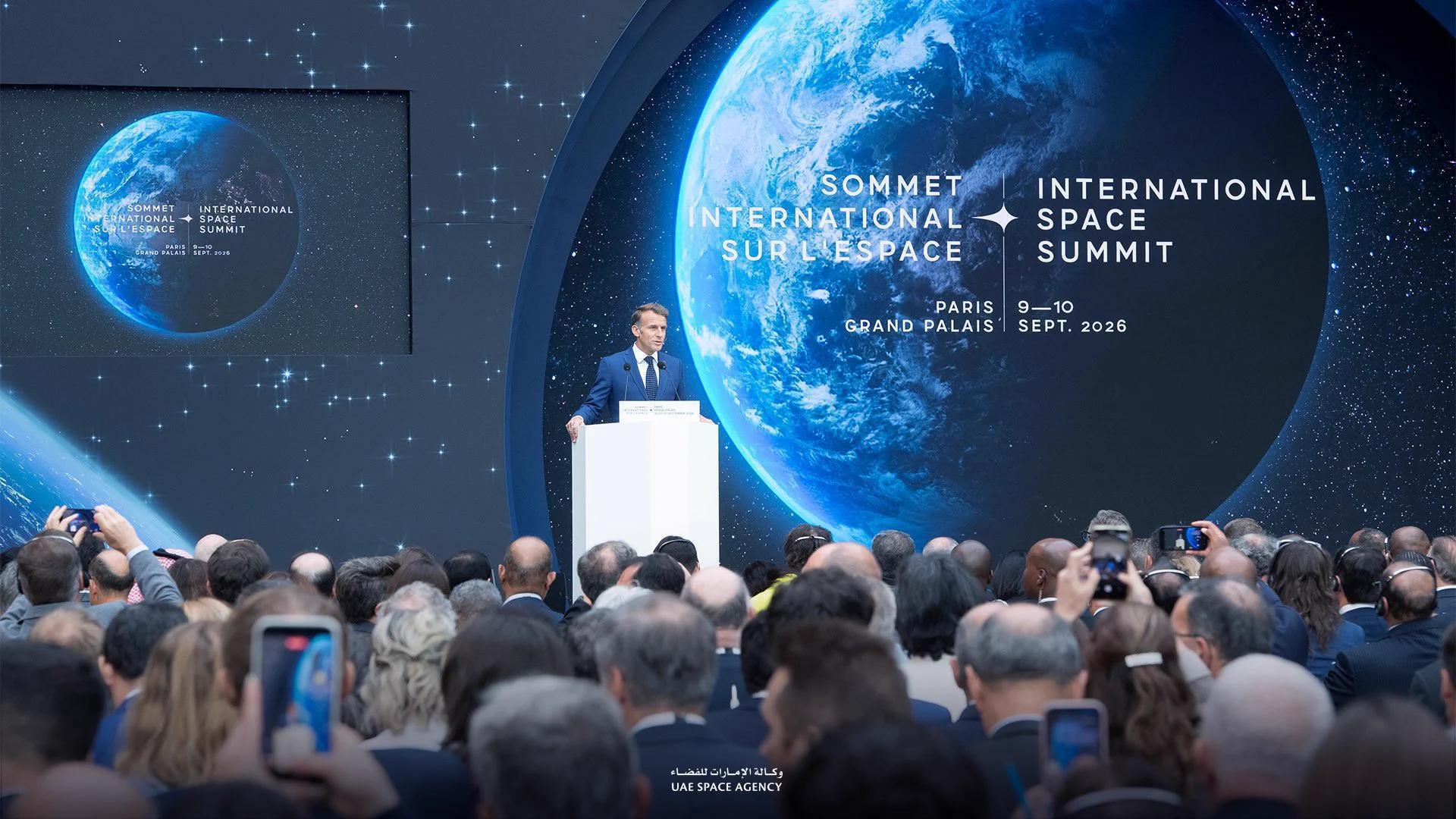
Africa-Press – Namibia. The International Space Summit held in Paris on September 9 and 10, 2026, co-chaired by France and Germany and attended by representatives from 120 countries, was an important occasion for various stakeholders in the space sector, featuring major global companies such as Airbus, Thales, and Amazon.
Africa was not absent from this event, as it participated with strong delegations, taking advantage of the opportunities the space sector offers for building networks, developing partnerships, and signing contracts.
The emerging company Leoblue signed a memorandum of understanding with the Senegalese Space Studies Agency to develop an early warning solution aimed at addressing several practical and urgent issues, including warning fishermen at sea about storms, managing crowds to enhance urban security during major events, and providing information related to health emergencies.
This partnership reflects a growing trend among several African countries and companies to utilize space technologies and data extracted from satellites to tackle development, security, and emergency response challenges.
During the summit, Yaya Sylla, head of Sah Analytics International, a company from Côte d’Ivoire that provides solutions based on space data analysis, expressed the importance of African participation in this international event. He stated that the level of interest and engagement in the space sector confirms that this interest “did not come from nowhere.”
Sylla believes that the current phase requires significant investments to build African capacities capable of achieving a balance against the giant companies in the field, such as Starlink, by developing products and solutions in the Global South and Africa, allowing the continent to benefit from the rapid developments in the sector.
Côte d’Ivoire, Rwanda, and Senegal have begun to notably develop their space sectors in an effort to build national capacities that go beyond merely benefiting from the space services provided by foreign companies.
Maram Kair, the director general of the Senegalese Space Studies Agency, calls for a comprehensive and long-term approach to developing the sector, emphasizing that building a national space industry cannot be achieved through isolated steps or short-term projects.
He explained that it starts with establishing the necessary infrastructure, allowing interested youth in the space sector to engage in activities within their countries, alongside providing training and qualification opportunities at the national level. After that, the phase of developing space programs comes, including the design and development of satellites based on local infrastructure and capabilities.
Kair affirmed that it ultimately concerns an “integrated system,” stressing that Senegal does not aim to implement a one-off action, such as launching a satellite, but rather seeks to build a leading nation in the field of space.
This ambition poses a challenge for several African economies facing financial constraints, prompting the search for new models to finance space investments and link them to the immediate developmental needs of countries.
In this regard, Dr. Tidiane Ouattara, chairman of the African Space Agency, believes that space-related investments should not be treated as separate from other sectors but should be distributed among programs and ministries concerned with various areas of development.
Ouattara clarified that there is a belief in the necessity of giving the space sector independent priority and allocating a separate budget for it, but he sees that the most effective approach is to view space from a sectoral and thematic perspective.
He cited the water sector as an example, explaining that if water issues are a priority for a country, it will work to provide the necessary resources to finance this sector. However, developing the water sector simultaneously requires reliable data, infrastructure, and effective equipment, where space can play a fundamental role in providing the necessary data and services.
He pointed out that applications of space technologies extend to many areas, including urban transport, marine pollution monitoring, coastal erosion tracking, agriculture, and other sectors that require accurate data to assist decision-makers in formulating policies and making appropriate decisions.
Ouattara emphasized that “space is not an end in itself but a means to help decision-makers move in the right direction within their areas of competence,” stressing that the space sector should not be viewed as a separate entity requiring independent funding but should be integrated structurally and thoughtfully within existing programs.
In addition to national investment, the importance of cooperation and joint work among African countries is highlighted, which is one of the tasks assigned to the African Space Agency, given the rising costs of space projects and the multiple fields requiring specialized expertise and capabilities.
Ouattara cited existing cooperation experiences among African countries, noting that Angola signed an agreement with South Africa this year. Angola possesses significant capabilities in satellite communications and has begun to develop its capabilities in earth observation, while South Africa is one of the leading countries in this field.
He believes that combining the capabilities of both countries can allow each to benefit from the other’s expertise and help avoid duplication of efforts and investments.
He also mentioned that Egypt has signed memoranda of understanding with several parties, as well as similar agreements and partnerships established by Rwanda, acknowledging that these partnerships are still limited in scope compared to the potential that African cooperation in the space field can provide.
The chairman of the African Space Agency emphasized that enhancing this cooperation is no longer an option, asserting that the multifaceted nature of the space sector and its high costs make it difficult for a single African country or entity to handle its various aspects alone.
Alongside government efforts, experts in the sector point to the importance of creating a more attractive environment for private sector companies and international actors by clearly and tangibly identifying national needs, allowing companies to understand the challenges that space technologies can help address, and opening the door for new partnerships and investments.