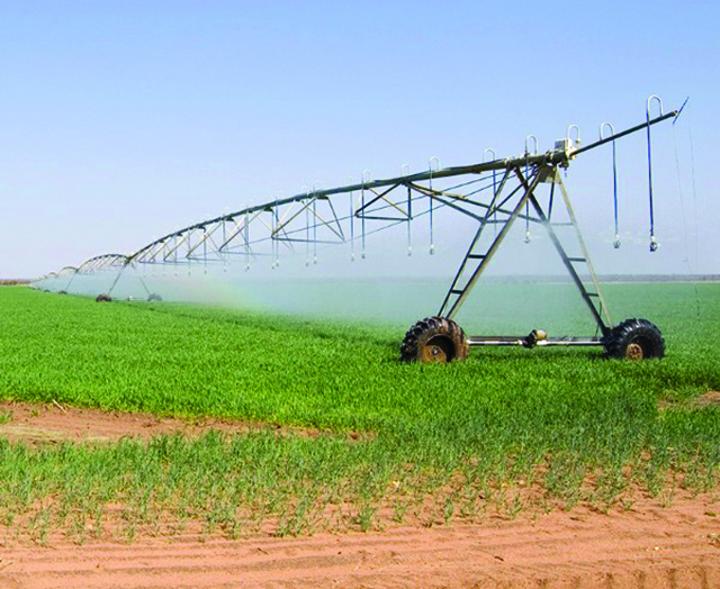
Africa-Press – Namibia. A SWAPO think tank report has advised the ruling party to allocate eight state-owned green schemes to regional councils to manage, create jobs and address food security.
The report, titled ‘Pursuing Efficient National Agricultural Land Use for an Enhanced Economic Growth And Food Security’, was tabled and discussed at the Swapo policy conference over the weekend.
It was produced by Swapo think tank chairperson Andrew Niikondo, and members Shitaleni Herman and Martina Mokgatle. The government currently owns 12 green schemes across the country on land measuring 4 100 hectares.
Four of the12 schemes are leased out to the private sector, while eight are managed through the state-owned Agriculture Business Development Agency (AgribusDev), which is facing closure.
According to the Swapo report, green schemes have gobbled up N$1,2 billion, while total losses are recorded at N$1,1 billion in the past eight years.
The government has added green schemes on the bucket list of projects it was selling to foreign investors in the Middle East – a move that has been condemned by local businesses such as the Namibia Local Business Association (Naloba).
The future of green schemes have become a topical issue in the corridors of power.
Some suspect that plans are already afloat to give the schemes to some Namibians and their foreign investors.
Now, Swapo’s research arm is advising the ruling party to shift green schemes to regional councils, which are led by governors who are, in turn, appointed by the president.
The report recommends that the government attach “each green scheme to the regional councils to manage it”.
“The regional councils manage, plan, budget, in terms of workforces and other innovative initiatives to meet performance expectations (produce, create employment and address food security),” the report says.
It gives the Erongo and //Kharas regional councils teaming up to run one green scheme as an example.
The Zambezi and Oshikoto regions were also to run one green scheme.
The think tank says regional councils will be strengthened to come up with their own initiative to take green schemes allocated to them to greater heights and generate income for regional development.
“This strategy will encourage the regions to engage more in agricultural production,” the report states.
This approach will produce food for national consumption and address the issue of food security, the report says.
“ . . . initiate value addition and solicit support for processing industries that can create employment for people in their regions (tillers, tractor and truck drivers, machine operators).”
The think tank is advising Swapo that there are other policy options to be supported through green schemes to respond to food security, such as targeted direct feeding programmes.
“These include school meals, the feeding of expectant and nursing mothers, as well as children under five through primary health centres, soup kitchens, and special canteens.”
Another advantage of giving green schemes to regional councils is to encourage food-for-work programmes.
“Food-for-work programmes provide support to households while developing useful infrastructure such as small-scale irrigation, rural roads, and buildings for rural health centres and schools,” the think tank says.
The report lists the existing green schemes as follows: Etunda, Hardap, Kalimbeza, Mashare, Musese, Ndonga-Linena, Orange River, Shadikongoro, Shitemo, Sikondo, Tantjieskoppe, and Uhvungu Vhungu.
Minister of agriculture, water and land reform Calle Schlletwein told investors in Dubai in March this year that the government would in June issue a request for proposals to lease out green schemes.
Schlettwein said investment opportunities abound in both green-scheme and brown-scheme projects, for which land is already secured.
“To better leverage private capital and ensure sustained production and productivity of the green schemes, the government has now taken a principle decision to lease out the 11 green schemes through competitive outsourcing as a first option, and through public-private partnerships as may be appropriate,” Schlettwein said at the time.
Neither Nikando, nor Schlettwein could be reached for comment yesterday.
The Namibian reported in April this year that three agricultural projects in northern Namibia have been at a standstill since the last harvest season in October 2021 due to financial constraints.
This was according to Agribusdev acting manager Berfine Antindi.
The three projects are the Etunda, Shadikongoro and Ndonga Linena irrigation projects.
Antindi said the agency received N$4 million from the Ministry of Agriculture, Water and Land Reform in April last year for winter crop production, but received nothing for summer production.
For More News And Analysis About Namibia Follow Africa-Press