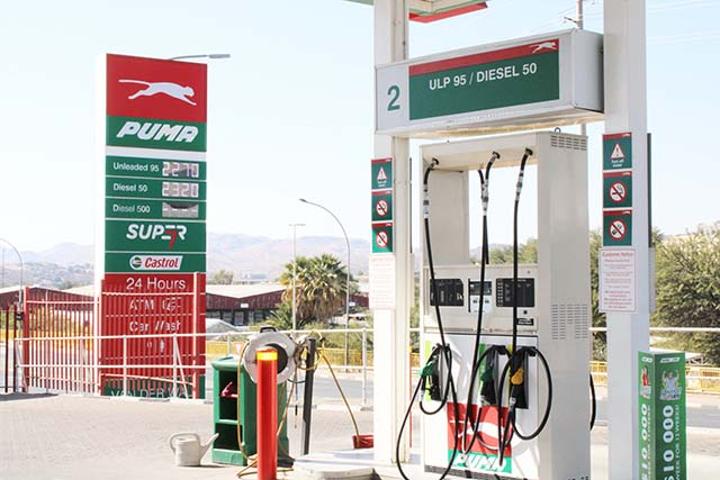
Africa-Press – Namibia. EVEN though the government has maintained fuel prices for August, analysts say increased dealer margins would add upward pressure on domestic fuel prices.
They say the 50 cents-increase in dealer margins is shifted towards consumers.
The Ministry of Mines and Energy on Friday said the price of petrol will remain at N$22,28 cents per litre, and the diesel price will remain at N$22,77 cents per litre at Walvis Bay.
The dealer margin has been increased from 113 cents per litre to 163 cents per litre, and involves the profit or revenue service station owners receive per litre of petrol or diesel sold to customers.
The rest of the country will also remain unchanged, the ministry said.
The ministry has, however, extended the temporary reduction of levies imposed on fuel.
This excludes fuel tax, which will return to 90 cents per litre on all products.
This means the Motor Vehicle Assistance Fund levy, road user levy, and the National Petroleum Corporation of Namibia levy will remain at their current levels until further notice.
These changes will become effective from 3 August.
Meanwhile, neighbouring South Africa has cut fuel prices, with petrol prices to be cut by R1,32 a litre for both 93 and 95 unleaded, while diesel prices will be lowered by 88 cents a litre (0,05% sulphur), and 91 cents (0,005% sulphur) a litre.
Economist Omu Kakujaha-Matundu yesterday said the government has shifted the whole dealer margin onto the consumer.
He said it is possible that South Africa has room to manoeuvre prices, while for Namibia’s struggle to maintain fuel prices points to the bad shape the National Energy Fund is in.
CONSUMERS’ PAIN
“It seems the only way Namibia can reduce fuel prices is by doing away with more levies, which the government is reluctant to do.
“So the pain will continue for the Namibian consumer, who in the end carries most of the burden,” he said.
Kakujaha-Matundu said consumers are taxed to the extreme, and still have to shoulder all fuel levies, whether they own a car or not.
He said higher fuel prices are later reflected in higher food prices, taxi fares and other services.
“Look at the pressure felt by civil servants. After years of no salary adjustment they can barely afford anything.
“Botswana has come up with a plan to cushion the consumer, but here the government even has the guts to shift the dealer margin onto the consumer,” Kakujaha-Matundu said.
Simonis Storm Securities economist Theo Klein says the increased dealer margin would also add upward pressure to local fuel prices, even though global oil prices are expected to moderate in the second half of this year.
Klein says fears of economic recession in the second half of the year for certain advanced economies is fuelling expectations for global oil prices to moderate, where consensus forecasts now point to global oil prices to be between US$90 and US$95 per barrel towards the end of the year.
“With Namibians paying roughly N$22 per litre, petrol station owners only receive N$1,13 in revenue for themselves. This has been increased by 50 cents in response to local fuel station owners facing high input costs, and profits and revenue are under significant pressure,” he says.
The Fuel and Franchise Association (Fafa) says the adjusted dealer margin is a step in the right direction, but the figure is substantially lower than what was recommended as a minimum upward adjustment to secure sustainable and profitable retail operations.
“It is further important to note the adjustment of the retail margin was only one of the challenges that materially affected the sustainability and profitability of fuel retailers in Namibia,” the association said on Friday.
Outstanding issues still need to be resolved by the ministry, or the industry would face serious consequences that may not only constitute a risk to the national security of fuel supply, but may even cause the collapse of retail networks within developing rural areas of Namibia, the association says.
For More News And Analysis About Namibia Follow Africa-Press