
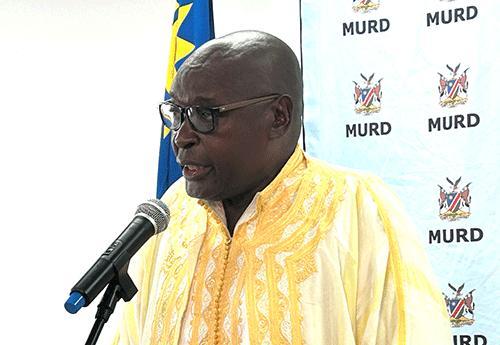
Urban and Rural Development Minister James Sankwasa has criticised local authorities for disconnecting water to pensioners and low-income residents over small arrears, while allowing businesses owing large amounts to continue receiving services unabated.
Sankwasa made the remarks on Monday during the Ministry of Urban and Rural Development Induction Training Workshop for local authority councillors and administrators, underway at Emirates Hotel in Ondangwa.
The workshop runs from 26 to 30 January 2026.
“This thing of local authorities running to disconnect water for pensioners who owe N$500, while leaving people with big businesses owing N$100 000, is unwelcome,” Sankwasa said.
He stressed that businesses must be held accountable, adding that payment for services “is not a choice.”
Sankwasa said debts must be settled for local authorities to function effectively but warned that water disconnections should not target poor and vulnerable residents.
He called on councils to apply fairness and humanity when enforcing credit control measures. Responding to a recent report by a local daily newspaper that he owes NamWater
N$170 000, Sankwasa said he would pay his water bill, so that everyone must pay their bill.
“No matter what, I will not stop calling for the settlement of accounts by councils. Accounts must be paid,” he said.
The minister further noted that after NamWater embarked on extending water connections to rural areas, about 80% of residents have had their water disconnected due to non-payment. He added that water could be cheaper if more boreholes were developed in rural areas.
Meanwhile, Sankwasa also ordered Affirmative Repositioning (AR) representatives to remove their party caps or leave the workshop, insisting that the meeting was not a political gathering. AR’s Angelina Immanuel requested an explanation, but the minister was not having it.
“I wish to place it on record that I respect authority, but I will not remain silent when authority is exercised without a legal basis,” Immanuel wrote on her Facebook page. She wrote that there is no provision in the Local Authorities Act, the Code of Conduct, or any adopted standing rule that prohibits a councillor from wearing a cap during an induction or council-related engagement.
Adding that, in the absence of a written rule, such an instruction becomes arbitrary rather than lawful.
“The symbol on my cap represents a revolutionary and historical identity, one that many Namibians sacrificed their lives for. Wearing it did not disrupt proceedings, disrespect the institution, or undermine governance. It expressed who I am and who I represent,” read the statement.
The ministry is hosting the induction workshop for newly elected regional and local authority councillors, chief regional officers, chief executive officers, management cadres and administrative staff. The programme aims to strengthen participants’ capacity to manage their institutions effectively and deliver quality services to communities, while introducing councillors to key issues in regional and local governance and equipping them with the knowledge and skills required to run councils efficiently.