Africa-Press – Namibia. NAMIBIA’S Critical Energy Transition Minerals (CETM) value chain has a trade-adjusted global export opportunity of US$221 million, with Asia representing the largest potential market.
This was highlighted in the recently launched report entitled “Rapid Assessment of Value Addition and Diversification within and beyond the Critical Energy Transition Mineral Value Chain.” The report is the result of a collaboration between the United Nations Conference on Trade and Development (UNCTAD) and the Government of Namibia.
The report emphasises that Namibia has significant opportunities for diversification, rather than relying on only a few export products, identifying ways for the country to move beyond an extractive economic model and transition towards sustainable industrialisation.
According to the report, Namibia could potentially produce 353 products competitively across 23 sectors, with the largest opportunities in chemicals, iron and steel, and machinery and mechanical equipment. It highlighted that 200 products could be exported globally, presenting a weighted (trade-adjusted) opportunity of US$811 million, with unweighted (theoretical) estimates rising to US$28.6 billion. About 33 of these products are within the CETM value chain.
“Global export opportunities within the CETM value chain are concentrated in chemicals and copper-based products. Under this scenario, 33 products are identified, with a weighted export opportunity of US$221 million, translating into a US$5.6 billion opportunity when unweighted,” the report states.
The report notes that chemicals, particularly inorganic chemicals, comprise the largest share, with an estimated US$153.4 million, accounting for 69.6% of the total trade-adjusted value.
“The unweighted scenario shows similar sectoral results, with chemicals representing the largest share of the total (39.1%), again driven by inorganic chemicals. Copper and other minerals and metals constitute the next most significant group, offering an estimated export opportunity of US$47.4 million. This is predominantly attributed to articles of copper, which make up nine of the 11 products in this category. Taken together, chemicals and copper-related products account for 91% of the weighted and 76% of the unweighted global export opportunities within Namibia’s CETM value chains,” the report explains.
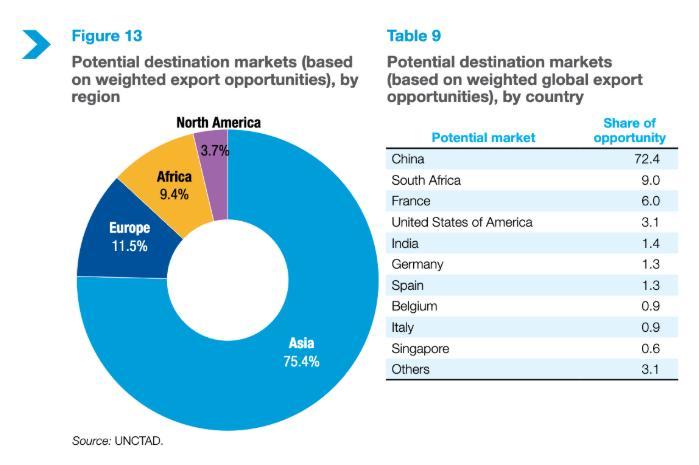
The report argues that Asia offers the largest market potential for Namibia’s CETM-related exports in terms of market-adjusted projections.
“In terms of weighted values, Asia offers the largest market potential for Namibia’s CETM-related exports. The region accounts for 75.4% (US$166.5 million) of export opportunities, led predominantly by China (72.4%), followed by India and Singapore (1.4% and 0.6%, respectively),” the report highlights.
The report further identifies Europe as the second-largest market (11.5%), driven by France (6.0%), Germany, and Spain (1.3% each).
“Africa ranks third, with 9.4%, with most opportunities concentrated in South Africa (9.0%). These weighted estimates largely reflect Namibia’s existing trade relationships, particularly with China, a key player in the global copper value chain,” the report reads.
For More News And Analysis About Namibia Follow Africa-Press