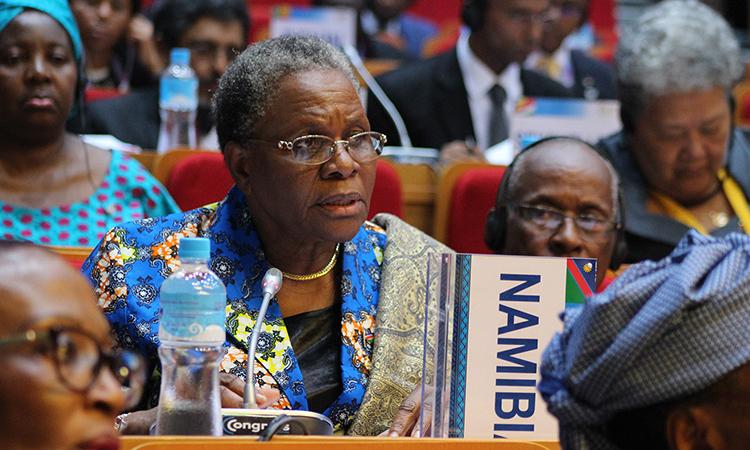
Africa-Press – Namibia. ECONOMIC analysts say it is still too early to comment on economic conditions should the newly elected Swapo vice president, Netumbo Nandi-Ndaitwah, become president in 2024.
Will she continue with the Harambee Prosperity Plan? What does she think of the country’s oil and green hydrogen ambiitons?
These are some of the questions analysts have posed.
Nandi-Ndaitwah (70) was elected over the weekend as successor of the current Swapo president, Hage Geingob, for the national polls in 2024.
Some economists, who preferred to remain anonymous, say this election was a restoration of economic hope, and could possibly lead to the rooting out of corruption, given Nandi-Ndaitwah’s image of integrity.
Oxford Economics analyst Louw Nel, however, does not believe Nandi-Ndaitwah will be Namibia’s next president.
“It would be tempting to suggest that Nandi-Ndaitwah is now set to become Namibia’s next president, but Swapo is no longer guaranteed success at the polls,” he says.
Nel says Nandi-Ndaitwah now has the difficult task of uniting the party – even though she will not be its actual leader – and reversing Swapo’s electoral fortunes.
Over the past years, the economy has slumped, and the political party has been rocked by various corruption allegations, and various economists have over the years indicated there was no political will to change ineffective economic policies.
Simonis Storm Securities analyst Theo Klein says it was still early days to comment on what Nandi-Ndaitwah could achieve, but there is hope.
“One can easily be excited given the fact that the new president could potentially be a woman, and given the common perception, backed by some psychological and behavioural economics academic papers, that women tend to score better with regards to honesty, integrity, leadership capabilities and compassion,” he says.
Klein says based on surveys, the trust in the government has continued to decline where the top structures comprised both men and women.
“Regaining this trust will prove to be very difficult. It maybe easier for a woman to do so ..,” he says.
It is not clear whether Nandi-Ndaitwah will follow through on Geingob’s economic blueprint.
“There is the uncertainty of the new presidential candidate’s economic, fiscal, and industrial policies, and an assessment thereof must first be made.
“For example, would the presidential candidate support the second Harambee Prosperity Plan, or would a new economic plan be created? Would green hydrogen and oil still be supported by the government? Would Vision 2030 be a priority?
“We do not know the answers to these questions, and this makes it difficult to predict what will shape our economy post 2024,” Klein says.
During the campaign for the Swapo vice presidency position, Nandi-Ndaitwah indicated that she intended to advance shared and balanced prosperity in a Namibian House where all feel safe.
Should she take over in 2024, she would inherit a nation with a very high debt-to-gross domestic product in the region of 75%, and low economic growth.
Email: [email protected]
Twitter: @Lasarus_A
Will she continue with the Harambee Prosperity Plan? What does she think of the country’s oil and green hydrogen ambiitons?
These are some of the questions analysts have posed.
Nandi-Ndaitwah (70) was elected over the weekend as successor of the current Swapo president, Hage Geingob, for the national polls in 2024.
Some economists, who preferred to remain anonymous, say this election was a restoration of economic hope, and could possibly lead to the rooting out of corruption, given Nandi-Ndaitwah’s image of integrity.
Oxford Economics analyst Louw Nel, however, does not believe Nandi-Ndaitwah will be Namibia’s next president.
“It would be tempting to suggest that Nandi-Ndaitwah is now set to become Namibia’s next president, but Swapo is no longer guaranteed success at the polls,” he says.
Nel says Nandi-Ndaitwah now has the difficult task of uniting the party – even though she will not be its actual leader – and reversing Swapo’s electoral fortunes.
Over the past years, the economy has slumped, and the political party has been rocked by various corruption allegations, and various economists have over the years indicated there was no political will to change ineffective economic policies.
Simonis Storm Securities analyst Theo Klein says it was still early days to comment on what Nandi-Ndaitwah could achieve, but there is hope.
“One can easily be excited given the fact that the new president could potentially be a woman, and given the common perception, backed by some psychological and behavioural economics academic papers, that women tend to score better with regards to honesty, integrity, leadership capabilities and compassion,” he says.
Klein says based on surveys, the trust in the government has continued to decline where the top structures comprised both men and women.
“Regaining this trust will prove to be very difficult. It maybe easier for a woman to do so ..,” he says.
It is not clear whether Nandi-Ndaitwah will follow through on Geingob’s economic blueprint.
“There is the uncertainty of the new presidential candidate’s economic, fiscal, and industrial policies, and an assessment thereof must first be made.
“For example, would the presidential candidate support the second Harambee Prosperity Plan, or would a new economic plan be created? Would green hydrogen and oil still be supported by the government? Would Vision 2030 be a priority?
“We do not know the answers to these questions, and this makes it difficult to predict what will shape our economy post 2024,” Klein says.
During the campaign for the Swapo vice presidency position, Nandi-Ndaitwah indicated that she intended to advance shared and balanced prosperity in a Namibian House where all feel safe.
Should she take over in 2024, she would inherit a nation with a very high debt-to-gross domestic product in the region of 75%, and low economic growth.
For More News And Analysis About Namibia Follow Africa-Press