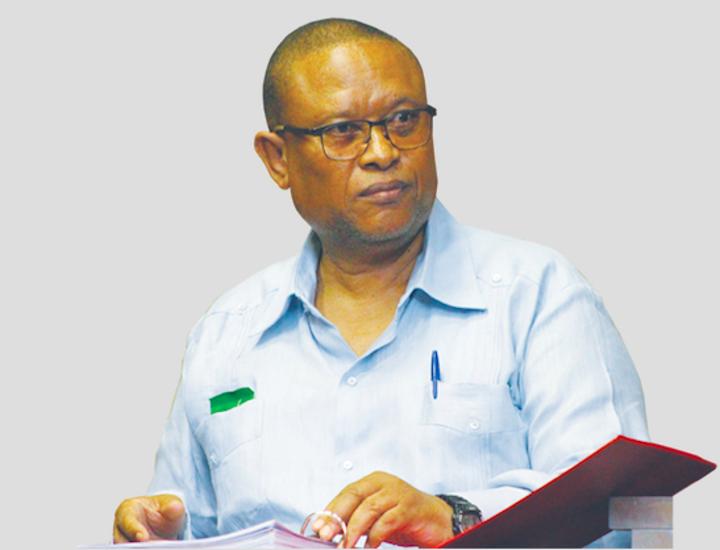
Africa-Press – Namibia. FORMER minister of fisheries and marine resources Bernhard Esau said in the Windhoek High Court yesterday that he played a limited role in the allocation of Namibian fishing quotas, which, according to him, was a task performed by the office of the fisheries ministry’s permanent secretary or executive director.
Testifying on the second day of a bail hearing before acting judge David Munsu, Esau said as minister of fisheries and marine resources he was a political appointee and did not have the capacity to do due diligence checks on applications for fishing rights and quotas received by his ministry.
The evaluation of such applications was done by the office of the ministry’s permanent secretary – now the executive director – and by the ministry’s administration, which also took decisions on the allocation of fishing rights and quotas, Esau said.
Those decisions, he added, were then recommended to him as minister to be accepted.
Esau said his name “was used in letters” stating that he had approved fishing quotas, but he wants to see the ministry’s internal memoranda that preceded those letters.
In his capacity as minister, he relied “110 percent” on the office of the fisheries ministry’s then permanent secretary, Ulitala Hiveluah, and the ministry’s administration, he said.
He gave these explanations in connection with the allocation of Namibian horse mackerel quotas to the company Namgomar Pesca SA, which plays a key role in the so-called Fishrot case about the alleged corrupt use of Namibian fishing quotas to which the Icelandic fishing company group Samherji gained access.
The state is alleging that Esau (65), who faces charges that include counts of racketeering, corruptly using an office or position to obtain gratification, fraud and money laundering in connection with the allocation of fishing quotas to Namgomar Pesca SA and the state-owned National Fishing Corporation of Namibia (Fishcor), from 2014 to 2019 awarded fishing quotas that ended up being used by Samherji companies.
Close to N$200 million that Samherji companies paid for the quotas was pocketed by Esau’s co-accused in the Fishrot case, and he also received a traceable financial benefit of at least N$5,4 million from their alleged scheme to get access to Namibian fishing resources, the state is alleging.
During Esau’s testimony, one of his defence lawyers, Florian Beukes, referred him to a letter jointly signed by the then chairperson of the Law Reform and Development Commission of Namibia, Sacky Shanghala, who is also a co-accused of Esau in the Fishrot case, and the board chairperson of Angola’s Support Fund for the Development of the Fishing Industry and Aquaculture, Francisco Antonio Santos.
In that letter, addressed to the fisheries ministers of Namibia and Angola and dated December 2013, Shanghala and Santos stated that Namgomar Pesca SA had been set up in Angola as a joint venture to exploit marine resources along the Namibian and Angolan coastlines, and that the two ministers may designate the company under the two countries’ laws and give them access to the countries’ marine resources.
Esau said he agreed with an opinion of the then attorney general, Albert Kawana, that the letter signed by Shanghala was “irregular”.
As minister of fisheries, he could not delegate any of his duties or responsibilities to someone outside the fisheries ministry, Esau said.
By the time that letter was written, there was no fisheries cooperation agreement between Namibia and Angola, Esau noted.
He and his Angolan counterpart signed a cooperation agreement in June 2014, though, and after that he signed a letter in which he informed the Angolan minister, Victoria de Barros Neto, that the fisheries ministry was nominating Namgomar Pesca SA, together with the company Namgomar Pesca Namibia, to harvest Namibian marine resources in terms of the agreement between the two countries.
Esau said that letter was prepared by Hiveluah as well.
Hiveluah died in a road accident in November 2016.
The bail hearing is continuing.
For More News And Analysis About Namibia Follow Africa-Press