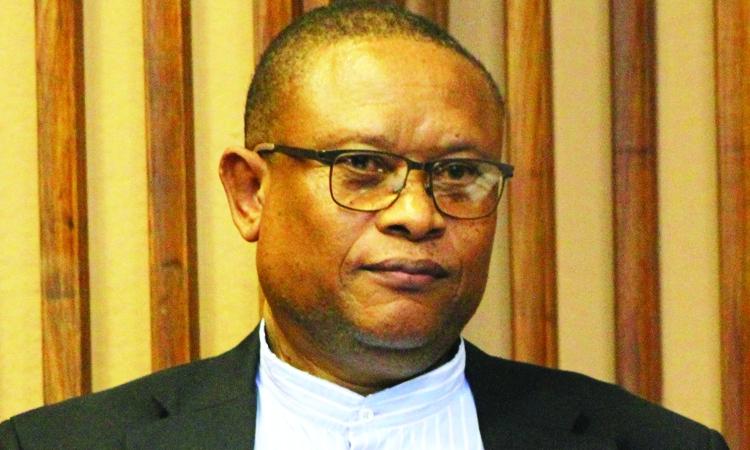
Africa-Press – Namibia. FORMER minister of fisheries and marine resources Bernhard Esau denied in the Windhoek High Court yesterday that he initiated amendments made to Namibia’s Marine Resources Act in 2015, to open the way for fishing quotas to be allocated to the National Fishing Corporation of Namibia (Fishcor) despite it not being a fishing rights holder in terms of the act.
“I never ever unilaterally changed the law, which is today referred to as the ‘Esau amendment’ of the law,” Esau said as he continued to testify for a fifth day before acting judge David Munsu in support of an application by him to be granted bail.
Esau told the judge the process to have the Marine Resources Act amended started in 2012, when a request for an amendment to be researched was sent to the Law Reform and Development Commission (LRDC).
However, the matter “gathered dust” in the commission’s office until High Court judge Shafimana Ueitele, in a judgement delivered in December 2014, declared that the allocation of a horse mackerel quota to Fishcor earlier in 2014 had been unlawful and irregular, he said.
In 2012, one of Esau’s co-accused in the Fishrot fishing quotas fraud and corruption case, Sacky Shanghala, was serving as chairperson of the LRDC.
Esau recounted that after Ueitele’s judgement, a proposal to amend the Marine Resources Act to make it possible for Fishcor to be awarded quotas for fish species despite it not being a fishing rights holder for the species involved gathered speed.
The proposed amendments to the law went through parliament smoothly, without opposition, in 2015, he recounted.
Esau gave this testimony in response to allegations by the state that he and some of his co-accused in the Fishrot fishing quotas fraud and corruption case devised a scheme to benefit from fishing quotas awarded to Fishcor by having amendments made to the Marine Resources Act, and thereafter diverting the proceeds from quotas allocated to the state-owned company into their own pockets.
The state is also alleging that, as part of the same scheme, Esau appointed one of his co-accused, former Investec Asset Management Namibia managing director James Hatuikulipi, who is a cousin of Esau’s son-in law Tamson ‘Fitty’ Hatuikulipi, as chairperson of Fishcor’s board of directors in May 2014.
It is further alleged that Esau proposed the secondment of another co-accused, Mike Nghipunya, from the Ministry of Fisheries and Marine Resources, of which he was a staff member, to a Fishcor subsidiary, before Nghipunya was appointed as caretaker chief executive officer of Fishcor, also in May 2014.
Esau yesterday denied that he and some of his co-accused conspired to have the law changed so that they could benefit from quotas awarded to Fishcor.
“There was no intent, knowingly or otherwise, to benefit myself in these amendments, neither to benefit anybody else, except to benefit the state and the state-owned enterprise Fishcor,” he said.
During his testimony on Monday, Esau told the court that as fisheries and marine resources minister he did not decide who received Namibian fishing quotas or the size of the quotas allocated.
He said those decisions were made by the office of the ministry’s permanent secretary or executive director and officials in the ministry, and were then simply forwarded to him to be approved.
“I’m just there to sign off; I’m there to rubber-stamp,” he stated.
He added yesterday that he could not take responsibility for the allocation of fishing quotas during his tenure as minister of fisheries and marine resources, as he merely accepted what was recommended to him by technocrats in the ministry – contrary to a public perception that he as the minister allocated quotas.
In an affidavit to which one of Esau’s defence lawyers, Richard Metcalfe, referred yesterday, Shanghala’s successor as LRDC chairperson, Yvonne Dausab, said it appeared the request to the commission to have the Marine Resources Act amended, which was made in September 2012, was regarded as urgent, as Shanghala reacted with speed after receiving the request.
The LRDC completed an ‘Urgent and Targeted Report on Fisheries’ in November 2012, Dausab stated.
She also remarked in her affidavit, which was provided to the Anti-Corruption Commission in December 2019: “It would not particularly seem like there was any untoward conduct on the part of the erstwhile chairperson [Shanghala] when the project was undertaken.”
She added: “From the documents submitted, provided and considered I am unable to confirm whether or not there was any bribery or corrupt practices that relate specifically to the commissioning of the report or the work of the LRDC in respect of this project.”
She further noted that the project to amend the Marine Resources Act was not handed over to her when she became the chairperson of the commission in July 2015, and that the project appeared to have continued with Shanghala in his then position as attorney general.
Esau is due to continue testifying in his bail hearing today.
For More News And Analysis About Namibia Follow Africa-Press