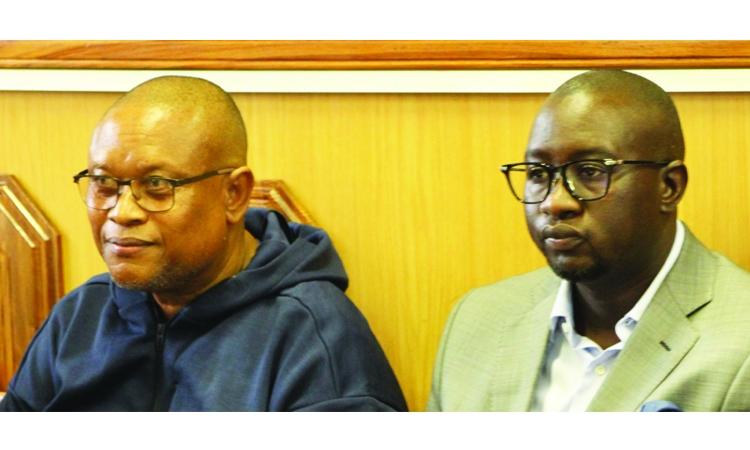
Africa-Press – Namibia. FORMER minister of fisheries and marine resources Bernhard Esau says one of his co-accused in the Fishrot fishing quotas fraud and corruption case, his ex-Cabinet colleague Sacky Shanghala, suggested the appointment of one of the key figures in the Fishrot case, James Hatuikulipi, as chairperson of the National Fishing Corporation of Namibia’s board of directors in 2013.
Esau yesterday testified in the Windhoek High Court, where the hearing of a bail application by him is taking place before acting judge David Munsu, that Shanghala suggested Hatuikulipi as a potential chairperson of the state-owned Fishcor’s board of directors when Esau carried out consultations on the appointment of new board members for the fishing company.
At that stage, Shanghala was not yet a Cabinet colleague of Esau, but was serving as chairperson of Namibia’s Law Reform and Development Commission.
According to a document that is part of the evidence before the court, Shanghala suggested the appointment of his business partner Hatuikulipi to Esau in a cellphone message on 28 July 2013.
That was almost 10 months before Esau made the appointment of Hatuikulipi as Fishcor board chairperson in May 2014.
Esau said curricula vitae of potential Fishcor directors were provided to him, and Hatuikulipi’s – reflecting his position as managing director of Investec Asset Management Namibia, involvement in other companies and various company board positions – was impressive.
Because Fishcor was facing financial challenges, having received a qualified audit report for its financial year ending in April 2013, he thought the company needed someone with a sound financial background on its board of directors, Esau said.
He said he first met Hatuikulipi briefly at the wedding of his daughter to a cousin of Hatuikulipi, Tamson Hatuikulipi, in October 2011.
Esau told the judge he was not comfortable with appointing the board chairperson of Fishcor, but during morning prayers with the then permanent secretary in the Ministry of Fisheries and Marine Resources, the late Ulitala Hiveluah, she told him that he had to appoint the board chairperson.
Fishcor’s board of directors was appointed with effect from the start of May 2014 after the Cabinet had endorsed the appointments, he said.
Esau also said when candidates to be appointed as board members of Fishcor were identified, he and Hiveluah did not look at whether the candidates came from the same regions as themselves or were related to them, but only considered what they could do to help rescue Fishcor, which at that stage was insolvent, from possible total collapse.
In the indictment in which the charges against the 10 men and 18 corporate entities charged in the Fishrot case are set out, the state is alleging that Shanghala’s position as chairperson of the Law Reform and Development Commission did not provide him with the authority or standing to make recommendations to the minister of fisheries and marine resources regarding the appointment of a board chairperson of a state-owned enterprise.
The state also records in the indictment that in terms of the National Fishing Corporation of Namibia Act of 1991, Fishcor’s board chairperson should be chosen by the company’s directors.
Esau told the court that in terms of the State-owned Enterprises Governance Act of 2006, though, the minister responsible for a state-owned company has to appoint the board members of such a company and also the board chairperson and deputy chairperson – which is what he did when he appointed James Hatuikulipi.
The state is also alleging that Esau and his co-accused – including Shanghala, James and Tamson Hatuikulipi, and former Fishcor chief executive Mike Nghipunya – set up a scheme to unlawfully get access to Namibian fishing quotas, including quotas awarded to Fishcor, and that as part of that scheme Nghipunya was appointed as acting chief executive of Fishcor in May 2014 and as substantive chief executive from December 2016.
Esau said Nghipunya, who was a staff member of the Ministry of Fisheries and Marine Resources before his appointment at Fishcor, was not known to him, but had impressed him with remarks that he made at a meeting on the challenges faced by Fishcor.
Asked what role he played in Nghipunya’s appointment at Fishcor, Esau answered: “Zero. Zero.”
However, he signed a letter to the Public Service Commission in which Nghipunya’s secondment from the fisheries ministry to Fishcor was requested, he added.
That letter, he said, was prepared by the office of the ministry’s administrative head, Hiveluah, and given to him to sign.
The bail hearing is due to continue today.
For More News And Analysis About Namibia Follow Africa-Press