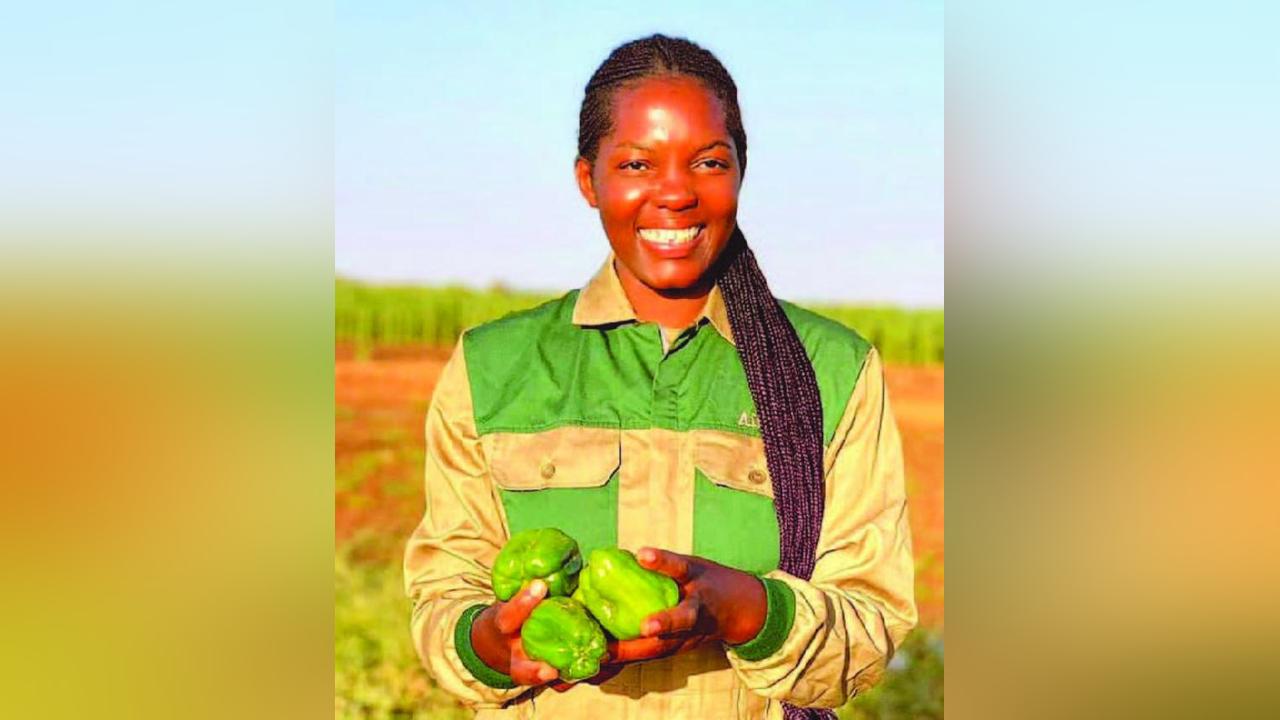
Africa-Press – Namibia. AINA Imalwa (29) says being a young vegetable farmer in Namibia is no easy feat, especially since local farmers are often excluded from major markets.
This can lead to stored produce rotting, she says.
Imalwa is an Etunda irrigation project farmer, and has taken to social media to market her produce.
“Hello Namibia, I’m ‘Aina the farmer’ based at Etunda in the Omusati region, and I am here looking for cabbage buyers as harvesting begins on 10 April.
“I have almost 6 000 heads of cabbage. Kindly contact me,” she recently posted on Facebook.
Two days later she has sold all 6 000 heads of cabbage, she says.
“It took only two days, whereas it would normally take weeks, while produce would spoil.
“I was surprised, overwhelmed and touched by the response I got from everyone. People called me from the south of the country, the coast, the north – in fact, from all over.
“People bought cabbages to resell, and unfortunately, some people were too far, so I couldn’t send cabbages out. Many others flocked to the farm to pick up their produce themselves.
“I didn’t realise the demand for fresh produce is this high. I am motivated to work harder through this experience,” Imalwa says.
She says she started farming with the onset of the Covid-19 pandemic in 2020.
Government-imposed lockdowns and curfews during this time meant farmers were faced with a substantial decline in sales.
“The Covid-19 pandemic has really brought many challenges. Firstly, we didn’t have access to major markets. I produce a lot, but the problem is always finding customers – especially those who can buy produce in bulk.
“I just started and lacked exposure. I would rent a vehicle which I used to sell my products at various open markets in the north,” she says.
Imalwa produces cabbages, carrots, buttenuts, maize, tomatoes, beetroots and green peppers.
Born at Engombe village in the Omusati region, she says her love for agriculture was instilled watching her grandmother working the fields.
“I always followed my granny. I would join her and imitate her while she cultivated, until I was old enough to do it properly myself.
“After completing school, I enrolled at the Omashale College of Agriculture in the Kavango East region, where I pursued a course in horticulture and agronomy.
“After completing my course, I started a sole agriculture business here at the Etunda irrigation project in 2020, and the rest is history,” she says.
“Social media is a great platform for anyone to market their business and showcase one’s products. It has really helped me.
“I have managed to build a new clientele through the platform, and I really appreciate it.
“I would like to advise young people who want to venture into agriculture that their dreams are valid, and anything can be achieved with the right mindset,” she says.
‘REGISTER PLEASE’
Ministry of Agriculture, Land and Water Reform spokesperson Jonah Musheko says fresh produce producers should be registered with the Namibian Agronomic Board (NAB) to be able to market their products.
“If you don’t register, there is no way they would know about you. Your products, after registering, would further be referred to the Agro-Marketing and Trade Agency (Amta), which is responsible for marketing fresh produce – unless your products are not up to standard,” Musheko says.
Imalwa says although she is registered with the Namibian Agronomic Board, there is so much they can do and it is not enough. “ I am a registered member of NAB, they do help at times to find us customers for our produces both locally and outside the country, however, it is not enough. When it comes to Amta producers have to contact them and they will offer very low prices for our products and we are the ones who have to look for a way to get the products. The whole process is costly and not beneficial. If they could at least pay us a little bit more ,” said Imalwa.
Public relations officer at the Namibian Agronomic Board Auguste Fabian said the NAB is mandated to promote the agronomic industry and facilitate production, processing, storage and marketing of controlled agronomy and horticulture products in Namibia through market regulation.
“Thus far the agronomy and horticulture development has grown from strength to strength in terms of local production and marketing when compared to imports. We don’t know if Imalwa is is registered in our database. We will have to check,” said Imalwa.
Amta’s regional manager, Jacob Hamutenya, said he could not comment much and referred all queries to the NAB. “You will have to talk to NAB. Producers who use our services are only registered when they bring produces to Amta,” said Hamutenya.
For More News And Analysis About Namibia Follow Africa-Press