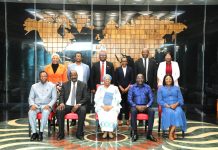
Africa-Press – Namibia. RUNDU – In a bid to pierce the years-long veil of uncertainty hanging over the Gciriku Traditional Authority, minister James Sankwasa descended upon Rundu recently for high-stakes consultations aimed at finally naming a successor to the late Hompa Kassian Shiyambi.
Sankwasa, under whose auspices traditional authorities fall, heads the urban and rural development.
The Gciriku community has been in a leadership vacuum since Shiyambi’s death in November 2019.
What followed was a bitter tug-of-war between two royal lineages – the Katiku (represented by Felix Muranghuli Mashika) and the Kandambo (represented by Arwita Kayoka) – a dispute that eventually spilt into the High Court.
Addressing the concerned parties at the Kavango East regional council auditorium, the minister was blunt about the limitations of legal battles in matters of the heart and heritage. “Customary or traditional chieftainship is not determined by the modern courts,” the minister cautioned.
“No matter how much money we spend on lawyers, you will still come back to tradition,” he said.
While the atmosphere was charged with the hope of a breakthrough, the Friday marathon session ended without a white smoke. The minister revealed that the testimony provided during the hearing uncovered new “gaps” and additional stakeholders who must be heard before a final verdict is rendered. “We were not here to investigate but to validate the investigation that was done already,” he explained.
“It depends on how urgently we can get hold of the stakeholders. I don’t know how busy they are,” he said.
Despite the lack of an immediate name, the minister assured the Gciriku people that the case would soon be “laid to rest” for a community where land allocation and traditional administration have been stalled for over four years.
Therefore, “soon” cannot be fast enough.
As the delegation departed, the message remained clear: the solution to the Gciriku throne lies not in a judge’s chambers in Windhoek but in the authentic oral history and customary laws of the VaGciriku themselves.
Minister Sankwasa highlighted that the lack of a chief has stalled critical community functions, specifically the allocation of land and grazing rights, which are traditionally the responsibility of the Hompa.
For More News And Analysis About Namibia Follow Africa-Press